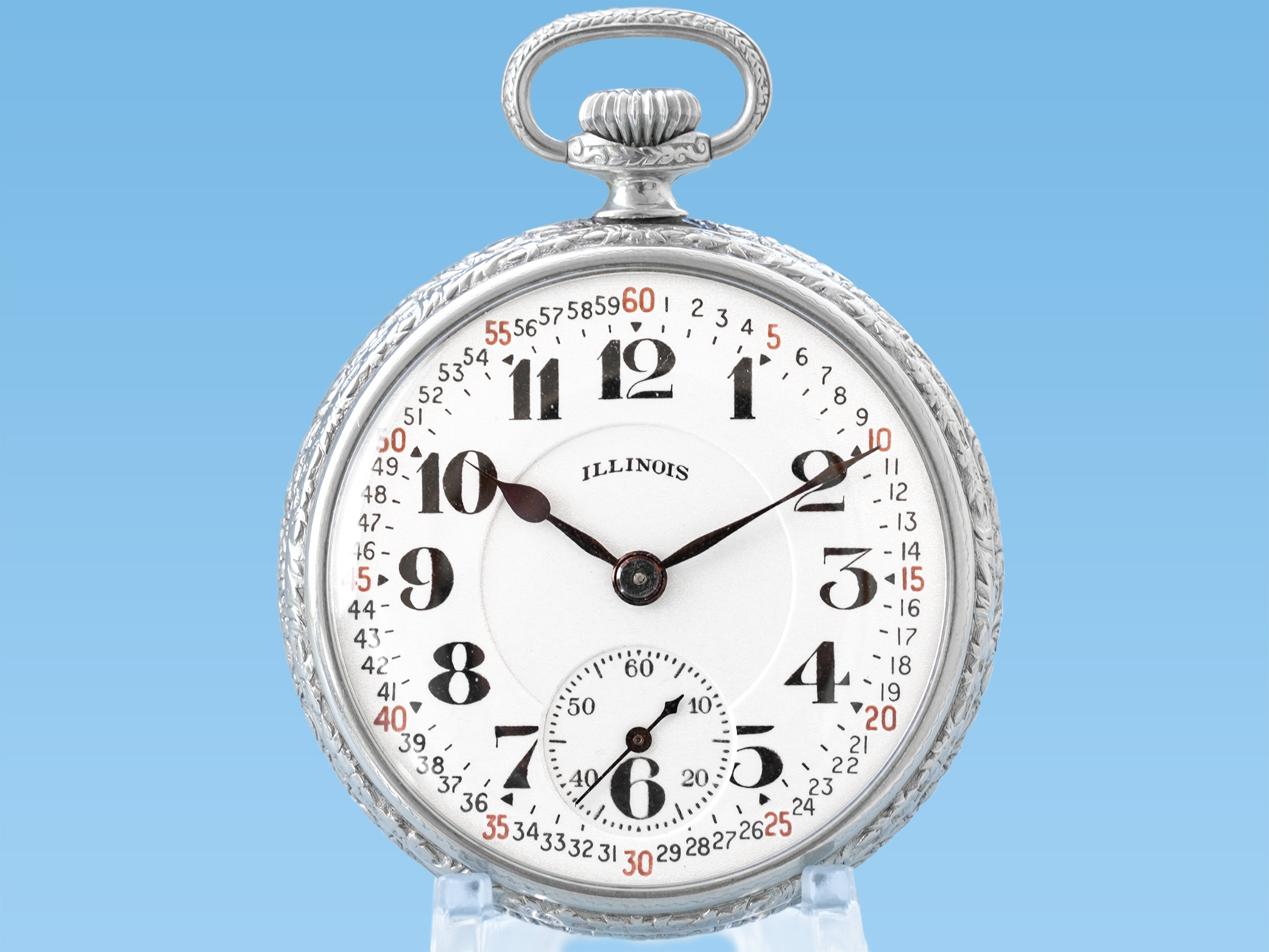
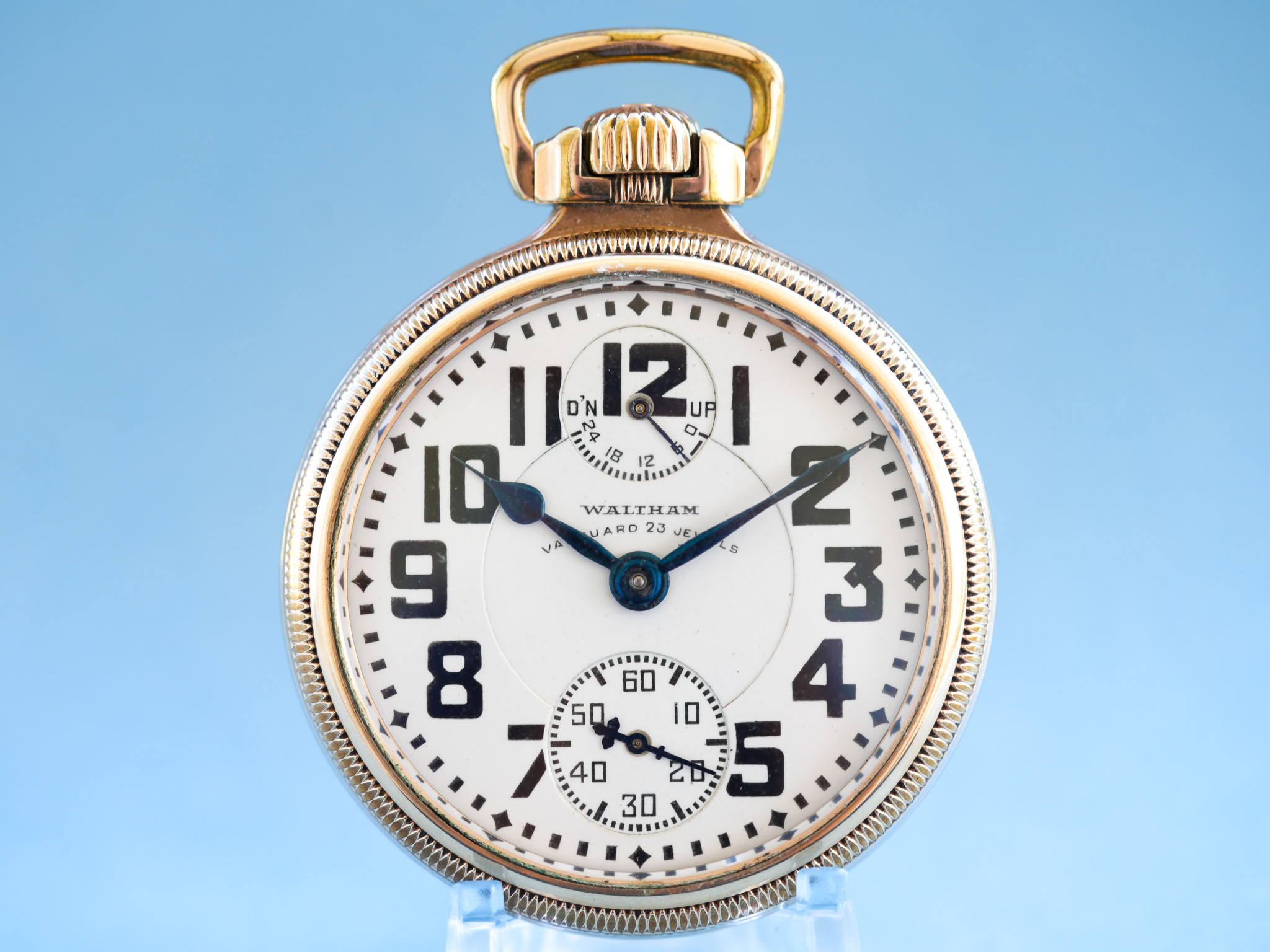
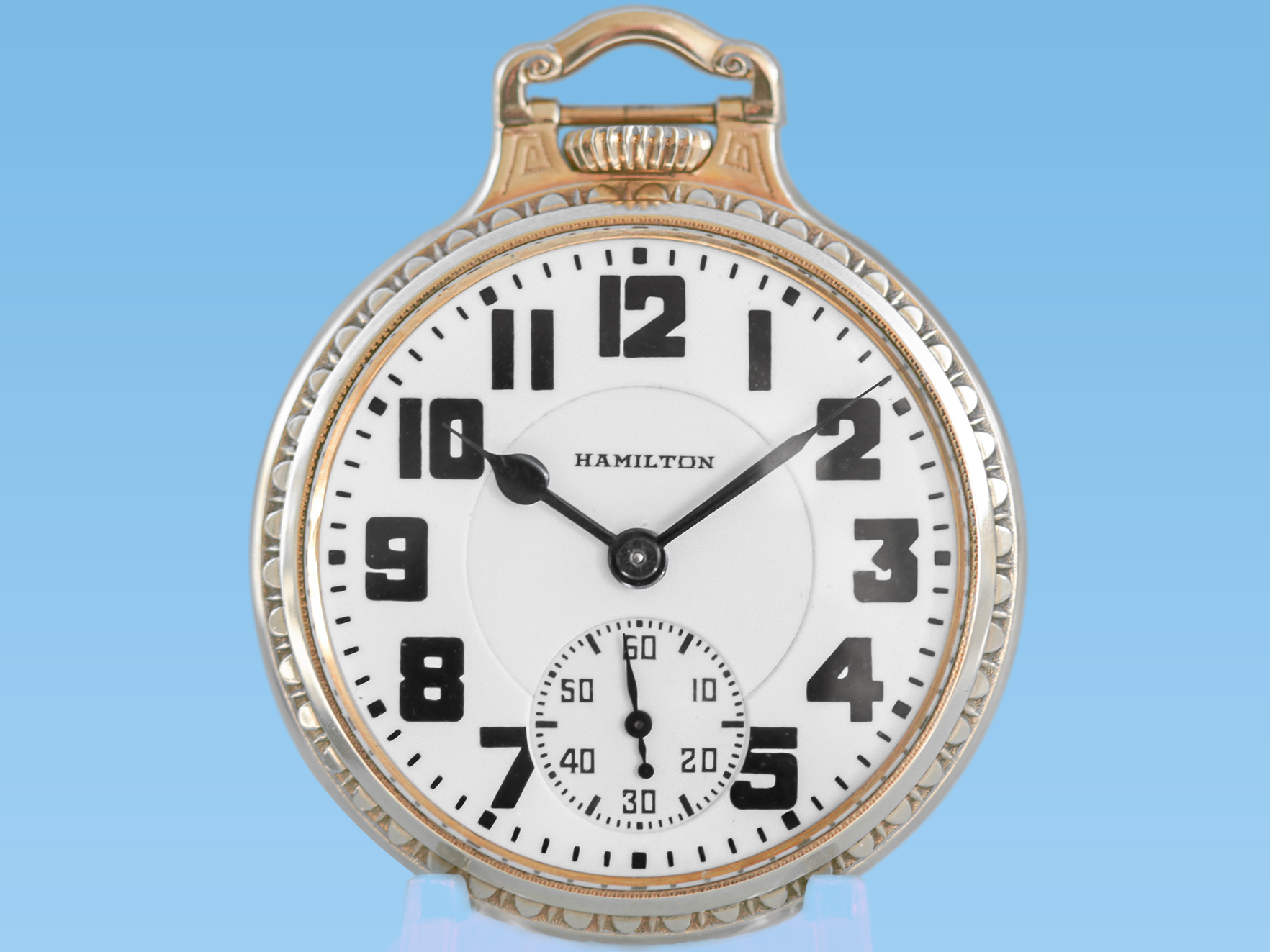
The Elgin National Watch Company is one of the great American success stories. Founded in 1864 in the small city of Elgin, Illinois — about 40 miles northwest of Chicago — the company grew into one of the largest and most prolific watchmakers the world has ever known. Over the course of nearly a century, Elgin produced an estimated 60 million timepieces, and today their pocket watches remain among the most collectible and historically significant American timepieces you can own.
Whether you're a seasoned collector or just starting to explore the world of antique pocket watches, Elgin offers something remarkable at nearly every price point. From their entry-level gentleman's dress watches to their finest railroad-grade movements, the quality and craftsmanship are unmistakable. Let me walk you through what makes Elgin special and what to look for when building your collection.
A Brief History of the Elgin National Watch Company
The story begins in 1864, when a group of Chicago businessmen — led by former mayor Benjamin W. Raymond — founded the National Watch Company in Elgin, Illinois. The location was strategic: close enough to Chicago's industrial resources and rail connections, but far enough removed to provide the clean air and stable environment that precision watchmaking demanded. The company later renamed itself the Elgin National Watch Company, after the city that became synonymous with American timekeeping.
Elgin's first completed movement rolled off the line in 1867, and by the 1880s the company was producing watches at a scale that rivaled even the mighty Waltham Watch Company. Where Waltham had pioneered American mass production of watches, Elgin refined and expanded it. At its peak, the Elgin factory complex covered 17 acres and employed over 4,000 workers, making it one of the largest watchmaking operations in the world.
The company's timing was impeccable. The great railroad expansion of the late 19th century created enormous demand for precision timepieces, and Elgin was ready. Their railroad-grade movements became trusted instruments on rail lines across the country, helping conductors and engineers maintain the split-second timing that kept the trains running safely. When the General Railroad Timepiece Standards were established in 1893 — requiring watches accurate to within 30 seconds per week — Elgin was one of the few manufacturers whose movements consistently met and exceeded those rigorous standards.
Elgin continued producing pocket watches well into the 1950s, with their final B.W. Raymond railroad movements representing the very last generation of American-made railroad pocket watches. The company eventually shifted to wristwatches and defense contracts before closing its doors in 1968. But the legacy lives on in the millions of surviving timepieces — each one a tangible connection to an era when American ingenuity led the world in precision manufacturing.
The Key Elgin Grades Every Collector Should Know
Veritas — "Truth" in Every Detail
The Elgin Veritas sits at the very top of Elgin's hierarchy, and the name says it all. Derived from the Latin word for "truth," the Veritas was Elgin's flagship movement — built for the greatest speed, longest runs, and the most demanding conditions on the rails. These movements featured strengthened frames, heavier balances, increased driving power, and fittings scientifically adjusted to perfection.
The Veritas line includes some of the most sought-after grades in the Elgin catalog. The Grade 214, for example, is a magnificent 23-jewel, 18-size movement — like serial number 12864003, produced in 1907, which represents the pinnacle of Elgin's craft. The Grade 376 Veritas, also 23 jewels in the 16-size configuration, was produced starting around 1915 and housed in cases like the desired Supreme Bulldog. Each Veritas movement received the finest finishing and burnishing, with every gear, wheel, and plate crafted to the highest standard.
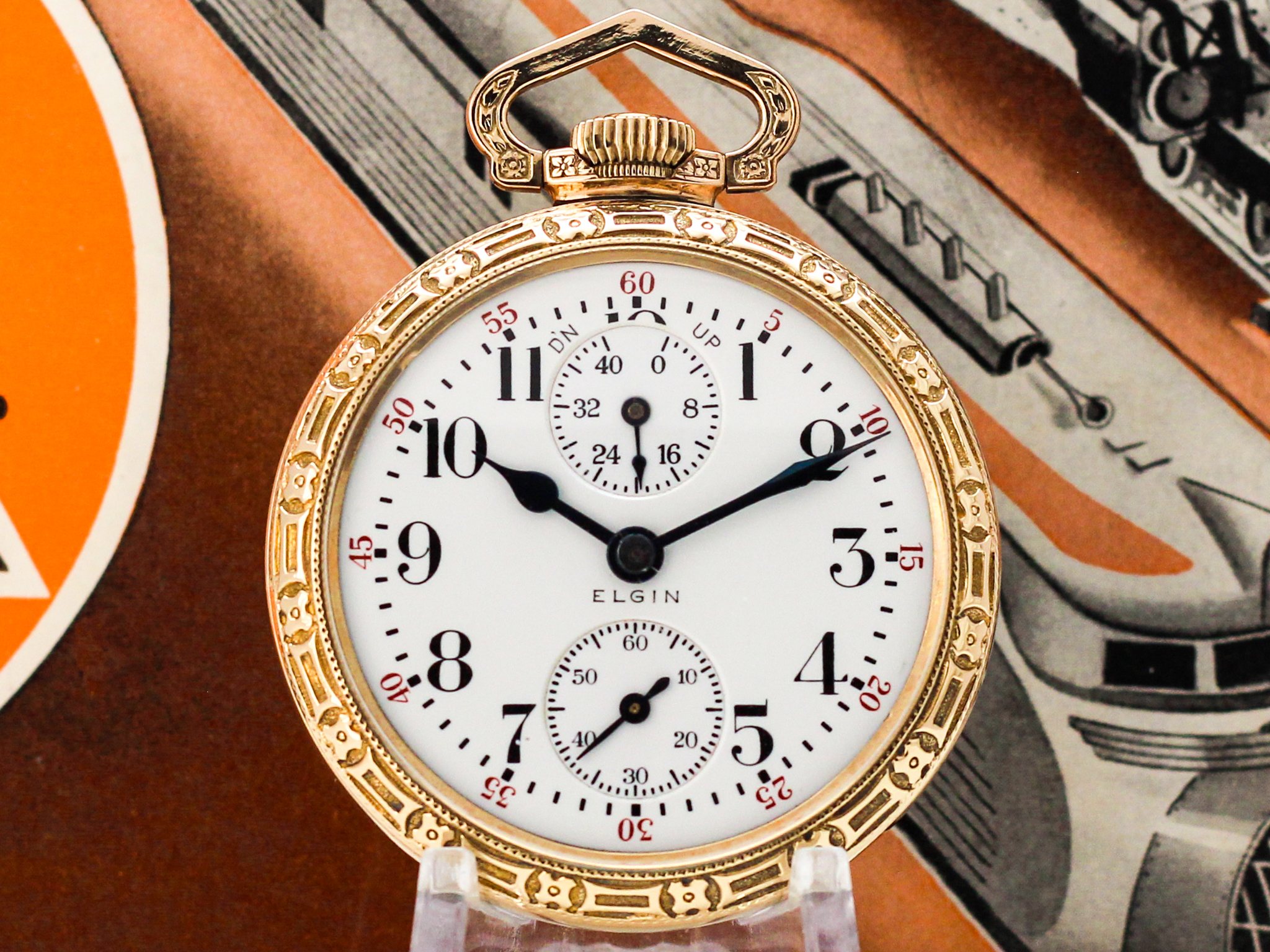
Veritas movements typically command the highest prices among Elgin collectors, and for good reason. They represent the absolute best that Elgin could produce, and surviving examples in excellent condition are increasingly difficult to find.
Father Time — The Workhorse of the Rails
If the Veritas was Elgin's prestige line, the Father Time was its most respected railroad workhorse. Named after the iconic figure of time himself, these 21-jewel movements were the standard-bearers on rail lines across America. The Father Time earned its reputation through sheer reliability — these watches were built to take a beating and keep on ticking with railroad-grade accuracy.
The Grade 252 Father Time is one of the most recognizable, an 18-size movement produced around the turn of the century. Serial number 8778475, produced in 1900, and serial number 9035436 from 1901 are both fine examples of this grade's quality and consistency. But the real prize for Father Time collectors is the Grade 374 with the Up/Down Wind Indicator — a rare 16-size, 21-jewel movement from 1917 with serial number 19311476. The wind indicator is one of the most fascinating complications in pocket watch collecting, showing exactly how much power remains in the mainspring. It was reserved exclusively for movements of the highest quality.
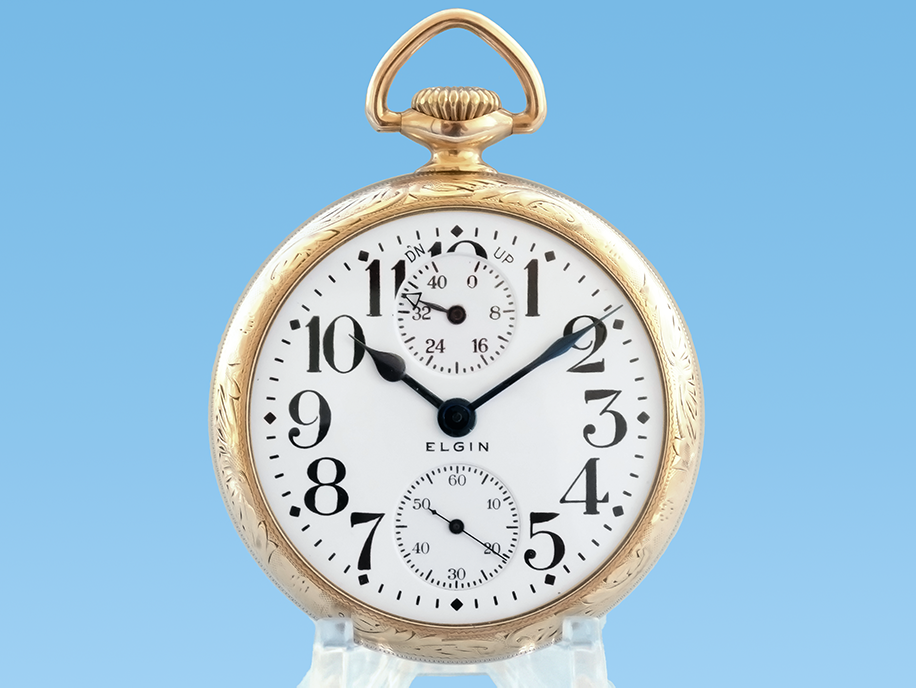
Father Time grades are excellent entry points for serious collectors. They deliver genuine railroad-grade quality and historical significance without the premium price tag of the Veritas line.
B.W. Raymond — Named for a Founding Father
The B.W. Raymond grade holds a special place in Elgin history. Named after Benjamin W. Raymond, the former Chicago mayor who was instrumental in founding the company, these railroad-grade movements carried the founder's name as a mark of pride and quality. The B.W. Raymond line spans nearly the entire history of Elgin pocket watch production, from early examples in the 1870s through the final railroad movements of the 1950s.
The Grade 571 B.W. Raymond is a particularly compelling piece of history. Serial number P803373, produced in 1953, represents one of the very last American-made railroad pocket watches ever manufactured. It's a 21-jewel, 16-size lever-set movement housed in the popular Style 3055 Streamline case — a watch that literally closed out the golden age of American railroad timekeeping. Owning a late-production B.W. Raymond is like holding the final chapter of a magnificent story.
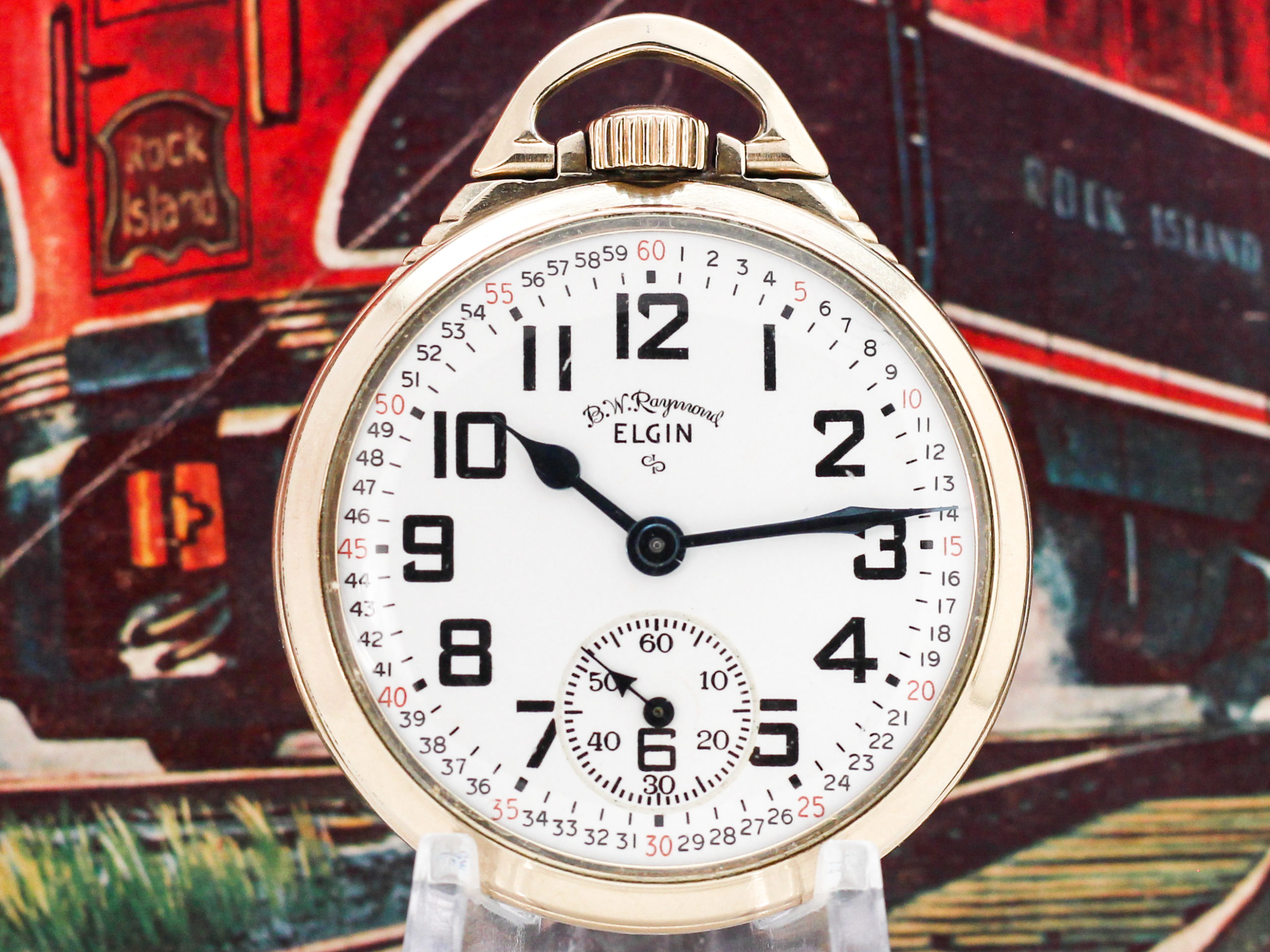
Earlier B.W. Raymond grades are equally fascinating. The Grade 391, a 21-jewel movement with an Up/Down wind indicator produced in 1912, and the Grade 478 from 1925 both showcase the evolution of this storied line across decades of production.
G.M. Wheeler — The Gentleman's Choice
The G.M. Wheeler grade represents Elgin's commitment to producing fine gentleman's watches that balanced quality with elegance. Named after one of Elgin's early master watchmakers, these movements were not typically railroad grade, but they were beautifully made and often housed in stunning cases. The Grade 452, like serial number 22709385 produced in 1920, is a 17-jewel, 12-size movement — a smaller, more refined watch perfect for dress wear. Housed in a solid 14K gold case, a G.M. Wheeler is the kind of watch that speaks to taste and refinement rather than industrial utility.
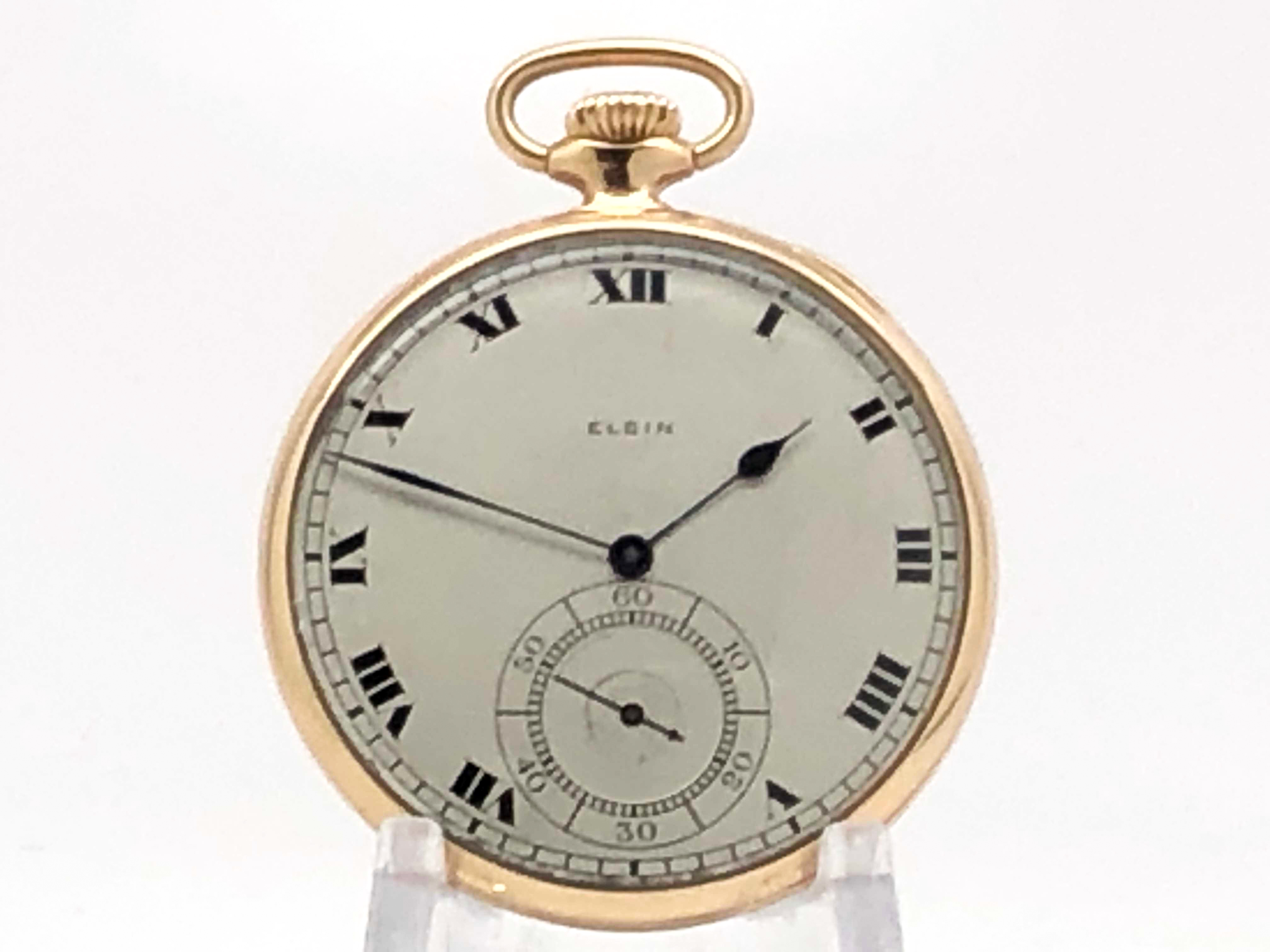
G.M. Wheeler grades are often more affordable than their railroad counterparts, making them an excellent choice for collectors who appreciate the artistry of the case and dial as much as the movement itself.
What to Look for When Collecting Elgin Pocket Watches
The Movement
The movement is the heart of any pocket watch, and with Elgin, the jewel count tells you a lot. Railroad-grade Elgins typically feature 21 or 23 jewels, while gentleman's dress watches may have 7, 11, 15, or 17 jewels. Higher jewel counts generally indicate a finer movement with less friction and better timekeeping. Look for movements with clean damascening — those beautiful swirling patterns on the plates and bridges that are a hallmark of quality American watchmaking.
The Serial Number
Every Elgin movement carries a serial number that can be used to determine the exact year of production, the grade, and the number of jewels. This is invaluable for authentication and dating. Resources like the Elgin serial number database allow you to look up any movement and confirm its specifications. When examining an Elgin, always check that the serial number matches the claimed grade and production year.
The Case
Elgin movements were cased in everything from humble nickel silver to solid 18K gold. The case can dramatically affect both the value and the character of a watch. Gold-filled cases from manufacturers like Keystone, Wadsworth, and Star offer excellent durability and a warm golden appearance. Solid gold cases — in yellow, rose, or white gold — command premium prices, especially when paired with fine movements. Coin silver cases have their own rustic charm and are particularly authentic for early American watches. For railroad watches, look for the classic open-face configuration with a lever-set crown, which was required by railroad regulations.
The Dial
A pristine dial can make or break a pocket watch's appeal. Elgin dials range from simple single-sunk designs to elaborate double-sunk railroad dials with bold Arabic numerals. Fancy dials with multicolored designs or raised gold numerals are highly prized. Hairline cracks are common on porcelain dials and don't necessarily indicate poor care, but a clean, undamaged dial will always command a premium.
Elgin Price Ranges: What to Expect
One of the great things about collecting Elgin pocket watches is the range of prices. Early key-wind models from the 1870s and gentleman's dress watches can often be found for a few hundred dollars, making them accessible to new collectors. Mid-range railroad grades like the Father Time and B.W. Raymond typically fall in the $1,000 to $3,000 range for excellent examples. The finest Veritas movements, particularly those with complications like wind indicators or housed in gold cases, can range from $2,000 to well over $5,000. Exceptional pieces with solid gold cases, rare complications, or notable provenance can command even higher prices.
The current market offers outstanding value for collectors. Compared to Swiss luxury watches, American pocket watches — including the very finest Elgins — remain remarkably affordable given their historical significance, mechanical complexity, and sheer beauty.
Frequently Asked Questions
How can I tell if my Elgin pocket watch is railroad grade?
A true railroad-grade Elgin will have specific characteristics mandated by the General Railroad Timepiece Standards. Look for a minimum of 17 jewels (most have 21 or 23), adjustment to at least 5 positions and temperature, a lever-set configuration, an open-face case, bold Arabic numerals on the dial, and a double-sunk dial design. The grade name is also a strong indicator — Veritas, Father Time, and B.W. Raymond are Elgin's most recognized railroad lines. The movement should also be size 16 or 18. If in doubt, the serial number engraved on the movement can be looked up to confirm the grade and its railroad certification.
What is the difference between an 18-size and a 16-size Elgin?
The "size" refers to the diameter of the movement. An 18-size movement measures approximately 1.766 inches (44.86mm), while a 16-size measures approximately 1.706 inches (43.18mm). Early railroad watches were predominantly 18-size, but by the early 1900s, the 16-size became the new standard as manufacturing precision improved and railroads accepted the slightly smaller format. For collectors, 18-size watches have a commanding presence and historical gravitas, while 16-size watches tend to be more wearable for daily carry. Both sizes are equally collectible — it's really a matter of personal preference and which era of railroading speaks to you.
Are Elgin pocket watches still good timekeepers today?
Absolutely. A well-serviced Elgin railroad-grade movement can still keep time to within seconds per day — remarkable for a mechanical device that may be over 100 years old. The key is proper servicing by a qualified watchmaker. A full service includes disassembly, ultrasonic cleaning, replacement of worn parts, re-oiling, and careful timing adjustment. Once serviced, these watches can run beautifully for years. Many of the Elgins in our collection have been fully serviced and are ready for daily carry or display. They were built to last, and with proper care, they will continue to keep time for generations to come.
Should I collect Elgin or Hamilton pocket watches?
This is one of the most common questions I hear, and honestly, there's no wrong answer. Hamilton is renowned for producing fewer, higher-end movements — their Grade 950 and 992B are legendary. Elgin, on the other hand, produced a much wider range of grades, which means more variety for collectors and more accessible entry points. Many serious collectors own both. If you're drawn to the sheer breadth of American watchmaking history — from early key-wind movements of the 1870s through the final railroad watches of the 1950s — Elgin gives you a canvas that spans nearly the entire golden age. Start with what catches your eye and speaks to your sense of history. The collection will grow from there.