
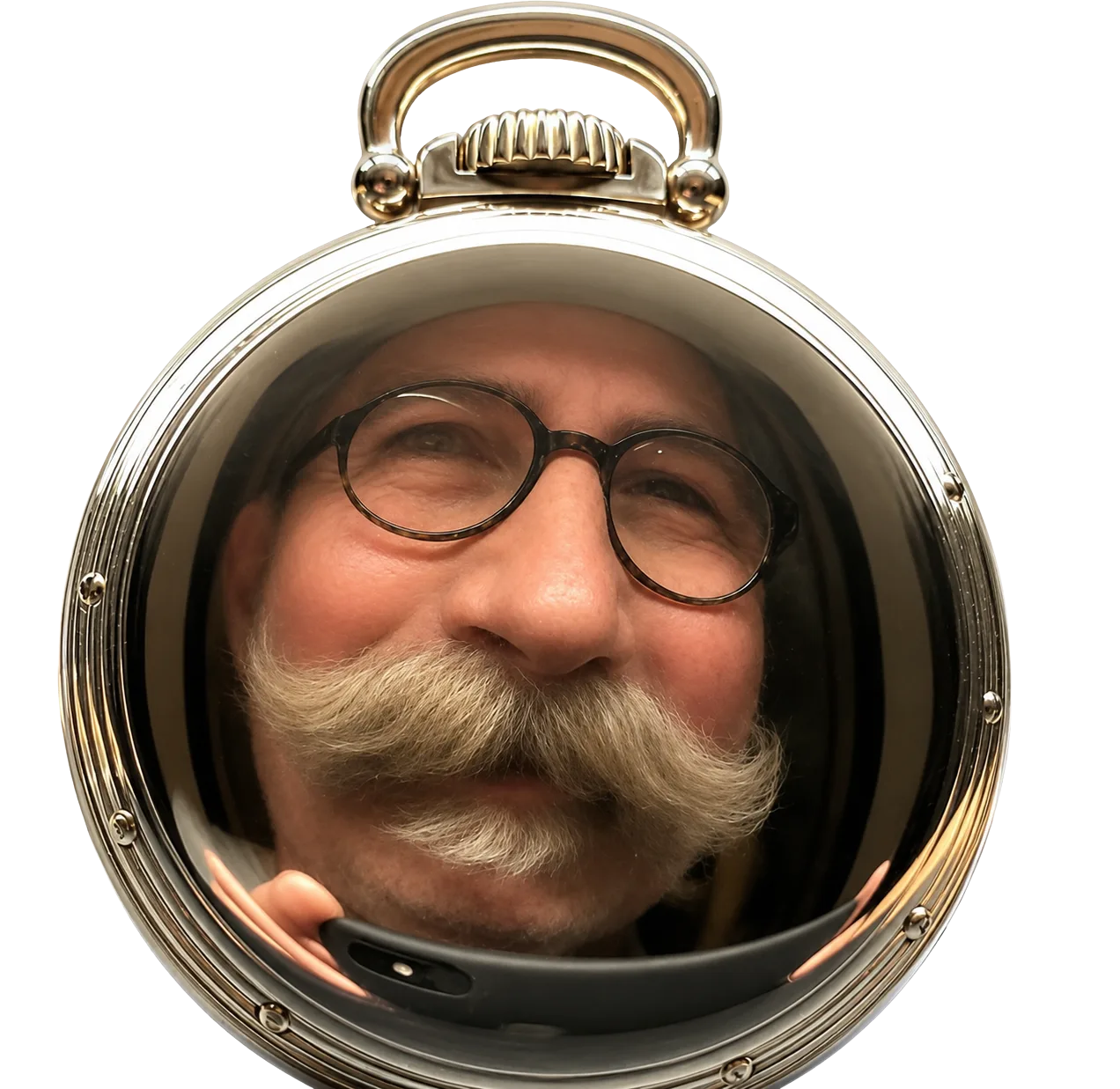
What I love is American horology — the art of it and the science of it both. The craftsmanship in these watches, and the standard of performance the factories held themselves to, stand with anything made anywhere in the world. Ask most collectors and you would never know it.
That gap is why this exists. When I started I was looking for a corner of the trade worth working in, and this one was sitting in plain sight — a whole chapter of horological history, and nobody making the case for it. So I made it mine.
The watches I sell come from a narrow window — roughly 1880 to 1950 — when American factories were simply the best in the world at this. Hamilton in Lancaster. Elgin, outside Chicago. Waltham in Massachusetts. Illinois in Springfield.
Look at what they were turning out. Dials fired in vitreous enamel, the numerals and the minute track burned into the glass rather than printed on it — a century on, they are still white. Hands cut and heat-blued by hand, in a dozen patterns: spade, whip, Breguet, skeleton. Cases in every style a man could want, from plain nickel to heavy gold with engraved bezels and hunting lids, each one built to take a particular movement. And the accuracy they were held to was the railroad’s — a watch that could not gain or lose more than thirty seconds a week, checked and certified, because a train ran on it.
That era is finished. Waltham and Illinois are long gone. Elgin’s plant closed in 1968 and Hamilton’s in Lancaster the year after — the Hamilton name still exists, but it belongs to a Swiss group now and hasn’t made an American watch in over fifty years. The machinery was scrapped and the skills went with the men who had them.
Open the back of a high grade American pocket watch and you find work nobody was supposed to see. Plates cut in damaskeen — wave patterns, circular graining, sunbursts — laid down by hand on metal that spends its whole life shut inside a case. Screw heads polished and blued. Jewels set in solid gold collets. Winding wheels finished on the underside, where only the next watchmaker to open it would ever look. None of it makes the watch keep better time. Accuracy was the science of these watches; this was the art of them, and no maker of that era counted one finished without the other.
That is the part that cannot be bought back. Millions of watches were made. The ones finished to that standard were hundreds of thousands, and what survives of those in original condition is a fraction again. Twenty years ago I could find original factory dials, hands and cases in real variety, week after week. I cannot now. Every one that gets preserved is a piece of American horological history that stays, and there are fewer of them every year.

Nothing leaves here untouched. Every watch is disassembled, cleaned, oiled, adjusted and timed before it is listed, and it carries a full year’s warranty. Where a part has worn past saving it gets replaced, and it gets replaced with the right one — correct for the grade, correct for the year.
But most of the work happens earlier, in deciding what goes up for sale at all. A watch has a useful life and some of them have spent it: brass worn through the gold on a case, pivots run oval, a dial tarnished or crazed or chipped, hands beginning to pit. What I list for sale is the opposite — the one that was looked after: original, honest, and, by the time it reaches me, wanting little more than fresh oil. Preserving these is what that comes down to, and telling the two apart is most of this job.
That is not a judgement on the rest of them. Whatever shape yours is in, if it matters to you it is worth putting right, and that work comes across the bench here every week.
If you want to know what you have, what it needs, or what it is worth, call and ask. I answer the phone myself, and when I miss it I return the call myself — not a service, not a queue, not a form. Not many people answer their own phone any more. I do, and I take every one of those calls seriously.
Our Process
From Workshop to Your Collection
Sourcing
Every watch is personally evaluated for quality, historical significance, and collectibility. We only acquire watches we’re proud to stand behind.
Restoration
Each timepiece is completely disassembled, ultrasonically cleaned, carefully inspected, oiled, and adjusted. No shortcuts, no compromises.
Testing
After service, every watch is tested for accuracy and reliability. We don’t list a watch until we’re confident it meets our standards.
Warranty
Every watch ships with a 1-year warranty, fitted gift box, and the peace of mind that comes from buying from a specialist.
Ready to Find Your Timepiece?
Browse our collection or reach out to Jeff directly — he’s always happy to help.