If you collect American pocket watches long enough, you will inevitably fall under the spell of the Illinois Watch Company. Founded in 1869 in Springfield, Illinois -- the home of Abraham Lincoln -- this company produced some of the finest timepieces ever to come out of the United States. Over the course of nearly seven decades, Illinois manufactured approximately five million pocket watches, and their top-tier grades remain among the most sought-after pieces in the hobby today.
I have handled hundreds of Illinois watches over the years, and they never fail to impress me. The movement finishing, the innovation, the sheer variety of grades and configurations -- there is something for every collector, whether you are just getting started or you have been at this for decades. So let me walk you through what makes Illinois special, what to look for, and what you can expect to pay.
A Brief History of the Illinois Watch Company
The Illinois Watch Company was incorporated in 1869 by John C. Adams, along with brothers John Whitfield Bunn and Jacob Bunn. John Whitfield Bunn was a friend and financier of Abraham Lincoln himself -- a connection that would later inspire one of the company's most celebrated grade names. The factory was established in Springfield, and production began in earnest in the early 1870s.
From the start, Illinois set out to compete with the established New England makers -- Waltham and Elgin -- and they did so by pushing the boundaries of quality and innovation. By the 1890s, Illinois had earned a sterling reputation for railroad-grade movements that met the rigid standards demanded by railway Time Inspectors across the country. These were not luxury items sitting in a drawer. They were life-or-death tools, checked regularly to ensure they conformed to specifications that kept trains running safely and on time.
Illinois continued to innovate through the early twentieth century, introducing higher jewel counts, superior adjustment standards, and eventually the groundbreaking 60-hour mainspring that set them apart from every other American maker. But the Great Depression was unkind to the watch industry. In 1927, the Hamilton Watch Company purchased the Illinois Watch Company for approximately $5 million -- roughly $75 million in today's money. Hamilton continued to operate the Springfield factory under the Illinois name for several more years, gradually shifting emphasis from pocket watches to wristwatches. The last Illinois pocket watch movements rolled off the line in the early 1930s, though some assembly continued through 1948 using existing parts.
The Key Grades Every Collector Should Know
Illinois produced a vast range of grades over its history, from affordable everyday watches to some of the finest railroad chronometers ever made in America. Here are the names that matter most to collectors.
Bunn Special
This is the crown jewel of the Illinois lineup, and arguably one of the greatest American pocket watches ever produced. Named after co-founder John Whitfield Bunn, the Bunn Special was Illinois' flagship railroad grade, manufactured from 1893 through the early 1930s. These watches were built to the highest standards: 21 to 24 jewels, adjusted to six positions plus temperature and isochronism, with lever-set configurations required for railroad service.
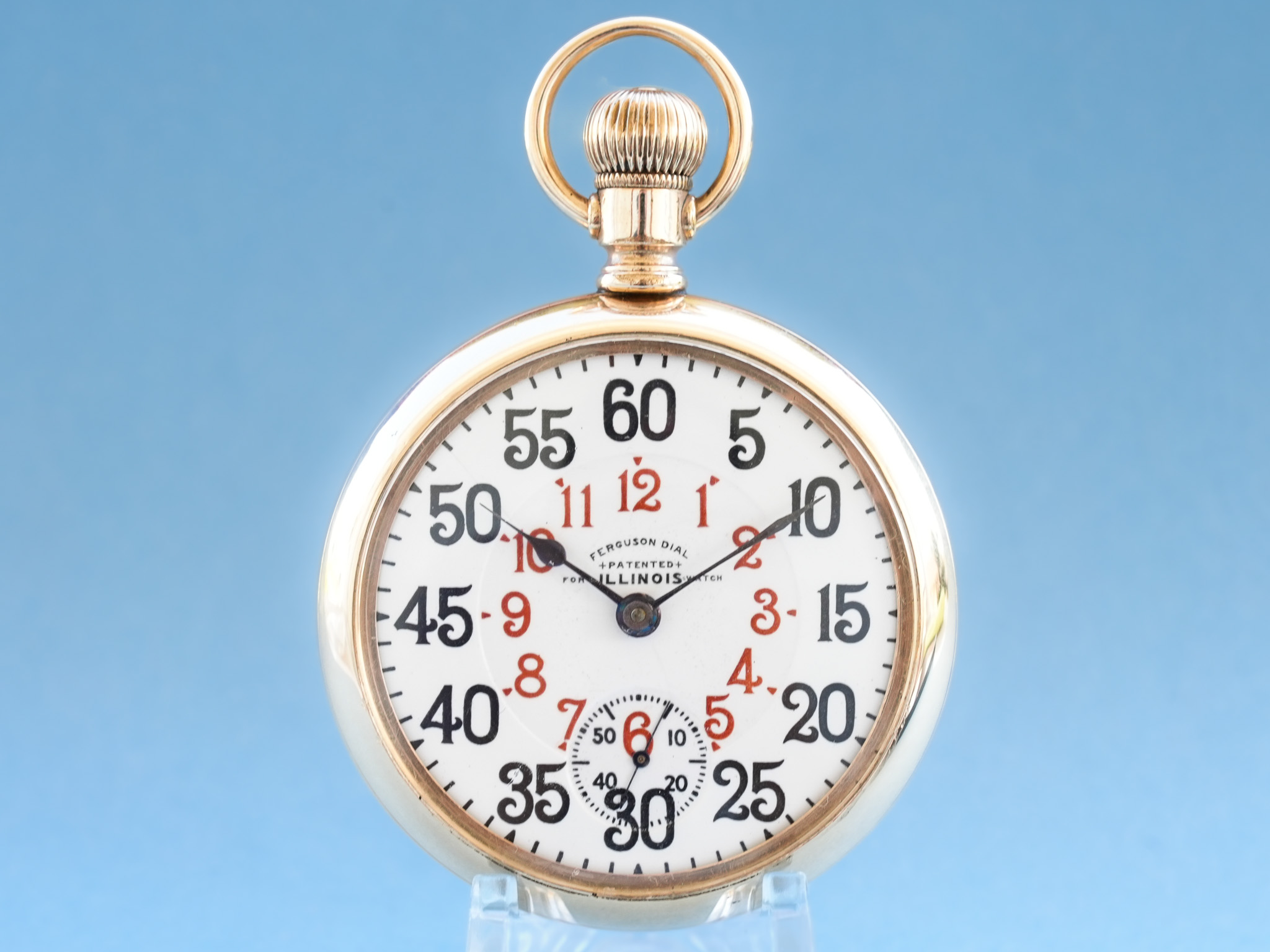
The Bunn Special went through several distinct types over its production run. Early models from the 1890s and 1900s came in the larger 18-size, like a gorgeous 1912 example with a rare Ferguson Railroad Dial that I have in stock -- a 21-jewel beauty in an 18-size case with the distinctive large minute numerals that Ferguson patented in 1908. Later production shifted to the more popular 16-size, and the final iterations -- the Type II and Type III movements -- incorporated the revolutionary 60-hour mainspring.
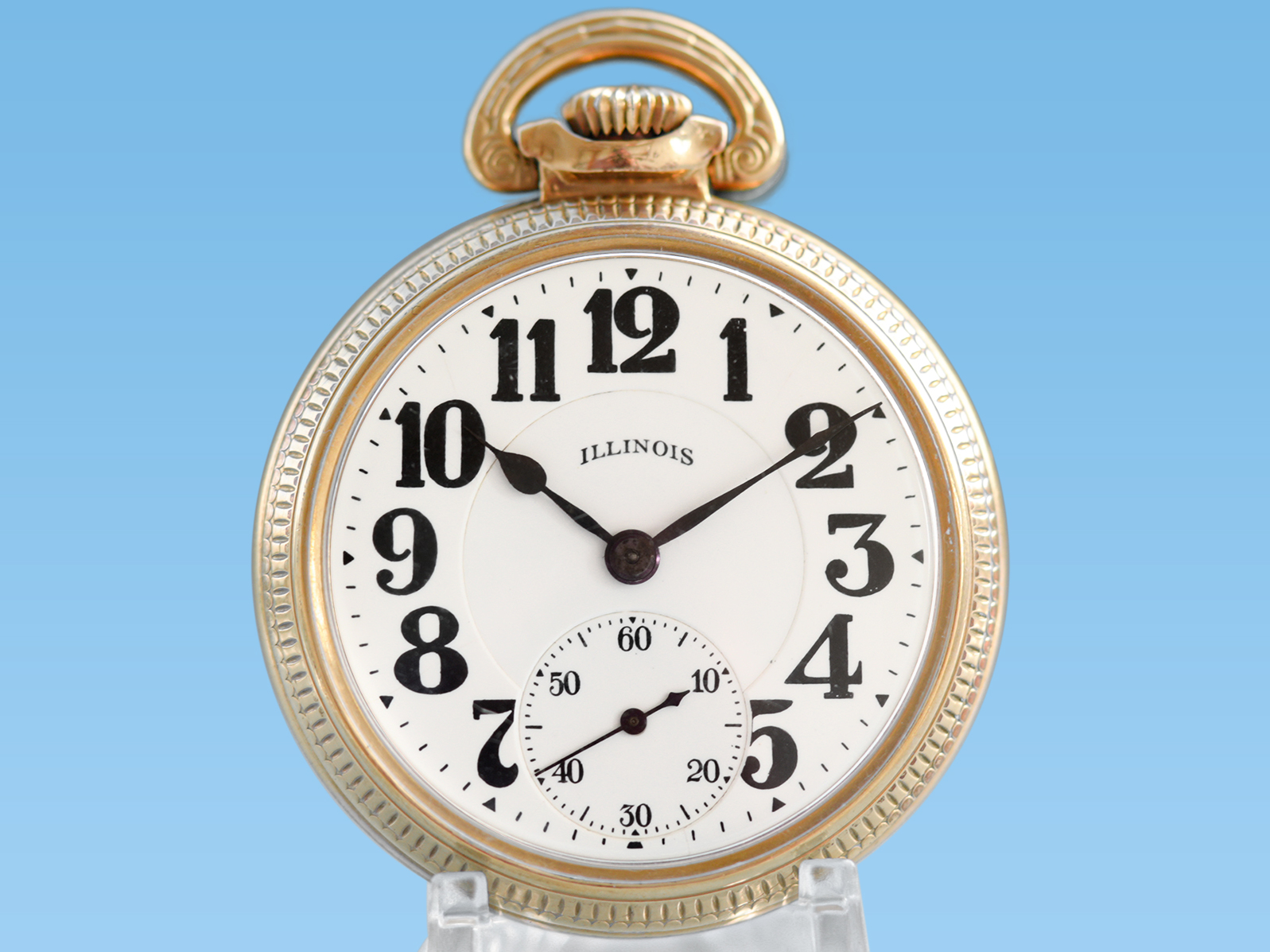
I currently have a stunning Bunn Special Type III 60-Hour from 1926 (serial number 4804404) that perfectly illustrates the pinnacle of this line. It features 21 rubies in raised gold chatons, the sought-after ray-pattern nickel finish, and a correct Wadsworth Bunn Special 10K gold-filled case. Adjusted to six positions, temperature, and isochronism -- this is what railroad precision looks like.
Production numbers varied by model and year, but the later 60-hour Bunn Specials are particularly collectible. The Grade 161A Elinvar Type IIB, for instance, saw only 16,550 produced between 1931 and 1948. The Grade 163 Type I Bunn Special was limited to just 1,000 pieces in 1930. Numbers like that keep the collector market very strong for these watches.
Sangamo and Sangamo Special
Named after the Sangamo Electric Company, also based in Springfield, the Sangamo grade represented Illinois' second-tier railroad offering -- though "second tier" is relative when you are talking about a 23-jewel movement adjusted to six positions. The Sangamo was produced starting around 1905 and featured the same meticulous finishing and adjustment that made Illinois famous.
The Sangamo Special took things even further with enhanced specifications and rarer production numbers. A 1925 Sangamo Special (serial number 4556641) that I sold was one of only 11,200 produced, featuring 23 jewels and housed in a Wadsworth 14K white gold-fill case with a desirable Montgomery dial. Watches like that are true collector's dreams.
The regular Sangamo grade also commands strong interest. An early example from 1905 (serial number 1789023) featured a high-quality 23-jewel railroad-grade movement with a double-sunk enamel Montgomery dial and Illinois' signature purple heat-treated hands. Only 26,135 of that model were ever made.
A. Lincoln
Named in honor of the sixteenth president -- who had deep ties to Springfield and to the Bunn family -- the A. Lincoln grade was Illinois' premium gentleman's dress watch. These were typically 12-size movements with 21 jewels, stem-wound and stem-set for convenience. They were not railroad watches but rather high-grade dress pieces aimed at gentlemen who wanted the finest Illinois had to offer for everyday wear.
The A. Lincoln featured bridge-plate construction with a nickel silver finish and fine ruby jewels. These are beautiful watches that showcase Illinois' ability to produce refined, elegant timepieces that went well beyond the utilitarian demands of railroad service.
Burlington Watch Co.
This one surprises a lot of collectors. The Burlington Watch Company was actually Illinois' mail-order division, created during the early twentieth-century boom in catalog retail. Burlington watches were manufactured by Illinois in Springfield but sold under the Burlington banner, often featuring more artistic and flamboyant designs than their mainline counterparts. Today, Burlington-branded Illinois watches have developed a devoted following among collectors who appreciate their ornate cases and distinctive dial designs.
The 60-Hour Innovation
If there is one thing that sets late-era Illinois pocket watches apart from every competitor, it is the 60-hour mainspring. Most pocket watches of the era were limited to approximately 42 hours of continuous run time between windings. Illinois' 60-hour motor barrel was a genuine engineering breakthrough -- and a critical safety feature for railroad service.
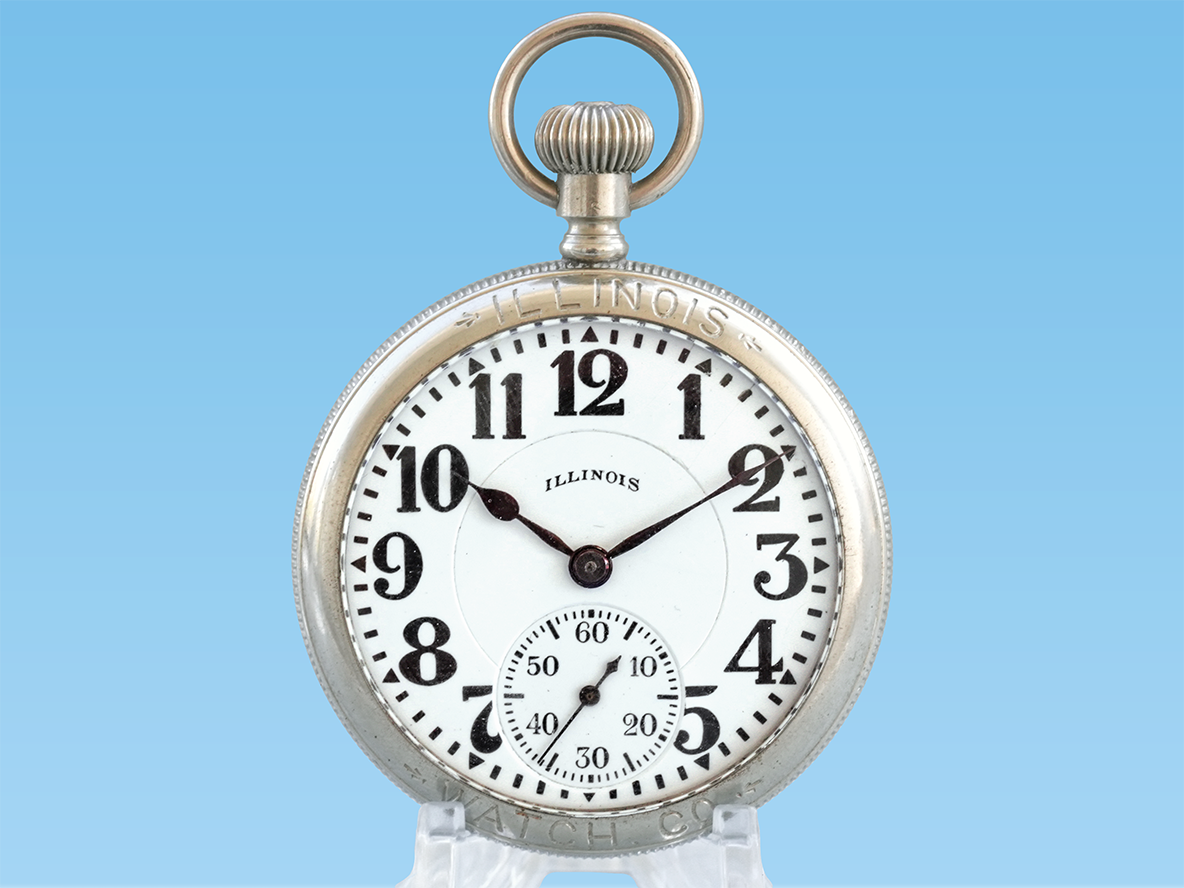
Think about it from a railroader's perspective. If your watch ran down mid-shift because you forgot to wind it, the consequences could be catastrophic. A 60-hour reserve meant that even if a rail worker missed a winding, the watch would keep running through an entire extra shift. The Type III Bunn Special dial proudly proclaims this technology with "23 jewel 60-hour" text curved above the sunken seconds sub-dial. It was a selling point, and rightfully so.
I have a beautiful 1923 Bunn Special in a rare salesman display case (serial number 4282853) that gives you a window into the movement itself -- literally. The see-through case back was originally used by salesmen to demonstrate the movement in action without exposing the inner workings to dirt and debris. It is a fantastic way to appreciate the pocket watch in motion.
What to Look For When Buying an Illinois
After years of buying, servicing, and selling these watches, here is what I tell collectors to focus on.
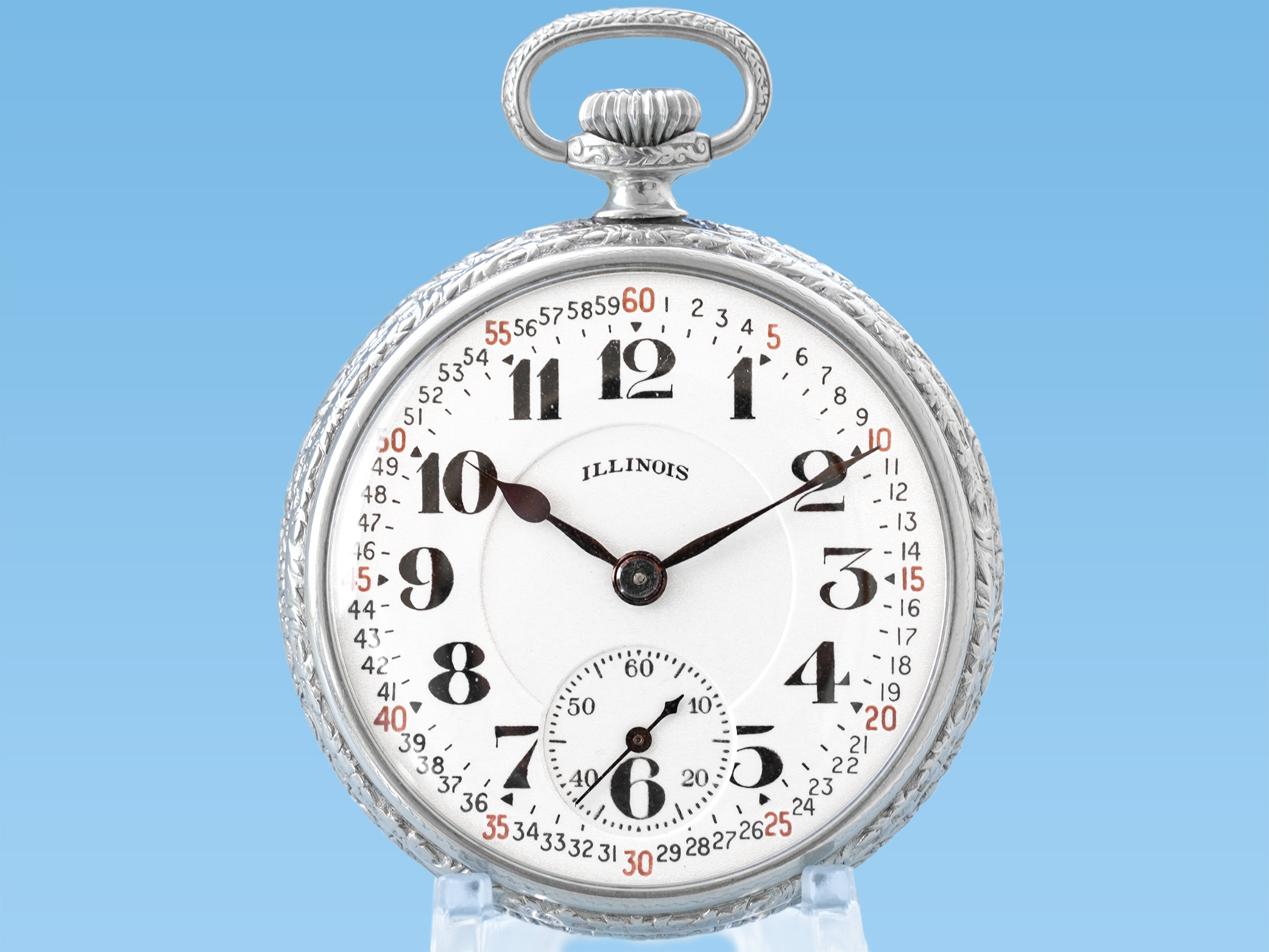
Dial condition is everything. A pristine double-sunk enamel dial with heavy ink saturation and no hairlines or restorations is the gold standard. Illinois dials are known for their crisp typography and bold numerals. Look for original dials with no chips, cracks, or faded text. The Montgomery dial -- with its outer track displaying individual minutes numbered 1 to 60 -- is particularly desirable on railroad grades.
Movement finishing tells the story. Illinois movements are renowned for their decoration. Look for the ray-pattern nickel finish on later Bunn Specials, the fish-scale damaskeening on earlier models, and the stunning two-tone finish that appears on some turn-of-the-century pieces. Gold jewel settings, gold gear trains, and red lettering on the movement plates are hallmarks of the highest grades.
Case originality matters. A period-correct case adds significant value. Illinois Watch Case Company cases, Wadsworth Bunn Special cases, and Keystone cases are all correct for various models and eras. Gold-fill cases in yellow, white, rose, and even the uncommon green gold are all found on Illinois watches. The two-tone Model 206 Bunn Special case is highly cherished among advanced collectors.
Hands should be original. Illinois' signature heat-treated hands -- often showing a distinctive purple or deep blue hue -- are unmistakable. Replaced hands diminish the watch's completeness and value. The heat-treated plum-color spade and whip hands are synonymous with Illinois railroad watches.
Price Ranges for Illinois Pocket Watches
Illinois watches span a wide range depending on grade, condition, rarity, and configuration. Here is a general guide based on what I see in the current market.
Entry-level Illinois watches -- lower-grade dress models like the Grade 305 or Grade 173 in good condition -- can be found in the $500 to $1,000 range. These are wonderful starting points for new collectors.
Mid-range pieces -- higher-grade dress watches like the Grade 605, Art Deco models, and the A. Lincoln -- typically run from $1,000 to $1,500. A pristine Illinois Grade 605 from 1921 (serial number 3800403) with its Art Deco metal dial and Breguet Moon hands is a perfect example of what you can find in this range.
Railroad-grade Bunn Specials in excellent condition command $1,500 to $3,500 depending on the specific model, jewel count, and configuration. A 21-jewel Bunn Special from 1918 with a Montgomery dial (serial number 3381502) in a 14K gold-fill case is the kind of watch that sits comfortably in this range at $1,950.
Top-tier pieces -- 60-hour Bunn Specials, Sangamo Specials, rare Ferguson dial configurations, 24-jewel models, and watches with unusual case combinations -- can command $2,500 to $4,000 or more. A 23-jewel Bunn Special with a Ferguson dial or a 24-jewel early model from 1900 represents the absolute pinnacle of Illinois collecting.
Frequently Asked Questions
What is the difference between a Bunn and a Bunn Special?
The Bunn and the Bunn Special are two distinct grades from Illinois, though both are named after co-founder John Whitfield Bunn. The standard Bunn grade was a solid, well-made watch but did not carry the full suite of adjustments found in the Bunn Special. The Bunn Special was Illinois' top-of-the-line railroad grade, adjusted to six positions plus temperature and isochronism, with higher jewel counts (21, 23, or even 24 jewels) and superior finishing. If you are looking for the best Illinois had to offer, the Bunn Special is the one you want.
Are Illinois pocket watches good investments?
Illinois watches -- particularly the higher grades -- have shown consistent strength in the collector market. The Bunn Special in its various configurations has a devoted following that keeps demand high, especially for 60-hour models, rare dial types like the Ferguson and Montgomery, and unusual case combinations. Production numbers for the top grades were relatively limited. The Grade 163 Type I, for example, was limited to just 1,000 pieces. The Sangamo Special saw only 11,200 produced. Scarcity combined with enduring collector interest makes these watches a sound addition to any collection. That said, I always tell collectors to buy what you love first -- the value will follow.
How can I tell if my Illinois pocket watch is a railroad grade?
True railroad-grade Illinois watches share several key characteristics. They are lever-set (you pull the crown to a second position to set the time, preventing accidental time changes). They feature open-face configurations with the crown at 12 o'clock. They carry a minimum of 17 jewels, though most railroad-grade Illinois watches have 21 or 23. They are adjusted to at least five positions plus temperature. The dial will typically be double-sunk with bold, legible Arabic numerals. And the movement will be marked with its grade name -- Bunn Special, Sangamo, Sangamo Special, or a numbered grade like 161A or 163. If your Illinois has all of these features, you are holding a genuine piece of American railroad history.
What happened to the Illinois Watch Company?
In 1927, the Hamilton Watch Company purchased Illinois for approximately $5 million. Hamilton continued operating the Springfield factory under the Illinois name, and some of the finest Illinois pocket watches -- including the 60-hour Bunn Special Type III and the Elinvar-equipped Type IIB -- were actually produced during the Hamilton era. The Elinvar hairspring, a newly developed alloy resistant to magnetic interference, was introduced during this period to address the safety concerns created by the railroad industry's transition from steam to diesel-electric locomotives. Hamilton gradually wound down Illinois pocket watch production through the 1930s, though final assembly from existing parts continued into 1948. The Illinois Watch Company is gone, but its legacy of superb, fully functional timepieces lives on in the hands of collectors worldwide.