Buying your first American pocket watch is a particular kind of pleasure. There is the weight of history in your palm, the soft tick of a movement that has been running on and off for a hundred years, the case worn smooth by someone's grandfather's coat pocket. There is also, honestly, the question of what to ask before you hand over the money.
I have had hundreds of these come through my shop in Los Angeles, and the buyers who end up happiest are the ones who slow down before they pay. Service history. Originality. Seller reputation. Return policy. Below are seven questions I would want answered before I bought a first vintage pocket watch, each one anchored to a real watch I have in the case right now. If something here raises a question of your own, my contact form is at the bottom of the post and I read every message myself.
1. Has it actually been serviced, or is it just "running"?
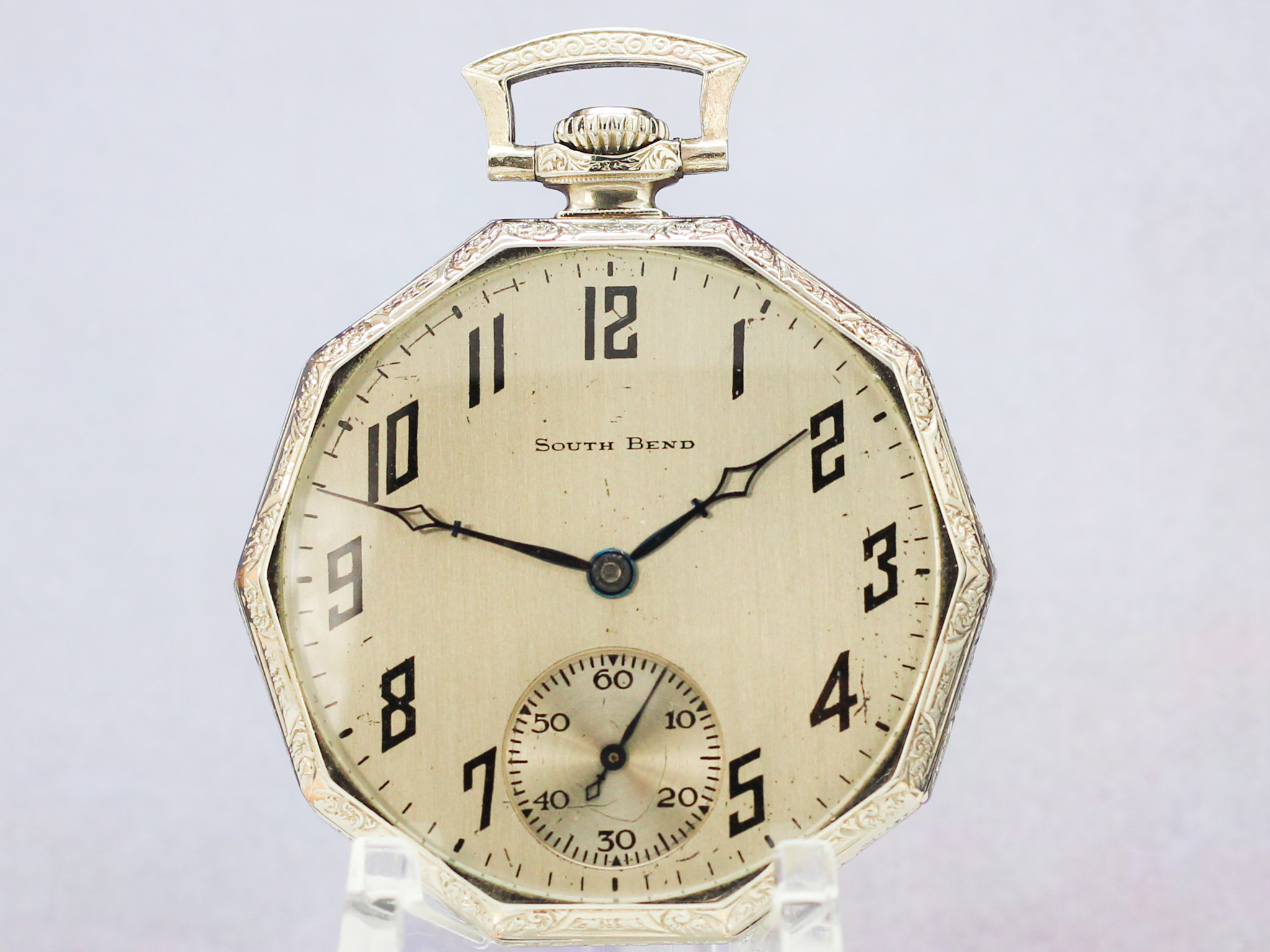
"Running" and "serviced" are not the same thing. A pocket watch can tick on a desk for a few minutes and look alive while old, varnished oil quietly grinds the pivots into dust. A serviced watch has been fully disassembled, cleaned, lubricated with the correct oils in the correct places, reassembled, adjusted, and timed. That is the work I do on every watch before it leaves the shop, and it is the single biggest factor in whether your watch will still be keeping time in five years.
Take this South Bend Grade 429 in a stunning 14K white gold fill case. It left the South Bend factory in 1925, the same year F. Scott Fitzgerald published The Great Gatsby and a Tennessee schoolteacher named John Scopes went on trial for teaching evolution. A 19-jewel gentleman's watch from that era can run for a few minutes on a hundred-year-old film of dried oil. Ask whether the seller has serviced it, when, and what was done. If the answer is vague, the price should be vague too.
2. What is the movement actually telling me?
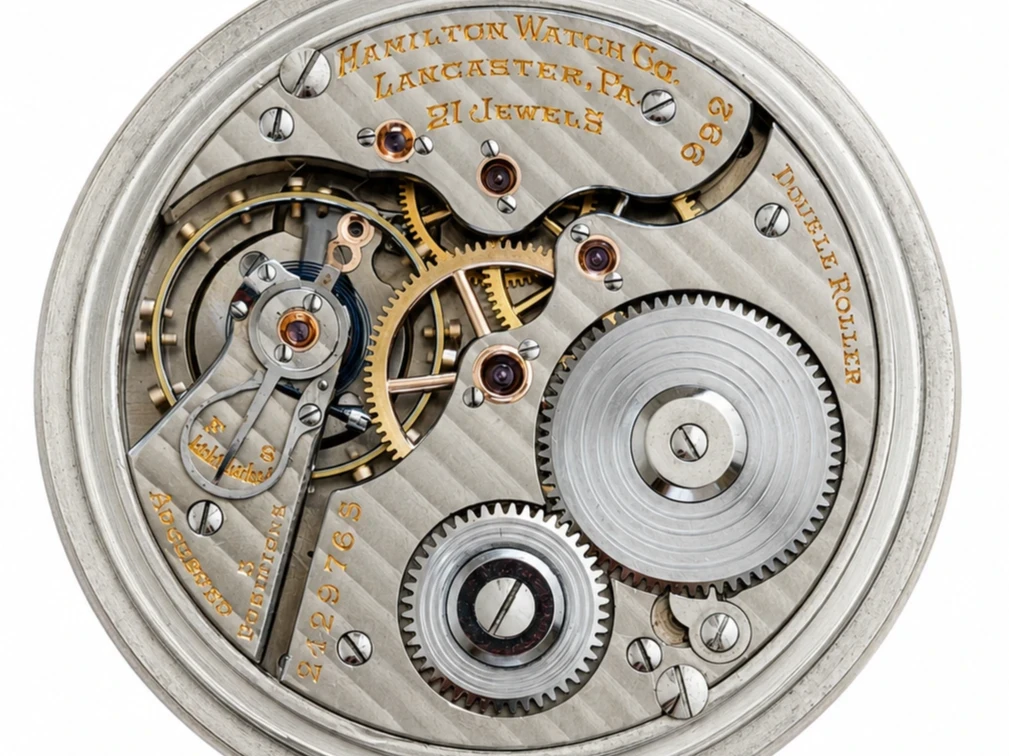
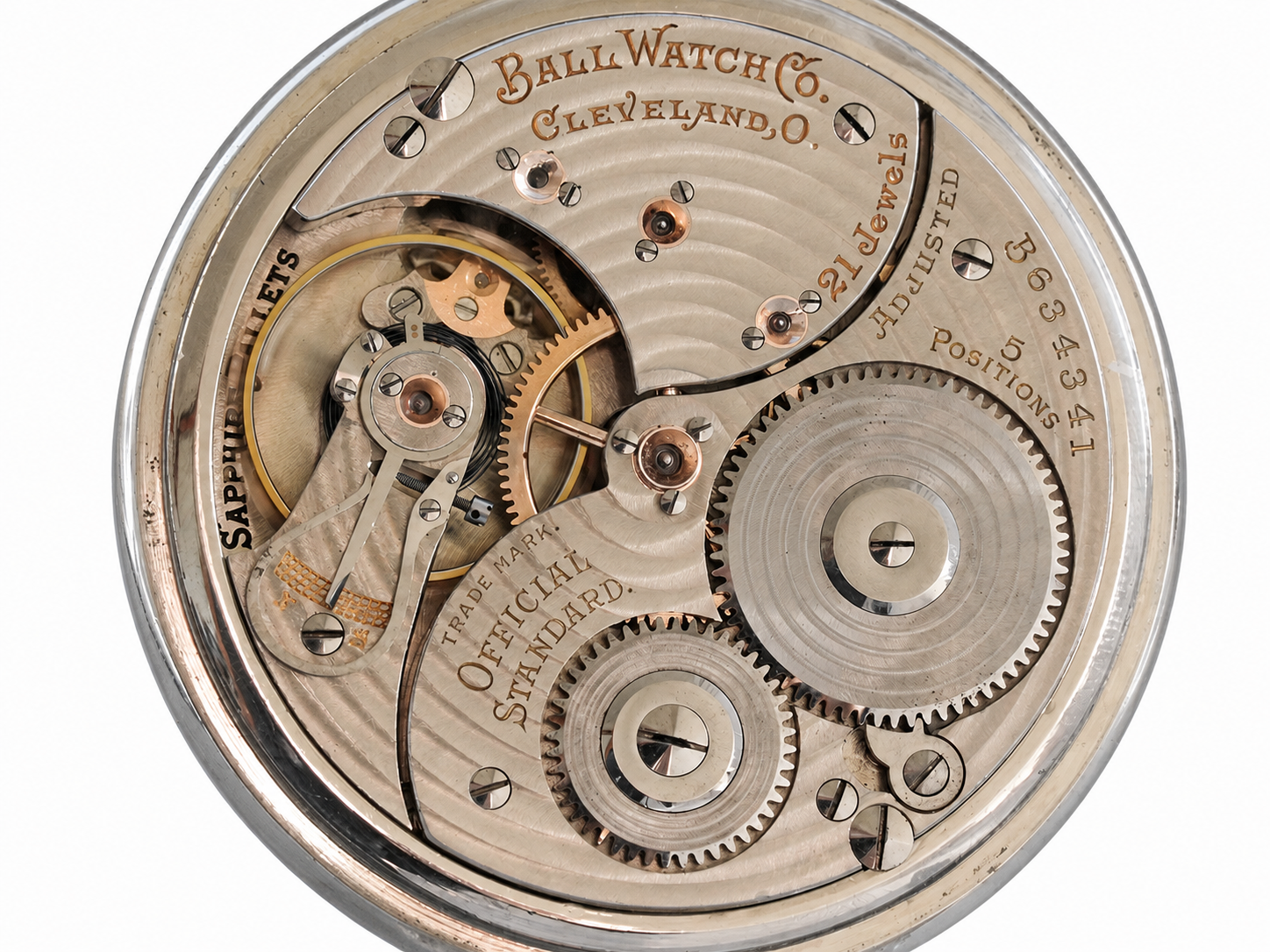
Open the back. The movement is the watch. The dial is the face, but the movement is the soul, and it carries the watch's biography in plain sight: the maker, the grade, the jewel count, the serial number, the adjustments. Look closely at this Hamilton Grade 992 from 1927. You can read "Hamilton Watch Co. Lancaster, PA," "21 Jewels," "Adjusted 5 Positions," and the serial number, all stamped right there on the bridges.
1927 was the year Lindbergh flew the Spirit of St. Louis from New York to Paris and Al Jolson opened his mouth in The Jazz Singer to give Americans their first talking picture. The 992 movement in your palm was a precision instrument when both happened. Twenty-one jewels in gold settings, damascened bridges, a lever-set escapement: these were not decorative choices, they were the railroad's specification for a watch that could keep an engineer alive. If a seller cannot tell you what the movement says, that is its own answer.
3. Is the dial original, or has it been refinished?
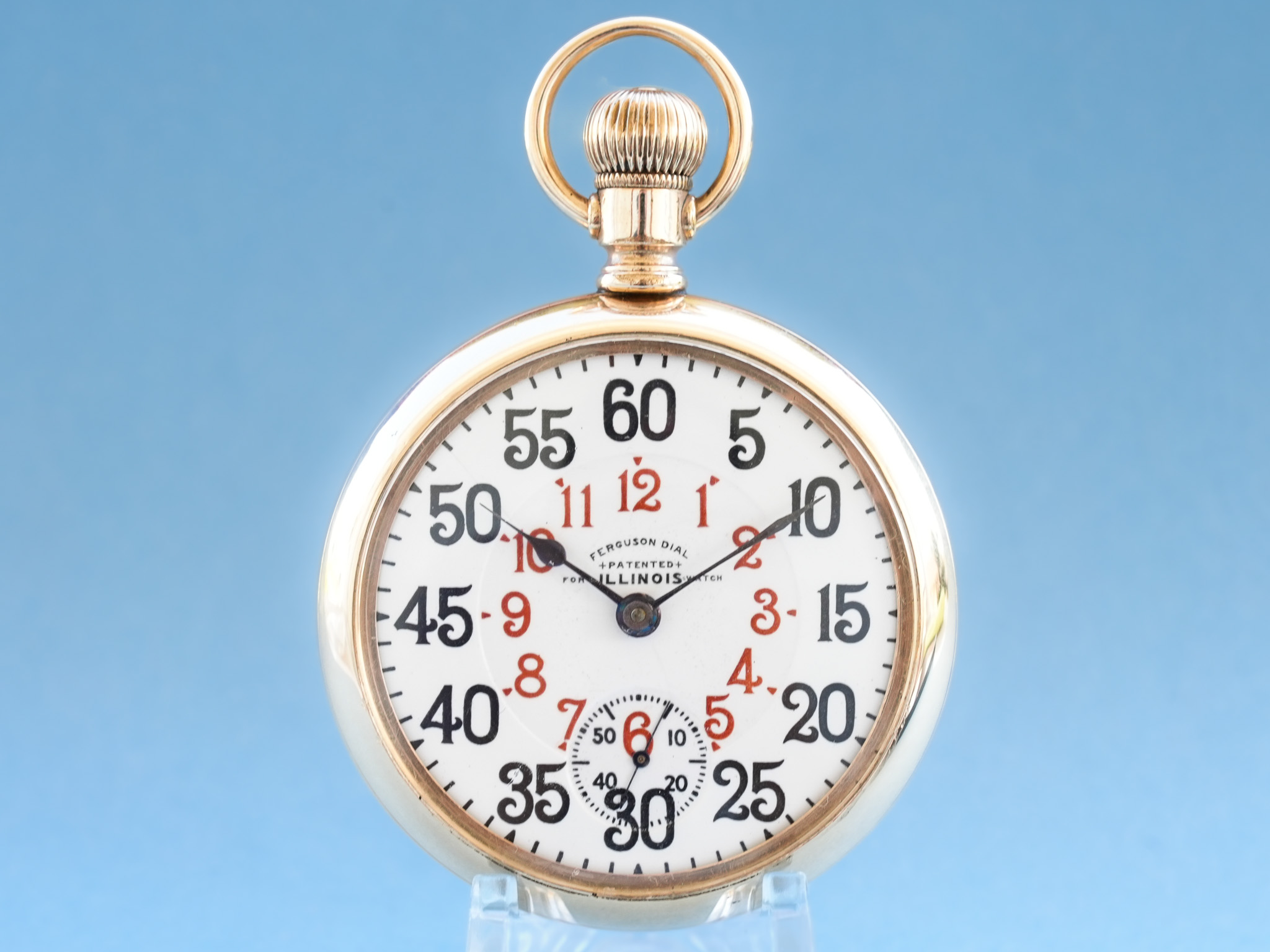
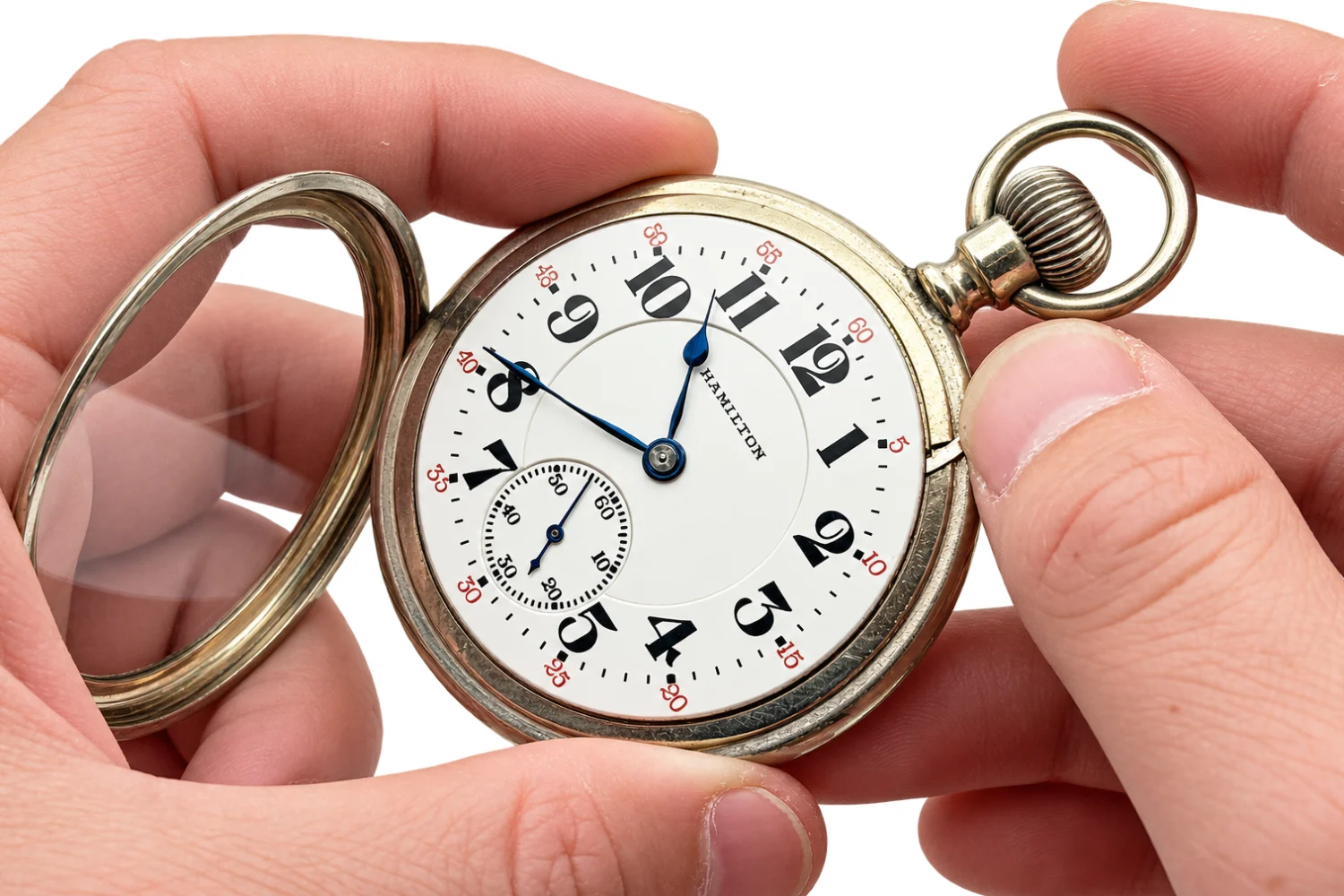
Dials are where a lot of first-time buyers get fooled. A refinished dial can look bright and clean and almost new, and that is exactly the problem. Original dials carry their age honestly: a faint hairline, a hint of porcelain warmth, sharp printing that has not been redone by a modern hand. A repainted dial can drop the value of an otherwise lovely watch by half.
This Illinois 23-jewel Bunn Special from 1912 wears a rare Ferguson railroad dial, with the minutes emphasized over the hours, an inner red ring for the hours and large black Arabic numerals on the chapter ring. The Ferguson dial was the first dial design patented in the United States, patented in 1908 by L.B. Ferguson of Monroe, Louisiana. 1912 was the year the Titanic sank in the North Atlantic and New Mexico and Arizona joined the Union as the 47th and 48th states. A dial that has survived from that year, original and undisturbed, is part of why a watch like this is collectible at all. Ask the seller, directly, whether the dial is original. A good dealer will tell you.
4. Is it really a railroad-grade watch, and does it matter?
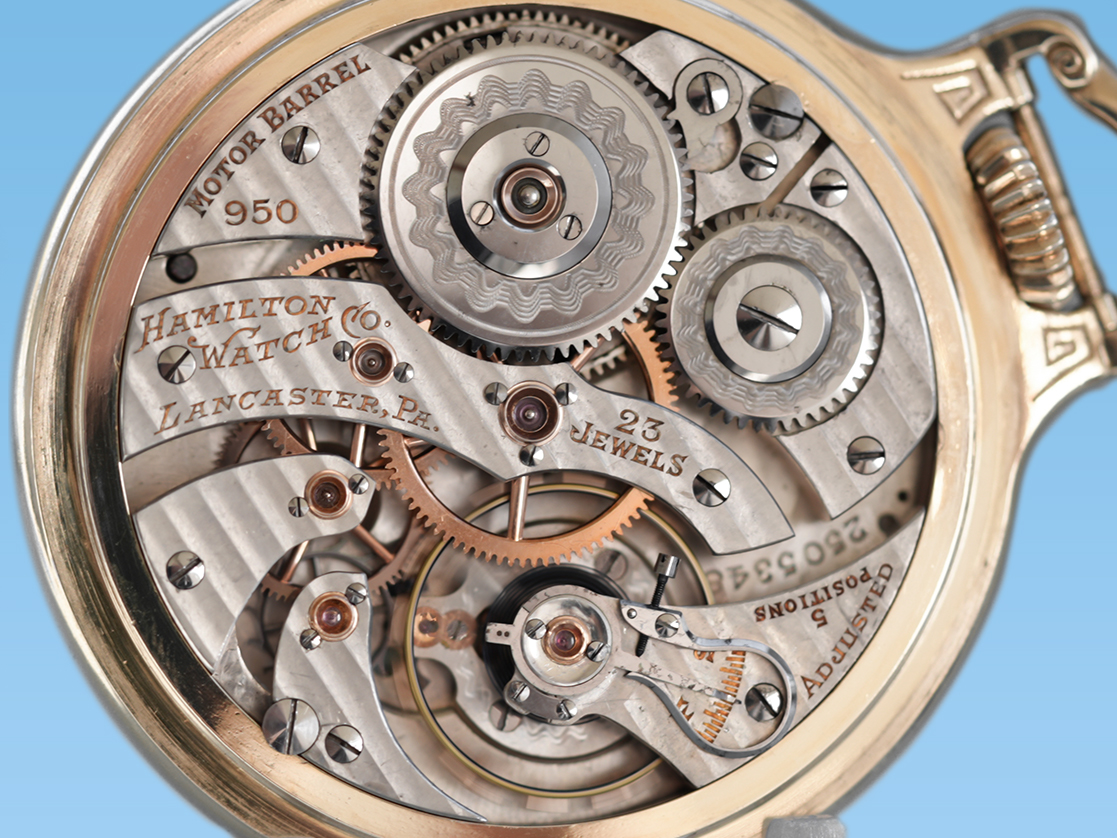
"Railroad" is the most over-used word in pocket watch listings. A watch in a railroad-style case is not a railroad watch. The 1893 General Railroad Timepiece Standards required watches to be open faced, size 18 or 16, have a minimum of 17 jewels, be adjusted to at least 5 positions, keep time within 30 seconds a week, be lever set, with a winding stem at 12 o'clock, the grade marked on the back plate, and a plain white dial with bold black Arabic numerals. If those things are not all true, it is not a railroad watch, no matter what the headline says.
Now look at this Hamilton Grade 950 in the Model #2 Bar Over Crown case from 1935. A 23-jewel lever-set movement with damascened bridges, solid gold train wheels, gold jewel settings, and sapphire pallet jewels. When the 950 was introduced in 1910, it featured 23 extra-fine ruby and sapphire jewels and a solid gold train, meaning the center wheel through the fourth wheel are solid gold. 1935 is the year Franklin Roosevelt signed the Social Security Act into law. The 950 was the watch a senior conductor carried while that bill was being argued in Congress. That kind of watch is why the railroad-grade question matters. If a seller calls something "railroad" without backing it up, ask why.
5. Does the case match the movement, and is it the case the watch was sold in?
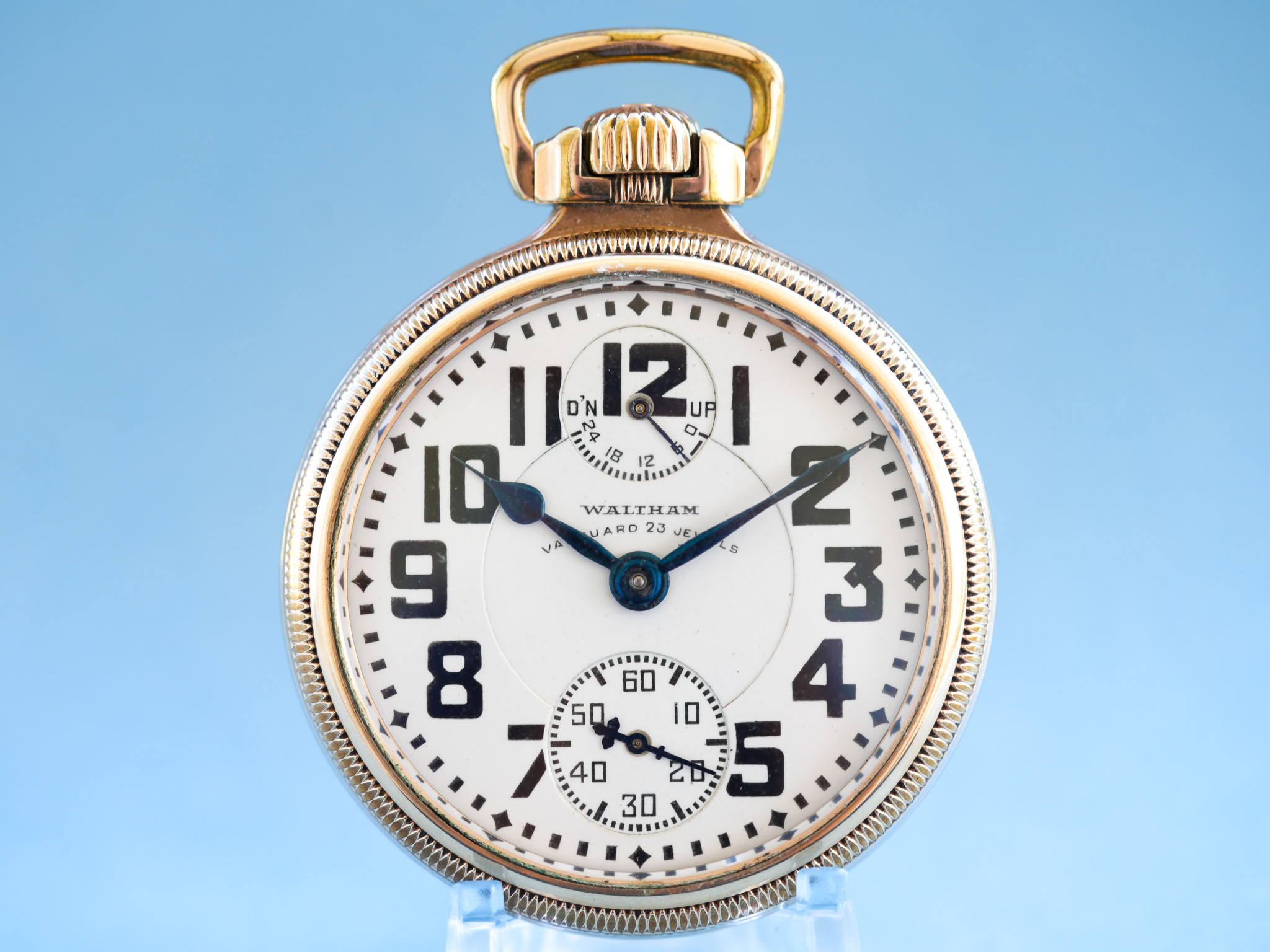
American pocket watches were almost always sold with the movement and case as separate purchases, then married at the jeweler's counter. That means cases and movements get swapped over the decades. A movement in the wrong case is not a forgery, but it is a different watch from one that has lived its whole life in its original case. Look at the serial numbers, the metal, the fit, and the wear pattern on the inside of the case back: a movement that has lived in one case for ninety years leaves a faint, even shadow on the inside.
This Waltham Railroad Grade Vanguard with the up/down wind indicator, housed in a Mainliner case, came out of Waltham in 1929. That year the Hoover administration was barely seven months old when Wall Street collapsed in October and the country slid into the Depression. The up/down indicator on the dial shows how much power is left in the mainspring, a feature engineers loved because it told them whether the watch had been wound that morning. Movement and case fit each other the way they should. Ask the seller to confirm that match before you buy.
6. What is the return policy, and what is the seller's reputation?
Pocket watches are not commodities. Two watches with the same model number can be very different watches depending on condition, originality, and service. That makes the seller the most important variable in the transaction. A good dealer will tell you the watch's flaws as readily as its virtues, guarantee the work in writing, and take the watch back if it is not what they said it was. Every watch I sell carries a one-year guarantee on the service work.
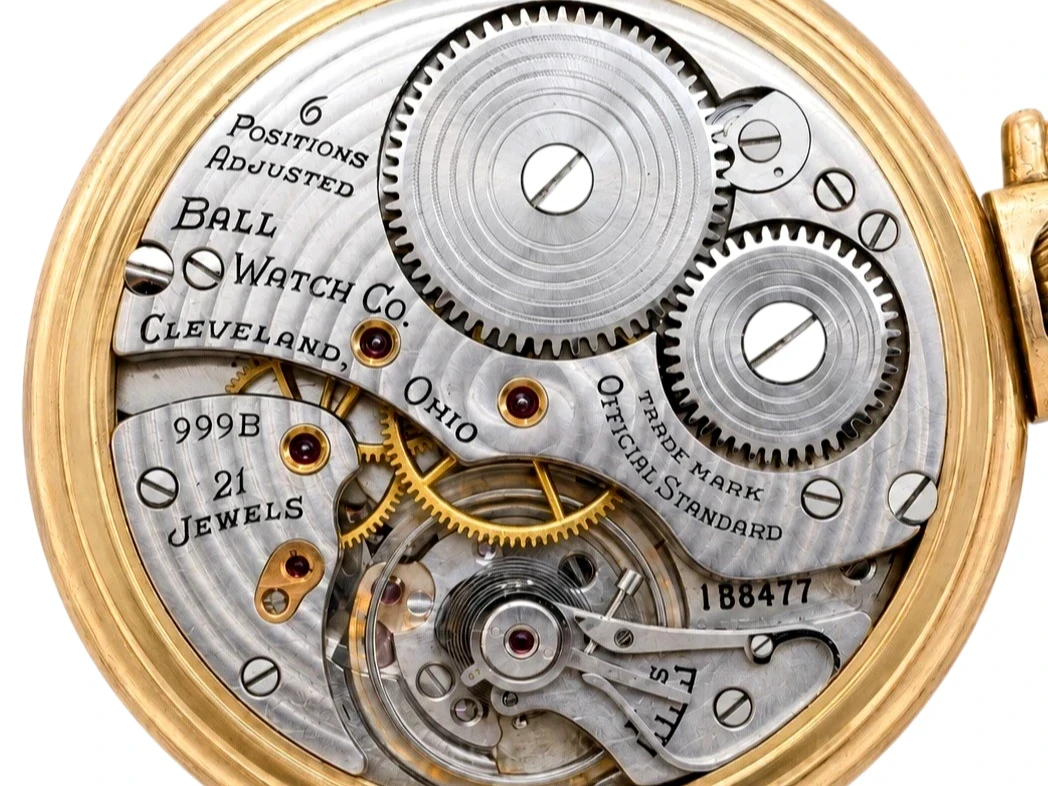
Consider this Ball Hamilton Grade 999B Model 5 from 1947. The Ball Watch Company didn't make pocket watches: it branded and sold timepieces manufactured by other American makers, including Hampden, Elgin, Hamilton, and Waltham, in cases by Wadsworth, Dueber, and Keystone. What Webb C. Ball did do was inspect and certify them to a standard the railroads trusted. 1947 was the year Jackie Robinson broke the color line at Ebbets Field and the Marshall Plan was being drafted in Washington. A 999B from that year is a piece of mid-century American precision. But none of that protects you if the seller will not stand behind the watch. Ask what happens if it stops keeping time next month. The answer should be in writing.
7. Who can I ask if I have a question after I buy?
This is the one most people forget. The relationship does not end at checkout. A good dealer is someone you can call months or years later when the watch stops, or when you want to add another piece to the collection, or when you just want to know what you have. I answer the phone at (310) 486-0572 and the email goes to me directly.
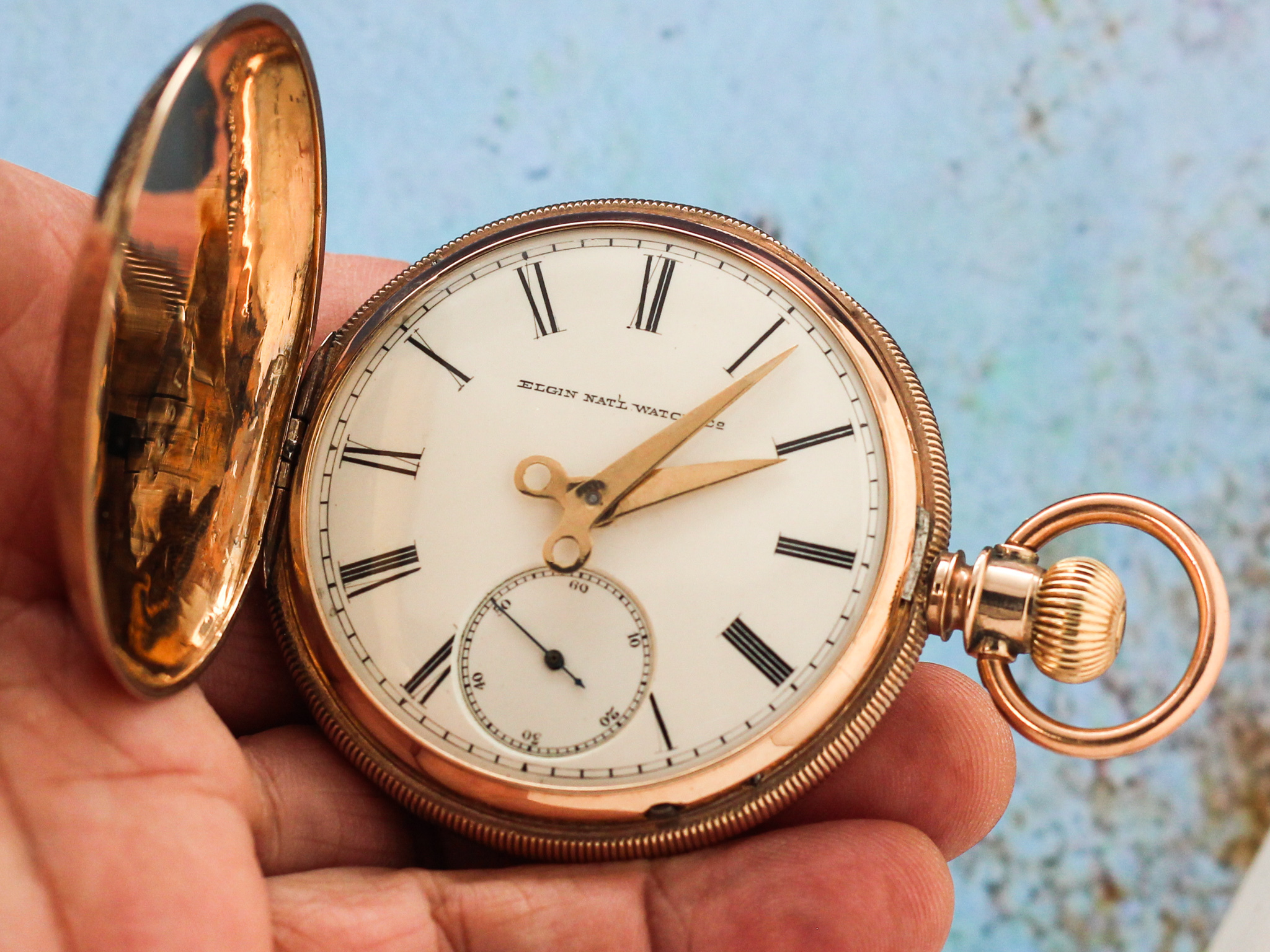
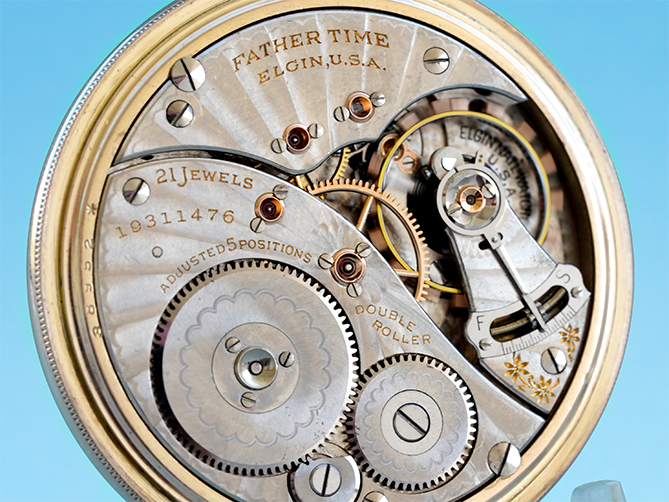
Look at this rare Elgin Father Time Grade 374 with 21 jewels and an up/down wind indicator, made in 1917. That spring the United States entered the First World War, and within months American railroads were nationalized under federal control to move troops and materiel to the ports. An engineer carrying a Father Time 374 was, in a real sense, helping run the war effort. These movements helped enable the industrialization of this country: the synchronization of the railroads, the war effort, the telegraph, and the building of an economy that ran on the minute hand. The finishing on a watch like this is honestly something we do not see today. If the same movement were produced now, it would be among the most expensive watches on the market.
How I chose these seven watches
Every one of these has come through The Pocket Watch Guy case. Every one has been fully disassembled, cleaned, lubricated, reassembled, adjusted, and timed by me, and every one carries a one-year guarantee on the service work. I picked these seven because they each illustrate the question they are paired with: the South Bend for service, the Hamilton 992 for movement reading, the Bunn Special for dial originality, the Hamilton 950 for railroad-grade authenticity, the Vanguard for case-movement matching, the Ball 999B for return policy and reputation, and the Father Time 374 for the long relationship between dealer and collector.
If you have a pocket watch in a drawer
If you inherited a watch and want to know what it is, or you have one that has stopped and want it brought back to life, I do that work in the shop. The watch repair page has more on what a full service involves. And if you are thinking of selling rather than buying, the we buy watches page is the place to start.
Ready to ask the questions on a specific watch?
The best way to learn about American pocket watches is to handle one and ask everything you can think of about it. If you see a watch on the site you have questions about, or you just want to talk through what a first watch should look like for you, send me a note through the contact form or call (310) 486-0572. I read every message myself, and there is no such thing as a beginner's question I have not happily answered before.