Identifying a Waltham is mostly a matter of one number. Almost every answer you need is stamped on the movement itself, and the factory records that turn that number into a year, a grade, and a model design have largely survived. Open the back, read the serial number off the back plate of the movement, and a couple of free databases will give you the rest in seconds.
Waltham produced more numbered movements than any other American watch company. Somewhere north of thirty-five million by the time the factory finally went dark in 1957. The number alone is striking, but the more interesting fact sits behind it: Waltham did not just supply the American watch industry, they invented it. Aaron Dennison and his partners borrowed the interchangeable-parts techniques being developed at the Springfield Armory for rifles and applied them, for the first time anywhere in the world, to high-precision watch movements. The Ford Model T plant of 1908 owed something to a watch factory in Waltham, Massachusetts, that had been doing the same thing fifty years earlier. I've had hundreds of these through the shop, in every era from Civil War 18-size key wounds to the late 16-size Vanguards, and what they share is the unmistakable fingerprint of a factory that figured out how to make precision instruments by the millions.
The number that matters is on the movement
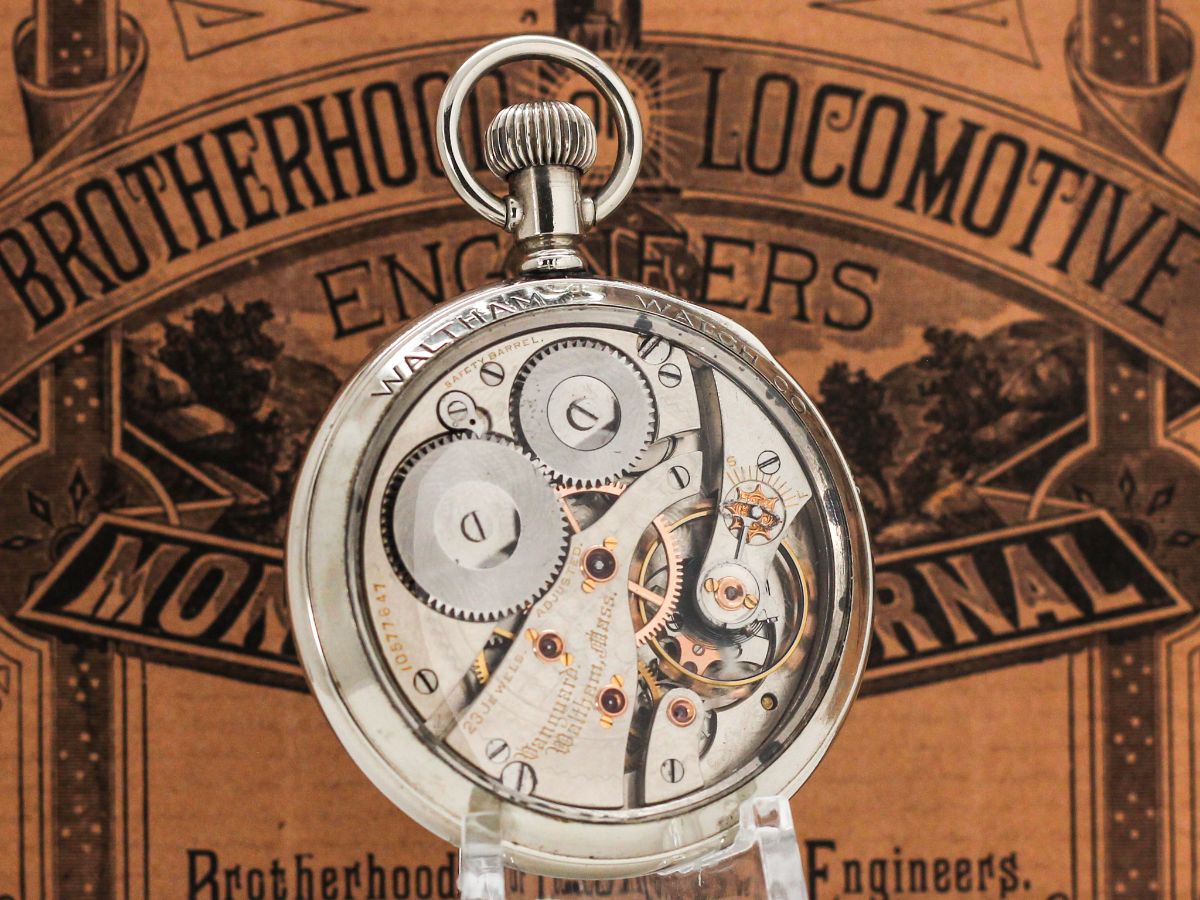
Waltham serial numbers identify the movement, not the watch. The case has its own number, often stamped into the inside of the back cover, but that case number is for the casemaker's records and won't tell you anything reliable about the year, grade, or jewel count of the watch you're holding.
The movement number is engraved on the back plate of the movement itself, typically six or seven digits, sitting alongside the grade name (Vanguard, Crescent St., P.S. Bartlett, Riverside, and so on). Plug it into the Pocket Watch Database at pocketwatchdatabase.com or the NAWCC's Waltham lookup, both built from the original factory ledgers, and you'll get the year of manufacture, the model designation, the grade name, the jewel count, and the size. The case material, dial style, and hands you read off the watch itself.
A short tour of the model years
Waltham named its models after the year of the design, not the year of production. A "Model 1883" Waltham was designed in 1883 but may have come off the line any time between then and roughly 1920. Once you know the model, you know the basic architecture and the size; the rest is detail.
Model 1857
The first practical mass-produced American watch, in 18-size, key wound and key set. Civil War era. The early grades carry names that read like a Boston law firm: Appleton, Tracy & Co., P.S. Bartlett, J. Watson. To hold one of these in good order is to hold an artifact of the very moment American manufacturing learned to make precision instruments at scale, born the year James Buchanan moved into the White House.
Model 1883
Eighteen-size, stem wound, and the workhorse of the Waltham line for nearly four decades. Roughly 5.4 million movements across more than a hundred different jewel and grade combinations. The Model 1883 is where the famous P.S. Bartlett grade really hit its stride, alongside higher grades like the Crescent St. and the Vanguard. If a Waltham was handed down through your family from before about 1920, it is most likely a Model 1883. The grade is named for Patten Sergeant Bartlett, who ran Waltham's plate and screw department in the company's early years; the fact that his name still rides on the dial of a watch a hundred and forty years on says something about how seriously this factory took the people who built its watches.
Model 1892
Eighteen-size, the natural successor to the 1883, and the home of some of the most beautiful high-grade Waltham movements ever made. Many railroad collectors point to the Model 1892 Vanguard as Waltham's mechanical peak: adjusted for temperature and five positions, with up to 23 jewels. These were coming off the line in the years around the great Columbian Exposition in Chicago, when the country first rode the Ferris wheel and tasted Cracker Jack. Pop the back of a high-grade Model 1892 Vanguard and the work is right there in front of you: hand-cut perlage on the bridges, polished steel parts, gold chatons holding the upper jewels, and a swan-neck regulator finished to a level the modern watch industry simply does not reproduce. A movement built to that standard today, if anyone still built them, would sit comfortably alongside the most expensive watches in the world.
Model 1908
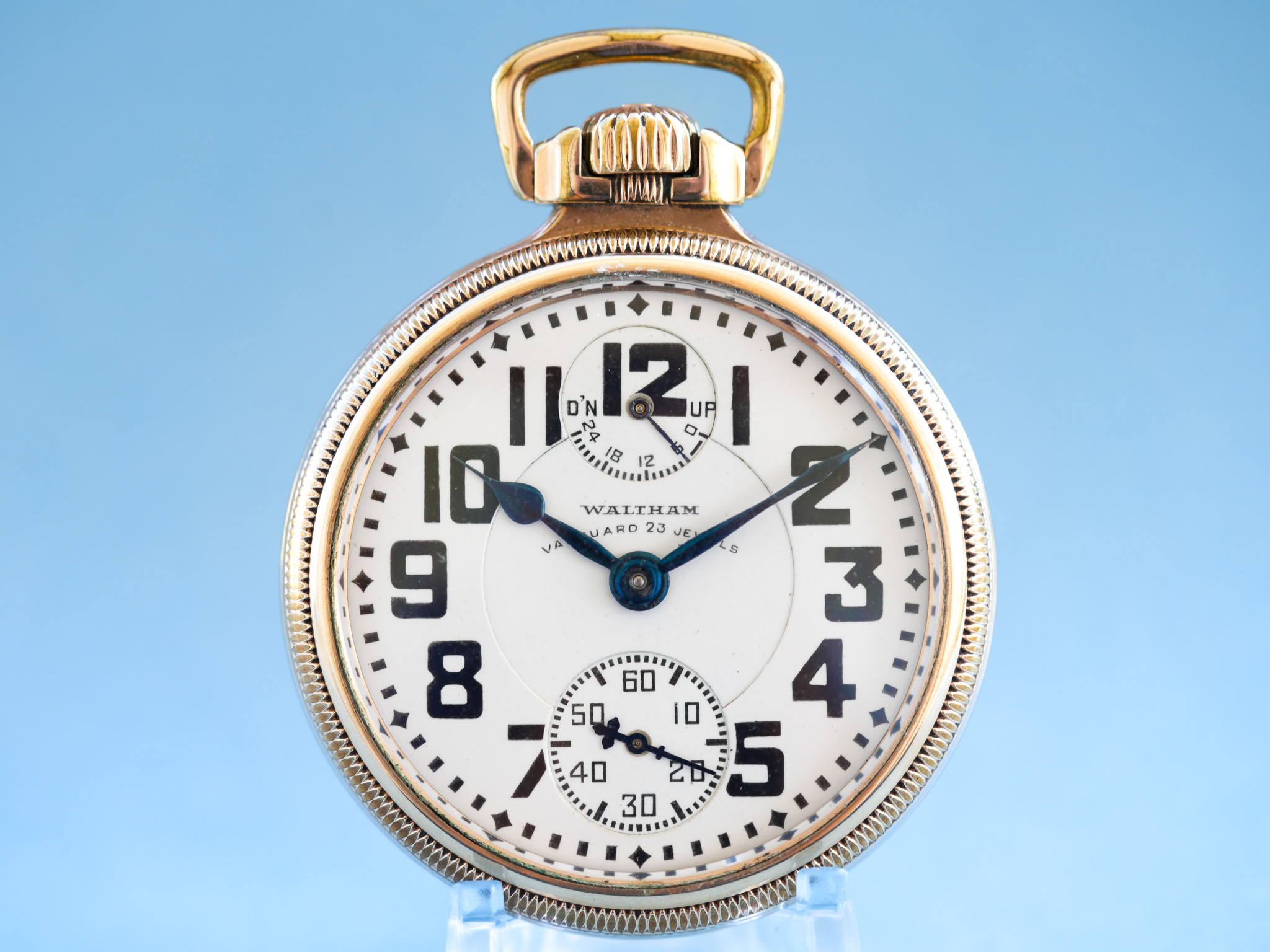
Sixteen-size, lighter and thinner than the 18-size Walthams, made for the changing taste of the early twentieth century. The Vanguard variant of this model continued in different numbered runs all the way through 1953, which means a 16-size Model 1908 Vanguard could have been built anywhere from the year Henry Ford's first Model T rolled out of Detroit to the year Eisenhower took the oath of office. Twenty-three jewels, lever set, double-sunk dial, adjusted for temperature, isochronism, and five positions. To my eye this is the Waltham most railroad collectors are chasing. I have a 1929 example with the original up/down wind indicator in the case right now, here it is, in a Mainliner gold-filled case, fully serviced and running well. It came off the line the same year as Black Tuesday, and yet here it still is, ticking.
The dial, the case, and the hands tell you the rest
A movement number narrows things down, but the watch as an object tells you the rest of the story.
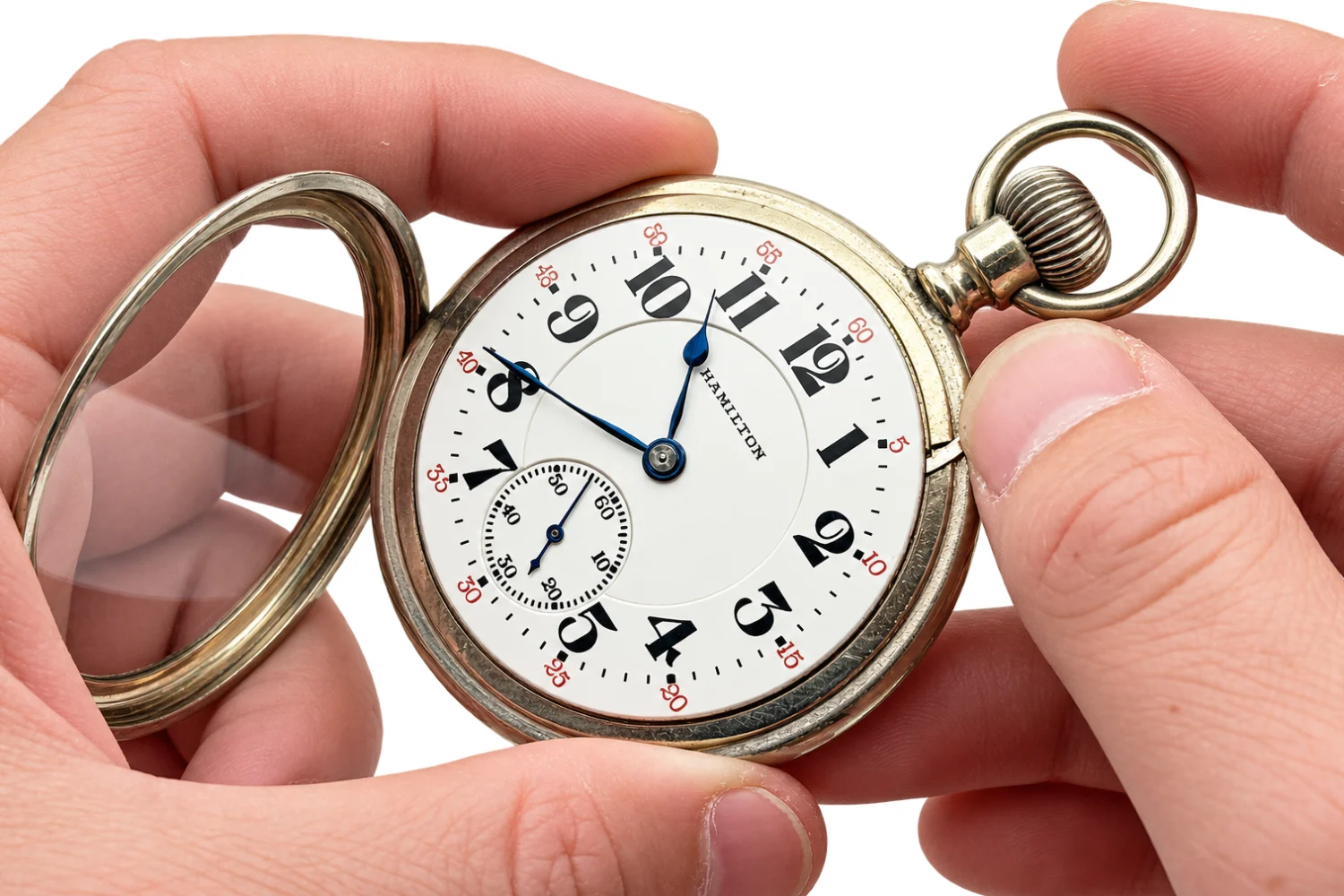
The originals on the high-grade railroad Walthams are double-sunk enamel dials, with a recessed center and a recessed seconds bit. There is a particular warmth to these dials under a loupe that no modern refinish ever quite captures. A flat single-plane dial on a Vanguard or a Crescent St. is usually a refinish. Refinishing isn't fatal, but it changes value, and it is worth noticing when you have the watch under glass.
Waltham did not make most of its own cases. Names like Crescent, Keystone, Wadsworth, Star, Dueber, Fahys, and Boss are casemakers, marked separately from the movement. A railroad-grade movement housed in its original railroad-grade case, open face, screw-back, gold-filled or solid gold, is what railroad collectors want. The same movement in a non-original case is a perfectly fine watch, just not a complete one.
The hands on railroad-grade Walthams are originally blued, in a spade-and-whip profile. Modern replacements tend to look too clean, too even; once you've seen enough originals, the wrong ones quietly raise their hand.
A 1915 Crescent St. on the bench
I had a 1915 Waltham Crescent St. on the bench last month, the same year Alexander Graham Bell placed the first transcontinental telephone call from New York to San Francisco. Twenty-one jewels, lever set, with the rare up/down wind indicator showing how much mainspring remains on each wind. The dial double-sunk enamel and untouched. The case a Mainliner gold-filled open face, the right kind of case for the watch. Hands original, blued, in correct profile. Movement clean inside, beautifully signed, with the original screws still seated and the perlage on the bridges catching morning light the way only old hand-finishing can. Here's the listing, if you'd like to see what a complete 1915 Crescent St. looks like.
The early dress Walthams
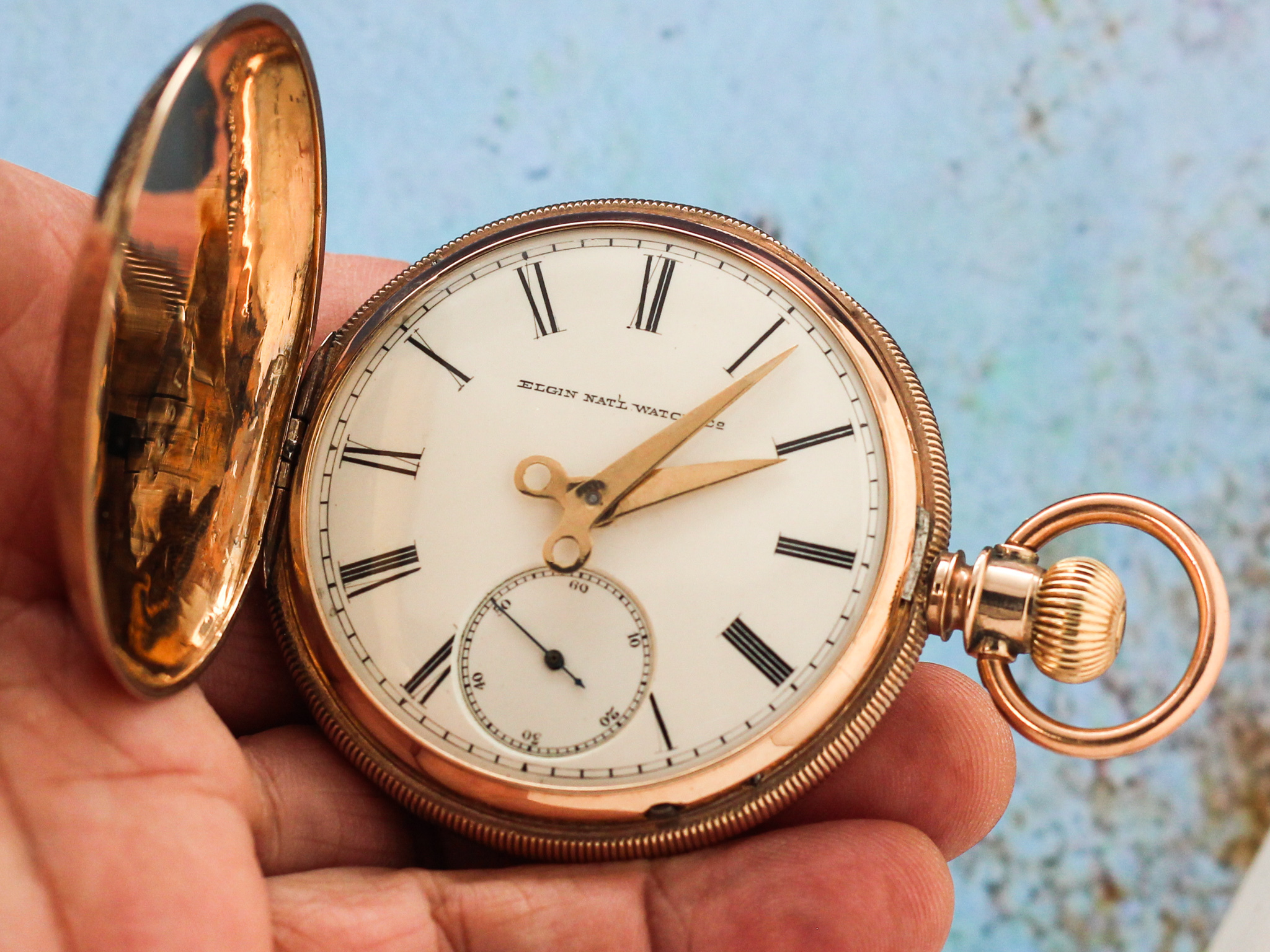
Before there were 23-jewel railroad Vanguards, there were the dress watches. These are the 18-size and 16-size Walthams in solid gold or gold-filled hunting or open-face cases, often with elaborate engine turning on the back. The Model 1883 in a high grade like the P.S. Bartlett was the everyday American gentleman's pocket watch for nearly forty years. I have a Masonic-engraved P.S. Bartlett in the case right now, here it is, with the square and compass hand-engraved into the back. A wonderful object, dressy and personal, a real pleasure to hold.
If you've got one
If you have a Waltham that's running fast or slow, these were built to be serviced. Send me photos through the repair page or give me a call at (310) 486-0572 and we'll sort it out together.
If you've inherited one and you're thinking about selling, I'd love to take a look. Send me a few photos or give me a call. I'll give you an honest number the same day, no pressure either way.
Mini FAQ
Where is the serial number on a Waltham pocket watch?
On the back plate of the movement, visible as soon as you open the case back. Six or seven digits. Not on the case.
What does a Waltham serial number tell me?
The year the movement was made, the model design year (1857, 1883, 1892, 1899, 1908, and so on), the grade name, the jewel count, and the size. The Pocket Watch Database and the NAWCC return all of this from a single free search.
Is the case serial number useful?
For dating the watch, no. For identifying the case maker, yes, sometimes. Names like Crescent, Keystone, Wadsworth, Star, Dueber, Fahys, and Boss were major American case makers, and the case markings will usually tell you which one made it.
My Waltham doesn't run. Is it ruined?
Almost certainly not. A non-running Waltham almost always needs a clean, oil, and adjust, and most of these movements come back to life with a proper service.
How can I tell a railroad-grade Waltham from a regular one?
A jewel count of 21 or more, lever set (a small lever near the dial pulls out to set the time, rather than the crown), a enamel dial with bold Arabic numerals, and adjustment to temperature and five positions. The movement face will usually say all of this in plain text.
Drop me a line either way, even if you're just asking.