Waltham was first. If you want to understand American pocket watchmaking, how we took an industry Europe had dominated for four hundred years and made it our own, you have to understand Waltham. And if you're building a collection, sooner or later you're going to own one. I've been at this thirty years and I still get a specific thrill every time a clean Vanguard comes across my bench.
This is the guide I'd give a customer walking into the shop asking about Waltham for the first time. The history that actually matters, the grades worth chasing, what a fair price looks like, and what's sitting in my inventory right now that might be the right watch to start with.
Why Waltham matters
Waltham was founded in 1850 in Waltham, Massachusetts, and they became the first company on earth to mass-produce pocket watches on interchangeable-parts machinery. Before Waltham, a watch movement was a hand-fitted object, every screw, every pinion, every wheel made and finished one at a time by a single craftsman. Waltham said no: we'll machine the parts to such tight tolerances that any gear fits any movement, and we'll do it at a scale that undercuts the Swiss by half.
It worked. The Waltham Model 1857 Appleton, Tracy & Company was the watch that opened the American era. By the time the railroads standardized time in 1893, Waltham was already the default supplier of precision movements for the entire American industrial economy. They produced roughly 40 million watches before they closed in 1957. That's a canvas across almost a full century of American history, and it's why a Waltham collection can go as deep as you want it to.
For a collector, that scale means two things: plentiful supply at the low end, and genuinely rare top-tier movements at the high end. Most of the Walthams you'll see at an vintage store or estate sale are gentleman's dress watches, lovely, historically real, often under $500. The ones that matter for a serious collector are the railroad grades.
The grades every Waltham collector should know
Vanguard, the one to own
The Vanguard was Waltham's flagship railroad movement. 21 or 23 jewels, 16 or 18-size, adjusted to five or six positions and temperature. They started production around 1892, kept it up through the 1940s, and along the way produced some of the most beautiful railroad movements ever made on American soil.
Here's my take: a clean Vanguard in a Mainliner case is one of the finest watches a collector can own for the money. The 23-jewel versions are flagship-grade, but even the 21-jewel Vanguards are remarkable, these were the watches that kept passenger trains on time through the first half of the 20th century, and they were built for that job without compromise.
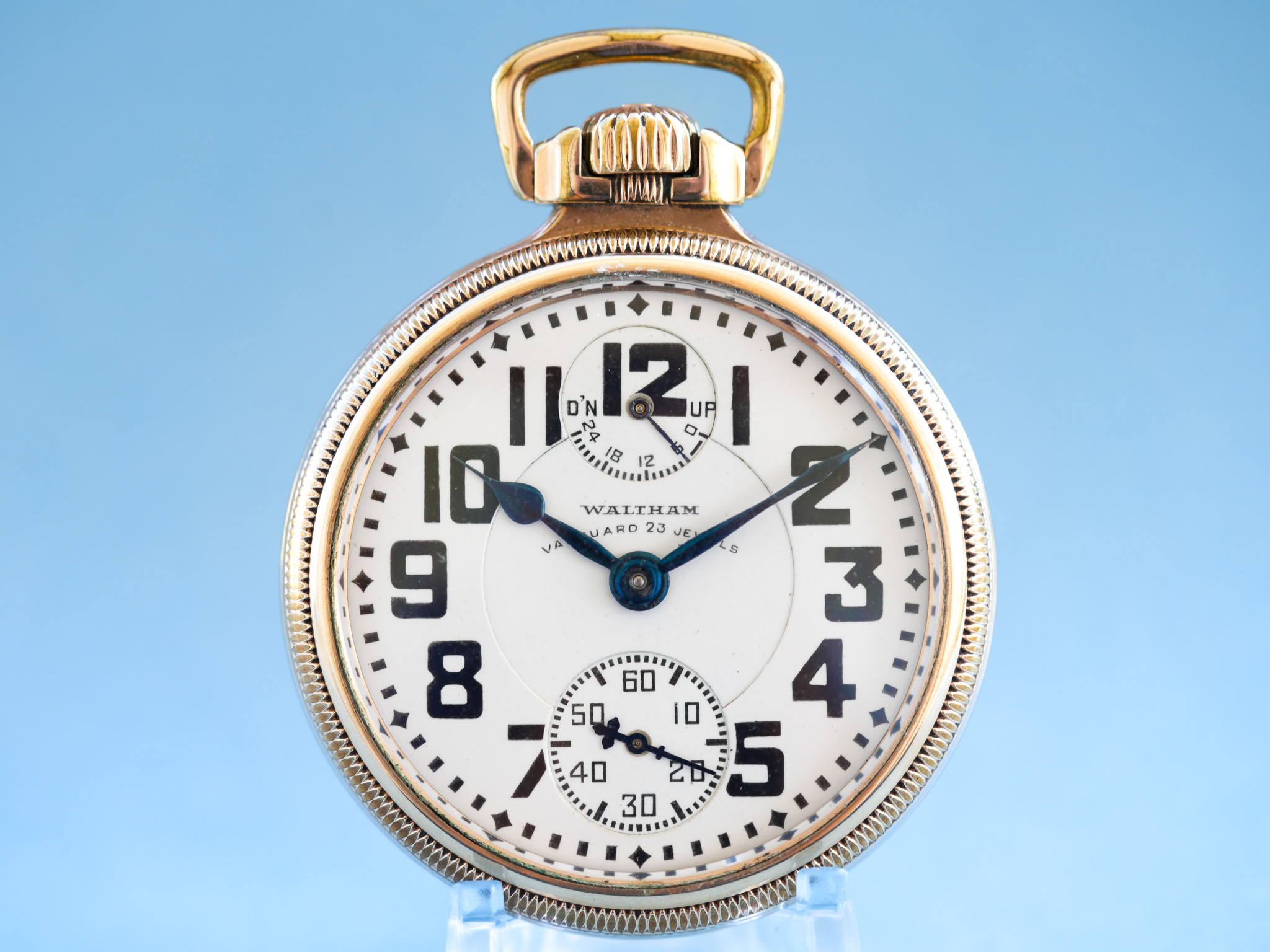
The Up/Down Wind Indicator Vanguards are my particular weakness. The wind indicator, a small dial on the face or movement that shows mainspring power remaining, was only ever installed on the highest-grade railroad watches. It's not a gimmick; a real working railroader needed to know before starting a long run whether he was going to make it.
I've got one in the shop right now: a Waltham Vanguard with Up/Down Wind Indicator in a Mainliner case. $2,475. If the Vanguard is the watch you want, that's about as honest a version of it as you can buy.
Crescent St., the Vanguard's quieter sibling
The Crescent St. was Waltham's other serious railroad movement. Typically 21 jewels, 16-size, adjusted to five positions and temperature. Not quite at the Vanguard's top-tier jewel count, but a true railroad-grade watch in every other respect. In my experience Crescent St. watches are consistently undervalued. People chase the Vanguard name without noticing that a properly serviced Crescent St. keeps time just as well.
I have a Crescent St. with an Up/Down Wind Indicator in a Mainliner case, $2,275. Same indicator complication as the Vanguard above, for $200 less. If you want a real railroad Waltham with a wind indicator and you're weighing value, that's the one.
Riverside Maximus and Riverside
Riverside was Waltham's premium dress movement, 19, 21, or 23 jewels in 12 or 16-size, typically housed in solid gold cases. Not railroad grade. These were for gentlemen who wanted the finest Waltham could produce in a dress watch. The Riverside Maximus is the top of this line and in a solid 18k case it's a genuinely stunning object. Less common than the railroad grades and priced accordingly.
P.S. Bartlett, the American classic
Patrick Starr Bartlett was the master watchmaker who joined Waltham in 1864 and put his name on some of their most successful gentleman's movements. The P.S. Bartlett was produced across decades, 15 to 17 jewels, various sizes, and represents solid, respectable Waltham craftsmanship at an accessible price. You'll see them often in fraternal-order cases. Masonic, Shriner, Odd Fellows, because they were the watch an American middle-class professional actually carried.
I have a Masonic P.S. Bartlett in the shop right now, $1,575. For someone wanting their first real Waltham, and ideally one with a personal historical flavor, that's a beautiful place to start.
Appleton, Tracy & Company, the original
Appleton, Tracy & Company was the earliest Waltham brand, named after two of the company's founding investors. These are the watches from the 1860s and 1870s, mostly key-wind, mostly 18-size, and they represent the actual beginning of American mass-produced watchmaking. Historically irreplaceable. Mechanically less accurate than later grades by modern standards. Collectors love them for what they are.
How to read a Waltham
The movement, always
Pop the back. I've said this for every brand and I'll keep saying it: the movement is the watch. On a Waltham the grade name is usually printed on the movement. Vanguard, Crescent St., P.S. Bartlett, Riverside, and so on. Jewel count is stamped. Serial number is engraved on one of the plates. Look up the serial number on the Pocket Watch Database to confirm the grade, the year of manufacture, and the jewel count the watch left Waltham with.
Damaskeening quality
Under a loupe, look at the plates. Waltham was known for especially fine damaskeen patterns, those swirling decorative swirls on the bridges. Original damaskeening should be crisp, distinct, and consistent across the plates. A movement that's been cleaned improperly will have muted, rubbed-out damaskeen that no watchmaker can bring back.
Dial condition
Waltham Montgomery dials and double-sunk railroad dials are the crown jewels. Original condition matters. A hairline crack on an original enamel dial doesn't hurt value much if it's otherwise clean. A freshly refinished dial hurts a lot, because the repaint obscures what the original dial looked like and because refinishing was usually done after other kinds of damage that a repaint doesn't fix.
Case choice
Like other American makers, Waltham sold movements without cases. Buyers chose their case at point of sale. A railroad-grade Vanguard in a Keystone or Wadsworth 20-year gold-filled case is period-correct and beautiful. A Vanguard in a solid 14k or 18k case is rarer and more valuable. A modern aftermarket case is a red flag. If a case looks too clean for the period, ask questions.
Waltham price guide, spring 2026
- Entry-level gentleman's watches (7–15 jewels, various grades): $150 to $400 for a clean, serviced example.
- P.S. Bartlett and mid-tier named grades: $500 to $1,800 depending on case, condition, and historical provenance (fraternal markings add value).
- Crescent St. railroad grade: $1,400 to $2,800.
- Vanguard railroad grade, 21 jewels: $1,500 to $3,000.
- Vanguard, 23 jewels or with wind indicator: $2,000 to $4,500.
- Riverside Maximus and exceptional dress grades in solid gold: $1,500 to $5,000+.
One honest observation: Walthams are consistently less expensive than equivalent Hamiltons of the same grade and condition. That's a market preference, not a quality judgment. A Vanguard is every bit the equal of a Hamilton 992. Better, in some people's view. If value is part of what attracts you to collecting, Waltham rewards you for looking past the crowd.
Got a Waltham you're considering selling?
I buy Walthams every month. If it's a Vanguard, Riverside, Crescent St., or anything in the railroad-grade family, there's real demand and I can give you a number the same day. Even the entry-level gentleman's Walthams in good original condition have a market. I sell plenty of them to new collectors. Send me photos through the site or call me directly at (310) 486-0572. I don't lowball. I pay what they're worth, because I sell to collectors who know.
Waltham needing service?
A Waltham that hasn't been wound in twenty years probably isn't broken. It's just thirsty. The oils dry. Dirt works into the train. The mainspring loses some of its spring. A proper service (full disassembly, cleaning, new oil, re-timing) brings it right back. I service Walthams every week on my bench. Send photos of what you've got or give me a call and we'll figure out what it needs.
Frequently asked questions
How do I know if my Waltham is railroad grade?
Minimum 21 jewels (some early 17-jewel Vanguards are technically railroad-grade but those are uncommon), open face, lever set, size 16 or 18, adjusted to at least five positions and temperature, and, most easily, a grade name that's a known railroad grade. Vanguard, Crescent St., and a few others are the most common. If the movement says "Waltham" and a 15-jewel grade name like P.S. Bartlett or Broadway, it's not railroad grade, no matter how nice the case is.
What's the difference between a Vanguard and a Crescent St.?
Both are 16-size railroad grades from Waltham. The Vanguard typically runs 21 or 23 jewels with adjustment to five or six positions, while most Crescent St. movements are 21 jewels with five-position adjustment. The Vanguard was the flagship name; the Crescent St. was the solid professional. In the field, a properly serviced Crescent St. will keep time indistinguishably from a 21-jewel Vanguard. The Vanguard carries more collector prestige and priced accordingly.
Are Waltham pocket watches still accurate today?
A serviced Waltham railroad grade will keep time within ten to fifteen seconds a day, easy. Some do better. Every one of these watches on my bench gets put on a timegrapher after service, and the ones that won't hit the railroad spec get more work until they do. That's what service is. If your Waltham is running fast, running slow, or stopped, it's almost certainly not broken, it needs service, not a repair.
Is Waltham or Hamilton the better starter brand?
They're genuinely different. Hamilton produced fewer models at a higher overall price point, the 950 and 992B are legendary and priced accordingly. Waltham produced a much wider range across a longer history, which means more variety and more entry points. For a first serious collector, I often steer people toward a Waltham P.S. Bartlett or a Vanguard because the price of admission is lower and the movements are still genuinely great. Once you have one of each, you'll have your own opinion.
What's the oldest Waltham worth collecting?
The key-wind Appleton, Tracy & Company movements from the 1860s and 1870s are the earliest American mass-produced watches in existence. They're historically significant and specific collectors love them. By modern standards they're less accurate than later jeweled grades. If you're collecting for history, they belong in the collection. If you're collecting for accuracy, start with the 1890s-and-later jeweled grades.
Happy collecting. Questions about a specific Waltham, or one you're thinking about buying? (310) 486-0572. I'm at the bench most days.