This is the quick-reference companion to How a Pocket Watch Works. Our listings link here whenever a description uses one of these terms, so you can see what it means without losing your place. Each entry is short. For the full picture of how a part fits into the movement, follow the "How it works" link under it.
Jump to: Mainspring and train · Escapement · Balance and hairspring · Regulator · Plates and finish · Jewels · Winding and setting · Adjustment
Mainspring and Train
Mainspring
The coiled steel spring that powers the watch. Winding tightens it, and as it unwinds it turns the barrel and drives the train. How it works
Barrel
The round drum that holds the mainspring. Teeth around its edge drive the center wheel.
Ratchet Wheel and Click
The ratchet wheel sits on top of the barrel and is turned by winding. The click is a small spring-loaded catch that keeps it from turning back, so the mainspring stays wound.
Safety Pinion
A pinion threaded onto its arbor so that if the mainspring breaks, the backward jolt unscrews it instead of stripping the train. Charles W. Fogg patented Waltham's version in 1865, and "Fogg's Patent" is engraved on a great many Waltham movements. Other makers used safety pinions of their own.
Train
The row of wheels that carries power from the barrel to the escapement: center wheel, third wheel, fourth wheel and escape wheel. How it works
Center Wheel
The wheel that turns once an hour and carries the minute hand. A gold center wheel is made of gold alloy, a feature of high-grade movements.
Fourth Wheel
The wheel that turns once a minute. The seconds hand sits on its arbor.
Cannon Pinion
A hollow pinion on the dial side that carries the minute hand. It is friction-fit, which lets the hands be turned for setting without forcing the train.
Quick Train and Slow Train
A quick train beats 18,000 times an hour, five beats a second, the standard for American railroad watches. A slow train beats 16,200 times an hour, common in earlier 18-size movements.
Escapement
Escapement
The mechanism that lets the train advance one tooth at a time and gives the balance a small push on each beat. How it works
Lever Escapement
The escapement used in almost every American pocket watch, made up of the escape wheel, the pallet fork and the roller on the balance.
Escape Wheel
The last wheel of the train, with fifteen specially shaped teeth that are caught and released by the pallet stones.
Pallet Fork (Lever)
The rocking part that carries the two pallet stones at one end and the fork slot at the other. It links the escape wheel to the balance.
Pallet Stones
Two polished jewels on the pallet fork that lock and release the escape wheel teeth. Sapphire pallet stones are noted on some high grades.
Roller Jewel (Impulse Jewel)
A tiny upright jewel pin on the balance roller. It knocks the fork to unlock the escape wheel, and the fork pushes back on it to keep the balance swinging.
Single Roller and Double Roller
On a single roller, the roller jewel and the safety action share one disc. A double roller gives the safety action its own disc, which keeps the fork from being knocked out of place by a jolt. The double roller became standard in railroad grades. How it works
Balance and Hairspring
Balance (Balance Wheel)
The wheel that swings back and forth and sets the pace of the watch. Together with the hairspring it is the timekeeping heart of the movement. How it works
Balance Staff
The fine steel axle the balance turns on. Its pivots are about as thick as a hair, and it is the part most often broken when a watch is dropped.
Balance Cock
The bridge that holds the top pivot of the balance. On older full plate movements it is often hand engraved. The regulator scale is usually marked on it.
Cut Bimetallic Balance (Compensating Balance)
A balance whose rim is brass outside and steel inside, cut through near the arms. In heat the free ends curl inward, so the balance swings faster and makes up for the hairspring weakening. Also called a split or compensation balance. How it works
Monometallic Balance (Solid Balance)
An uncut balance of one metal, used from the 1930s with temperature-stable hairspring alloys such as Elinvar, which made a compensating balance unnecessary. How it works
Balance Screws and Timing Screws
Screws around the balance rim used to poise the balance (make it evenly weighted) and to set its rate. Timing screws, also called mean-time screws, can be turned in or out for fine adjustment.
Hairspring (Balance Spring)
The fine coiled spring attached to the balance. It pulls the balance back toward center on every swing, and its strength sets how fast the balance swings. How it works
Breguet Hairspring (Overcoil)
A hairspring whose outer coil is raised up over the rest and curved back toward the center, an idea of Abraham-Louis Breguet around 1795. It opens and closes evenly, which helps the watch keep steady time in every position. Found on nearly every American watch adjusted to positions. How it works
Flat Hairspring
A simple spiral hairspring lying in one plane, used on many lower and mid grades.
Elinvar
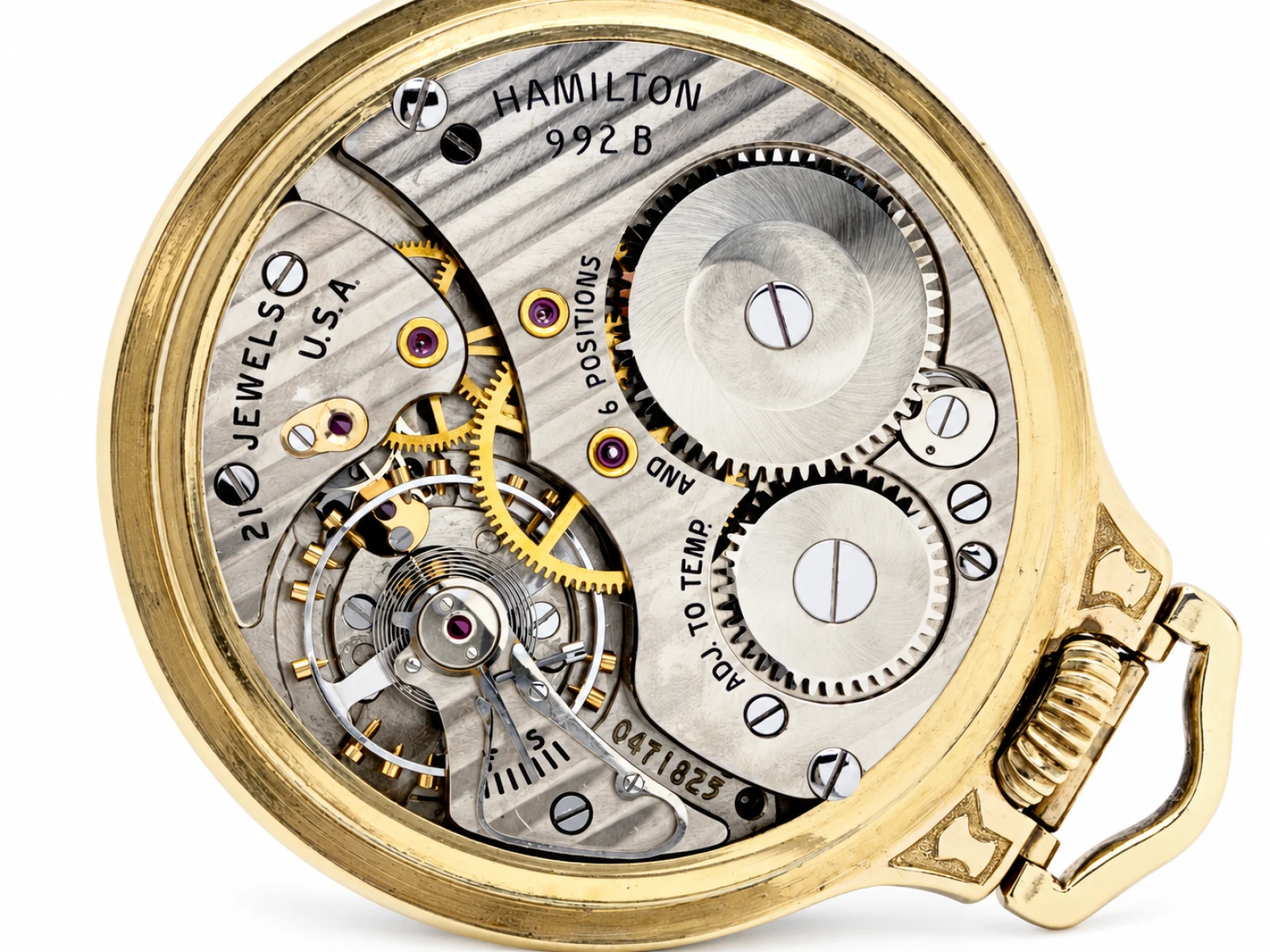
A nickel-steel alloy developed by Charles-Édouard Guillaume, winner of the 1920 Nobel Prize in Physics for his work on such alloys. A hairspring of Elinvar keeps its strength through heat and cold. Hamilton took it up around 1930 to 1931 and used it in the 992E.
Stud
The small block on the balance cock that holds the outer end of the hairspring.
Regulator
Regulator
The part that fine-tunes the rate. Two curb pins on it straddle the hairspring, and moving them shortens or lengthens the working part of the spring. How it works
Index Regulator
A regulator moved by hand with a pointer (the index) over a scale marked F and S (fast and slow), or A and R on Swiss watches.
Micrometric Regulator
A regulator moved by a fine screw or spring, so it can be set in very small, repeatable steps. Well known American designs include Reed's whiplash (1867), the Goldthwait, Church's star wheel regulator (1885 and 1892) and Webb C. Ball's (1896). How it works
Whiplash Regulator
George P. Reed's 1867 micrometric regulator, with a long curved spring arm and an adjusting screw. Hamilton, E. Howard, Illinois and many other American makers used it or a version of it.
Plates and Finish
Plates
The metal plates that hold the wheels between them. The dial-side plate is the pillar plate. How it works
Full Plate
A movement with one top plate covering nearly everything, the balance sitting on top under its own cock. Typical of 18-size American watches of the 1800s.
Three-Quarter Plate
A movement whose top plate is cut away where the balance sits, so the balance is level with the plate. Thinner, and easier to service. Most 16-size railroad watches are made this way.
Bridge Model
A movement in which the wheels are held by separate bridges rather than one top plate, often a company's finest work.
Gilt
Brass plates with a gold wash, the usual American finish through the 1870s, and on lower grades for some time after.
Nickel
Solid nickel plates, bright and silvery, used on the better grades from the 1870s and 1880s on.
Damaskeening
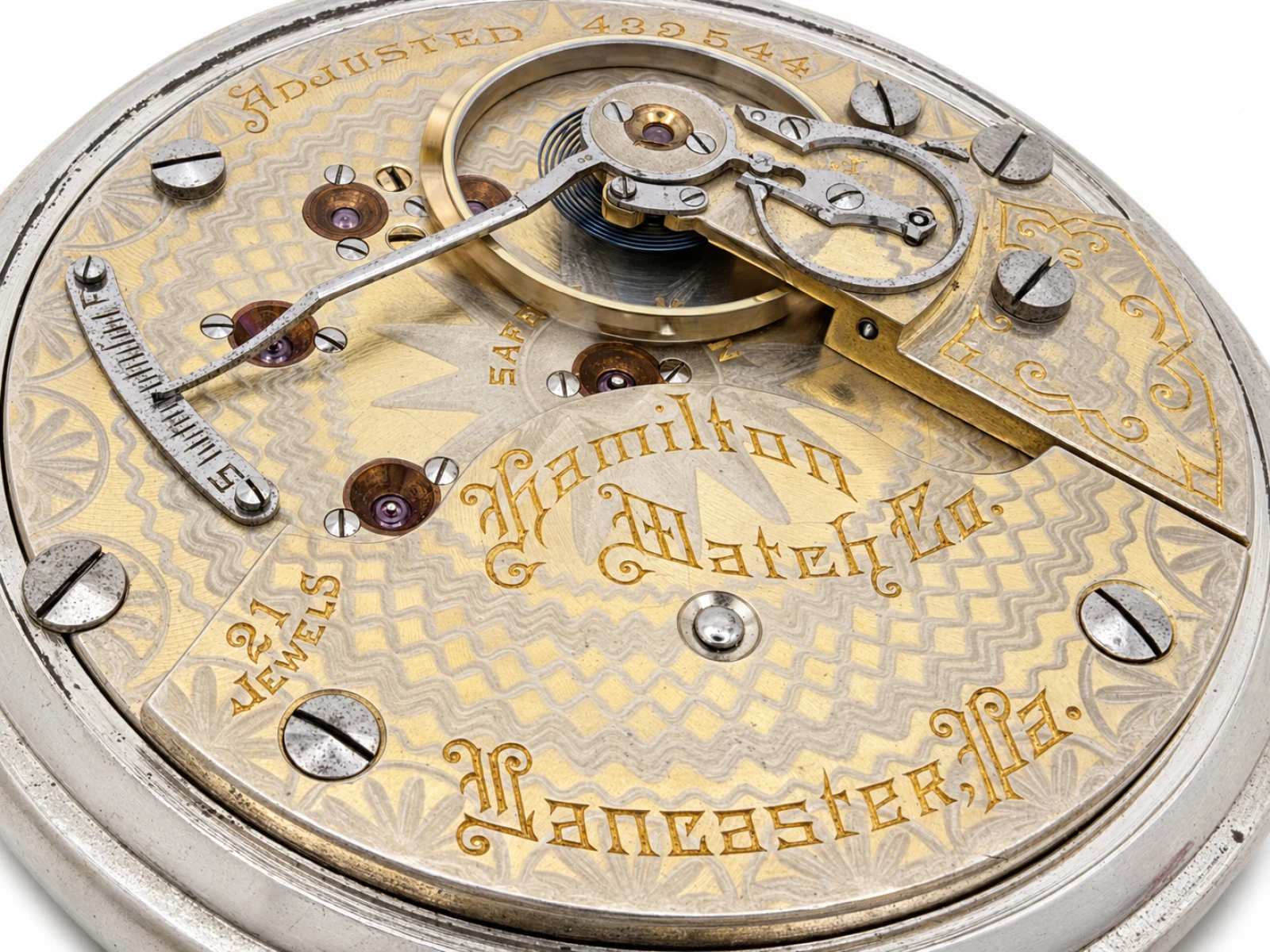
Decorative patterns of lines, waves and stripes cut into the plates by machine. An American specialty, and one of the first things collectors look at. How it works
Two-Tone (Gold Flash)
Damaskeened nickel plates with a thin layer of gold over part of the surface, so the pattern shows in gold and silver. Period catalogs called it gold over nickel.
Jewels
Jewels
Polished ruby or sapphire bearings for the pivots. They resist wear and hold oil. Most are synthetic, which is just as hard as natural stone. How it works
Hole Jewel
A ring-shaped jewel the pivot runs through.
Cap Jewel (Endstone)
A flat jewel over a hole jewel that the end of the pivot rests on. Found on the balance and, in finer grades, on the escape wheel and pallet fork.
Jewel Count (7, 11, 15, 17, 21, 23)
Seven jewels covers the balance and escapement. Eleven adds the pallet fork and escape wheel. Fifteen adds the third and fourth wheels. Seventeen adds the center wheel and was the minimum under the early railroad standards of the 1890s; 21 later became the norm. Twenty-one adds cap jewels to the pallet fork and escape wheel. Twenty-three usually adds the barrel arbor. How it works
Screwed Settings (Gold Chatons)
Jewels mounted in small gold collars held in the plate by screws, so a jewel can be replaced without disturbing the plate. Raised gold settings are a mark of a high-grade movement. How it works
Winding and Setting
Key Wind and Key Set
Wound by a key fitted to the barrel arbor through the back, and set by the same key fitted to the center of the hands. Still made in America through the 1880s, and in small numbers after that. How it works
Stem Wind
Wound by turning the crown. Standard in American watches from the 1870s on.
Lever Set
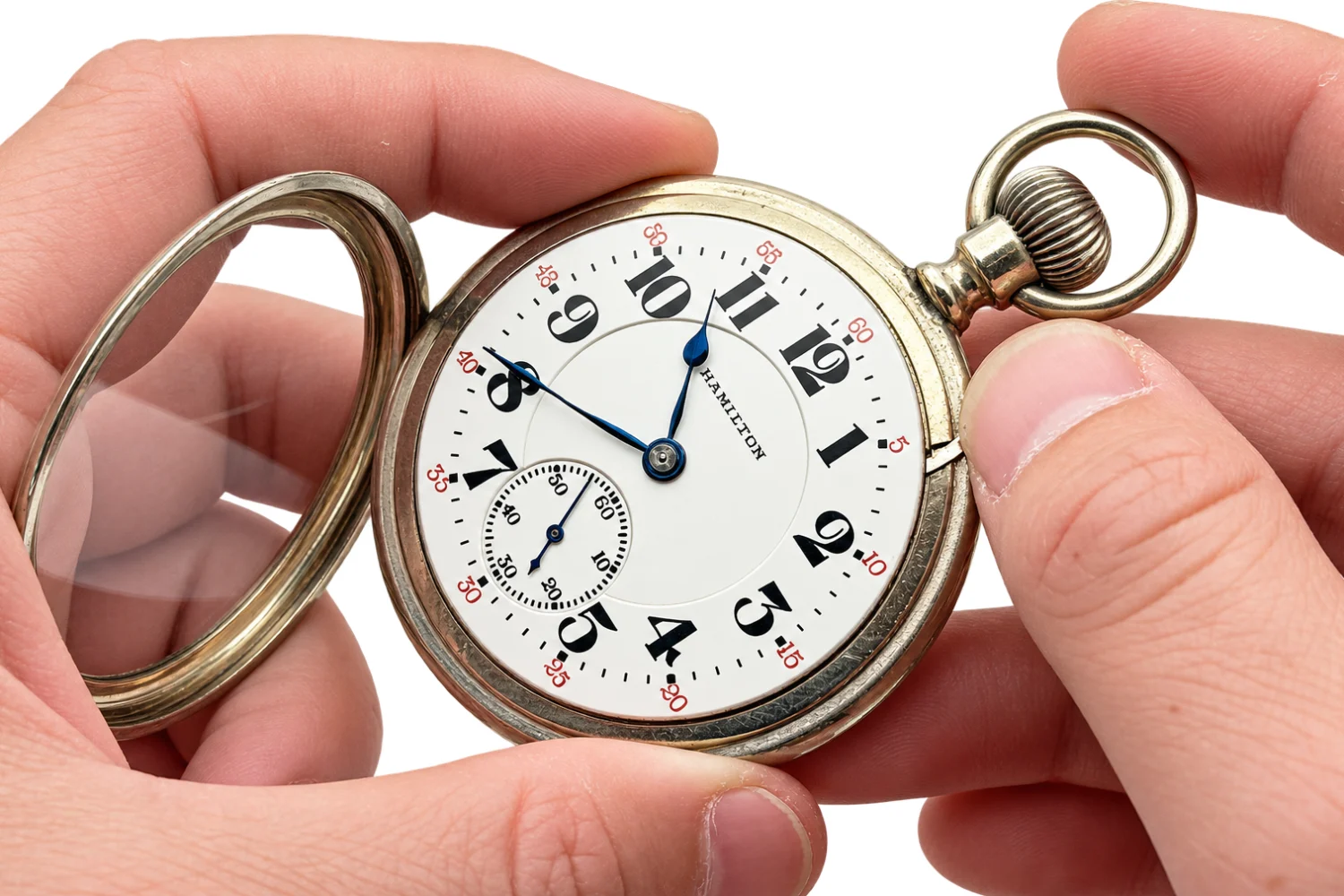
Set by removing the bezel, pulling out a small lever at the edge of the dial and turning the crown. The hands cannot be moved by accident, which is why American railroads required it. See how to open and set a lever-set pocket watch.
Pendant Set (Stem Set)
Set by pulling the crown out and turning it, then pushing it back in to wind. Convenient, and standard on dress watches, but not allowed in railroad service.
Pin Set
Set by holding in a small pin beside the pendant while turning the crown. Found mostly on Swiss and other European watches and on some early American stem-wind watches.
Hunting and Open Face Configuration
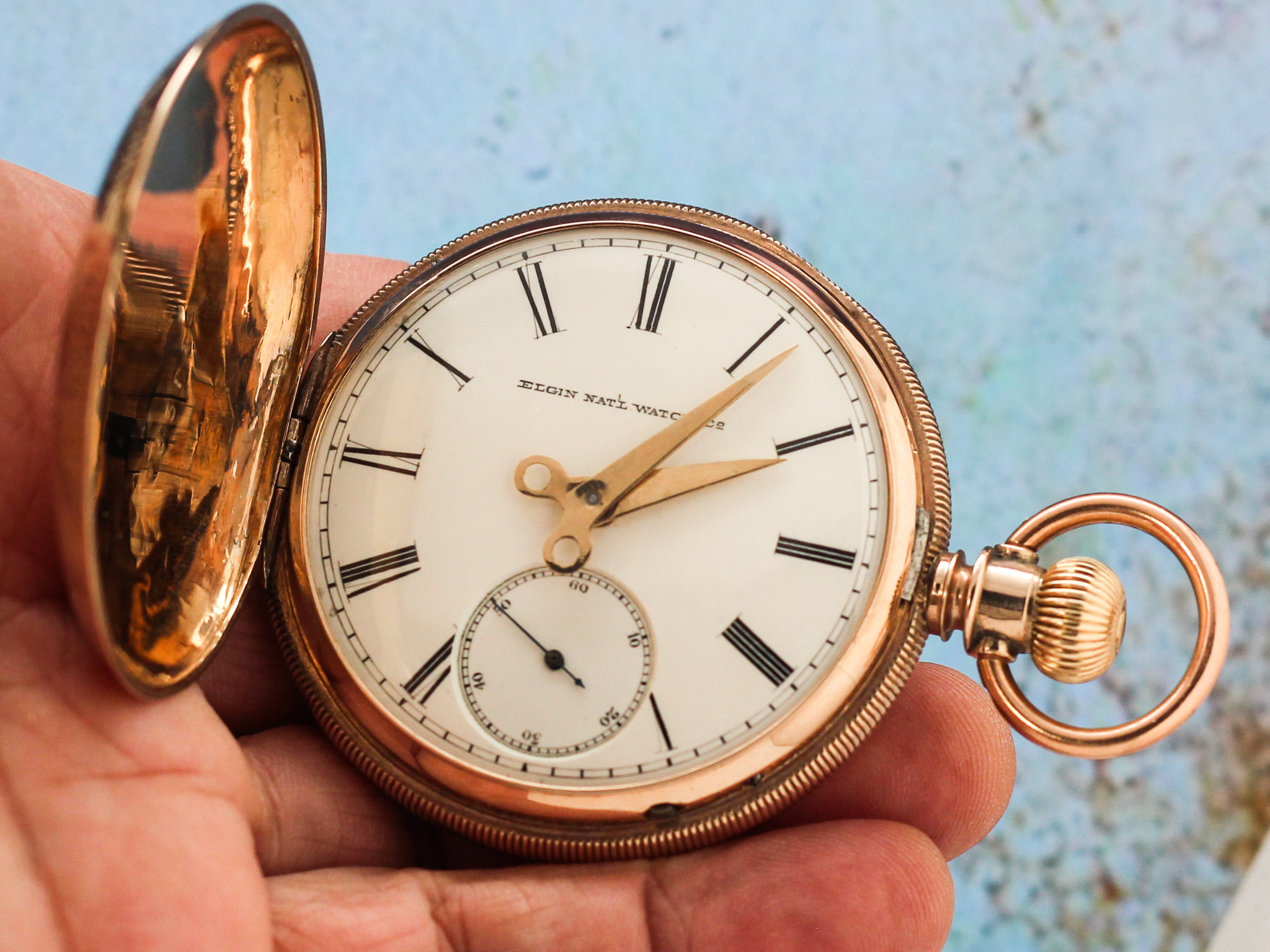
A hunting movement has the winding stem at 3 o'clock, for a case with a hinged front cover. An open face movement has it at 12 o'clock. Railroad watches had to be open face.
Adjustment
Adjusted
Corrected by hand at the factory to keep the same rate under different conditions. A plate marked simply "Adjusted" usually means adjusted to heat and cold, sometimes with a few positions as well. How it works
Adjusted to Positions
Keeps the same rate in different positions. Five positions: dial up, dial down, pendant up, pendant right and pendant left. Six adds pendant down. Railroad standards called for at least five.
Adjusted to Temperature
Keeps the same rate in heat and cold, through a compensating balance or a temperature-stable hairspring.
Isochronism
Keeps the same rate whether the mainspring is fully wound or nearly run down.
Don't see a term from one of our listings here? Give me a call at (310) 486-0572 and I'll explain it, and add it to this page.