Somebody hands you a pocket watch and it's stopped. You pull the crown out to set the hands the way you would on a wristwatch, and nothing happens. The crown won't budge. You turn it and the watch winds, but the hands don't move an inch. Nine times in ten what you're holding is a lever-set watch, and the thing that moves the hands isn't the crown at all. It's a small steel tab hiding under the crystal, and you have to open the watch to get at it.
This trips up almost everyone the first time. It isn't a fault and nothing is broken. It's a safety feature, and on the American railroads it was very close to a requirement.
Why Lever Set Exists
On a pendant-set watch — the ordinary kind, where you pull the crown out and turn — there is a way for the watch to end up in setting mode without anyone meaning it to. A crown catches on a pocket lining, gets pulled half a millimeter, and the hands are suddenly free to drift. On a wristwatch that's an annoyance. On a railroad it was a way to put two trains on the same piece of track.
Which is exactly what happened at Kipton, Ohio.
The Great Kipton Train Wreck, April 1891
The Lake Shore and Michigan Southern Railway ran a single line of track through Lorain County. Two trains were on it that morning: an eastbound fast mail, and a westbound passenger train out of Elyria. Single track means the two cannot pass, so the timetable does the work a second set of rails would otherwise do. The passenger train had orders to be in the siding at Kipton and wait while the mail train went through.
It didn't make it. The two met head-on at the Kipton depot on April 19, 1891. Nine men were killed. Six of them were postal clerks working the mail cars, men who had no way of seeing it coming and nowhere to go when it did.
The cause came down to a watch. The conductor's had stopped for four minutes, and then quietly started again on its own. When he checked it, it was running. It was also four minutes slow, and four minutes was the entire margin. His train reached the siding late. The mail train was exactly on schedule.
Nothing about that watch looked wrong. It was ticking in his hand when he read it. That's the part worth sitting with — a watch that stops and restarts gives you no sign at all that anything happened, and a man doing his job properly, reading his watch carefully, still gets the wrong answer.
What Came Out of It
The railway brought in a Cleveland jeweler named Webb C. Ball to find out how bad the problem was across the system. What he found was that there was no standard at all — every man carried whatever watch he owned, inspected by nobody, to no particular standard of accuracy.
Ball built the system that replaced it. By 1893 he had written performance and inspection standards, and set up the network of approved inspectors to enforce them: watches checked on a schedule, records kept, a watch that drifted taken out of service until it was put right. He became Chief Time Inspector for the line, and the model he built spread across American railroading. It's his name on the Ball watches that collectors chase today, and it came from this.
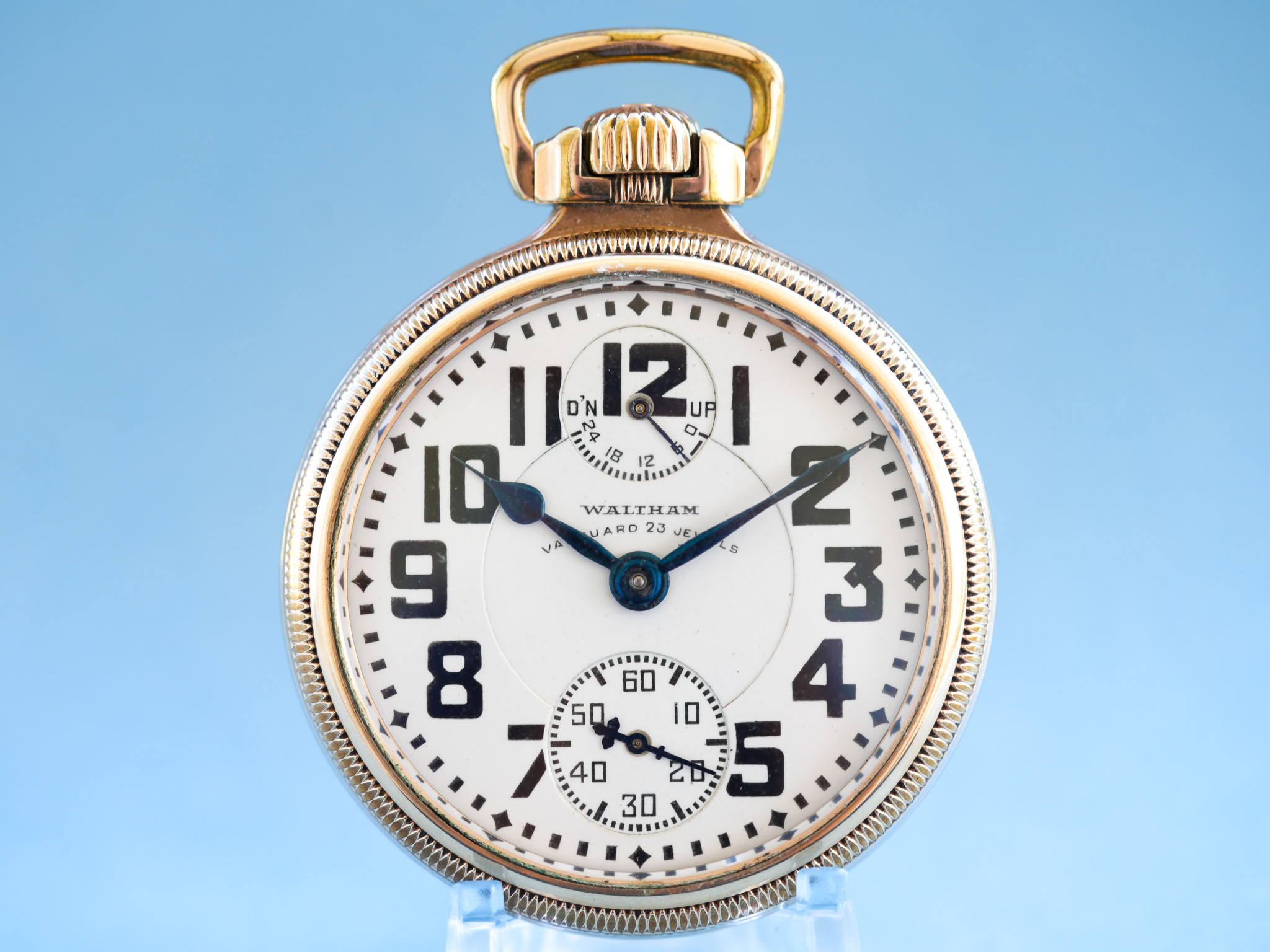
Among the things the standards called for was this one: a railroad watch should be lever set. To move the hands you had to deliberately open the case, pull out a lever, and turn the crown. Three separate actions, none of which happen by accident in a coat pocket. The standards also called for an open-face case, a minimum of 17 jewels, adjustment to five positions and to temperature, a plain white dial with bold black Arabic numerals, and accuracy to within 30 seconds a week.
Worth being precise about one thing, because it often gets overstated: these were standards, not statute. Each railroad set its own rules and adopted the recommendations that suited it, so you will find approved watches that depart from the list in one respect or another. But lever setting was adopted so widely, for so long, that in practice it became what a railroad watch was.
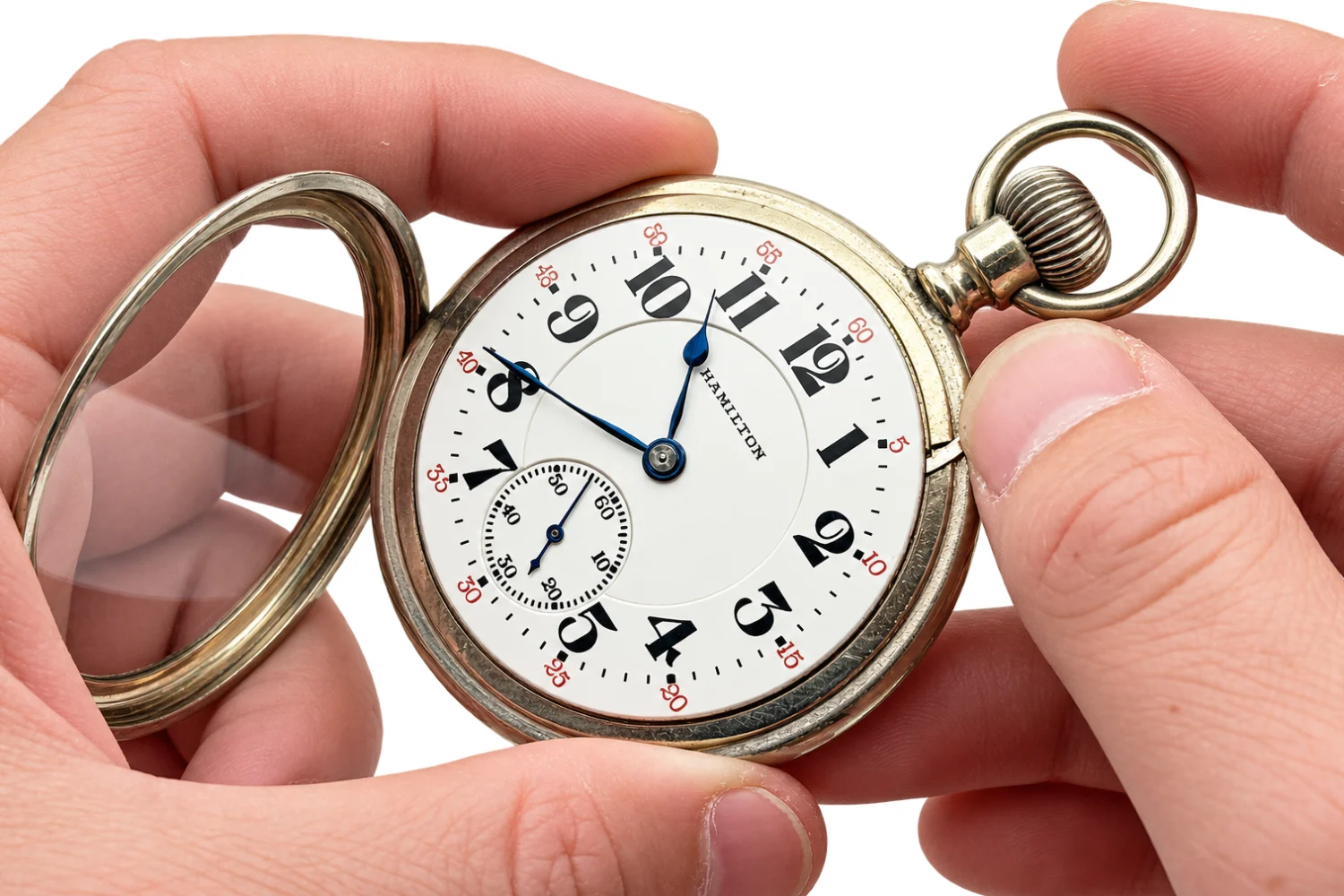
That's why nearly every railroad-grade American watch you'll pick up — Hamilton 992s and 950s, Illinois Bunn Specials, Elgin Veritas, Ball movements of every stripe — sets this way.
So the small inconvenience you're running into now is the whole point. Nine men died because a watch could be wrong without looking wrong, and the industry's answer was to make setting the hands something you could only do on purpose. The watch is doing exactly what it was built to do.
Before You Start
You need one tool, and it matters which one. A proper case knife has a short, thin, dull blade — it's made to spread a seam, not to cut. Bergeon makes the ones you'll see on most benches, and they cost very little. A thin pocket knife will do in a pinch. What will not do is a screwdriver, a butter knife, or anything with a point or an edge on it. Those slip, and when they slip they go across the dial or into the crystal, and now you have a repair instead of a watch.
If you don't have a case knife and don't want to buy one for a single watch, a local jeweler or watchmaker will open it for you in a minute and charge you nothing, or close to it. There's no shame in that — it's the cheapest insurance there is against a scratched dial.
Two other things worth saying before you open anything up. Work over a soft cloth on a table, not over a hard floor, because bezels roll. And when you have the front open, keep your fingers off the dial. Enamel dials show every fingerprint, and the oils will sit there for decades if nobody cleans them off.
Which Case Do You Have?
How you get in depends entirely on the case, and the case tells you which kind it is if you look at it for a moment.
Hold the watch face up and try turning the bezel — the metal ring holding the crystal — counterclockwise, with your fingers on the metal and not the glass. If it turns, you have a screw-on bezel and you won't need a tool at all. If it's solid and won't move, look around the edge of the case at roughly one or two o'clock for a small notch or a slight lip. That's a snap-on bezel, sometimes called friction-fit or press-fit, and the notch is where the knife goes. And if the whole front of the watch is covered by a hinged metal lid, you have a hunter case, and there's a button to press before anything else happens.
Three cases, three ways in. Here's each one.
Screw-On Bezel
This is the easiest of the three and the one that needs nothing but your hands. The bezel is threaded into the case like a jar lid, and it comes off the same way.
Grip the case body in one hand and the bezel in the other, fingers on the knurled metal edge, and turn counterclockwise. Take hold of the bezel, not the crystal — pressure on the glass is how old crystals crack, and a period-correct crystal is not a five-minute replacement.
It should start with light pressure. If it fights you hard, stop and look again, because you may be holding a snap-on case and be about to force something that was never meant to turn.
Once it's free, keep turning until it lifts away, and set it down crystal-up on your cloth. Never rest it face-down on the inside of the crystal.
If a bezel won't start at all and you're confident it's threaded, don't reach for a tool. Warmth in your hands helps, and so does a moment of firm, steady pressure rather than a sharp twist. Old cases collect a century of dust and dried oil in the threads, and that's usually all it is. A bezel that genuinely won't move is a job for a bench, not for leverage.
Watch the threads as it comes off, too. Gold-filled cases wear at the bezel before anywhere else, because that's the part that's been turned a few thousand times. If you can see brass coming through on the threads, the case has been opened a great deal over its life — which tells you something about the watch, and is worth knowing before you buy one.
With the bezel off you'll see the lever lying flush against the dial, out near the edge at about the five- or six-minute mark. It's small and it sits close to the dial, and on a dusty watch you may not spot it until you tilt the face to the light.
Snap-On Bezel
A snap-on bezel — friction-fit, press-fit, snap bezel, they all mean the same thing — is held on by nothing but the grip of metal on metal. There are no threads. It was pressed into place, and it comes off by being lifted out.
This is the one that needs the knife. Look around the rim for the nail notch: a small dimple or a slightly raised lip, usually somewhere around one o'clock. Not every case has one, but most do, and it's there precisely so you have a place to start.
Set the blade into the seam at the notch and use a small twisting motion — turn the knife rather than pushing it deeper. You want to lever the bezel up and off, not pry it sideways.
It gives suddenly, so keep your other hand cupped underneath. That first pop is startling the first time, and bezels bounce.
If your case has no notch at all, you're looking for the seam itself. Hold the watch to the light and turn it slowly; the joint between bezel and case shows up as a fine dark line. Start at one o'clock anyway — it keeps you well away from the hinge on cases that have one, and away from the crown.
The thing to avoid here is levering against a single point. Gold-filled bezels are thin, and prying hard in one spot will put a flat in the rim that you'll see forever afterward. If the first attempt doesn't lift it, move a quarter-turn around and try again rather than leaning harder on the same place. A bezel that has been off before usually comes off easily; one that has been sitting for fifty years may want three or four tries from different points.
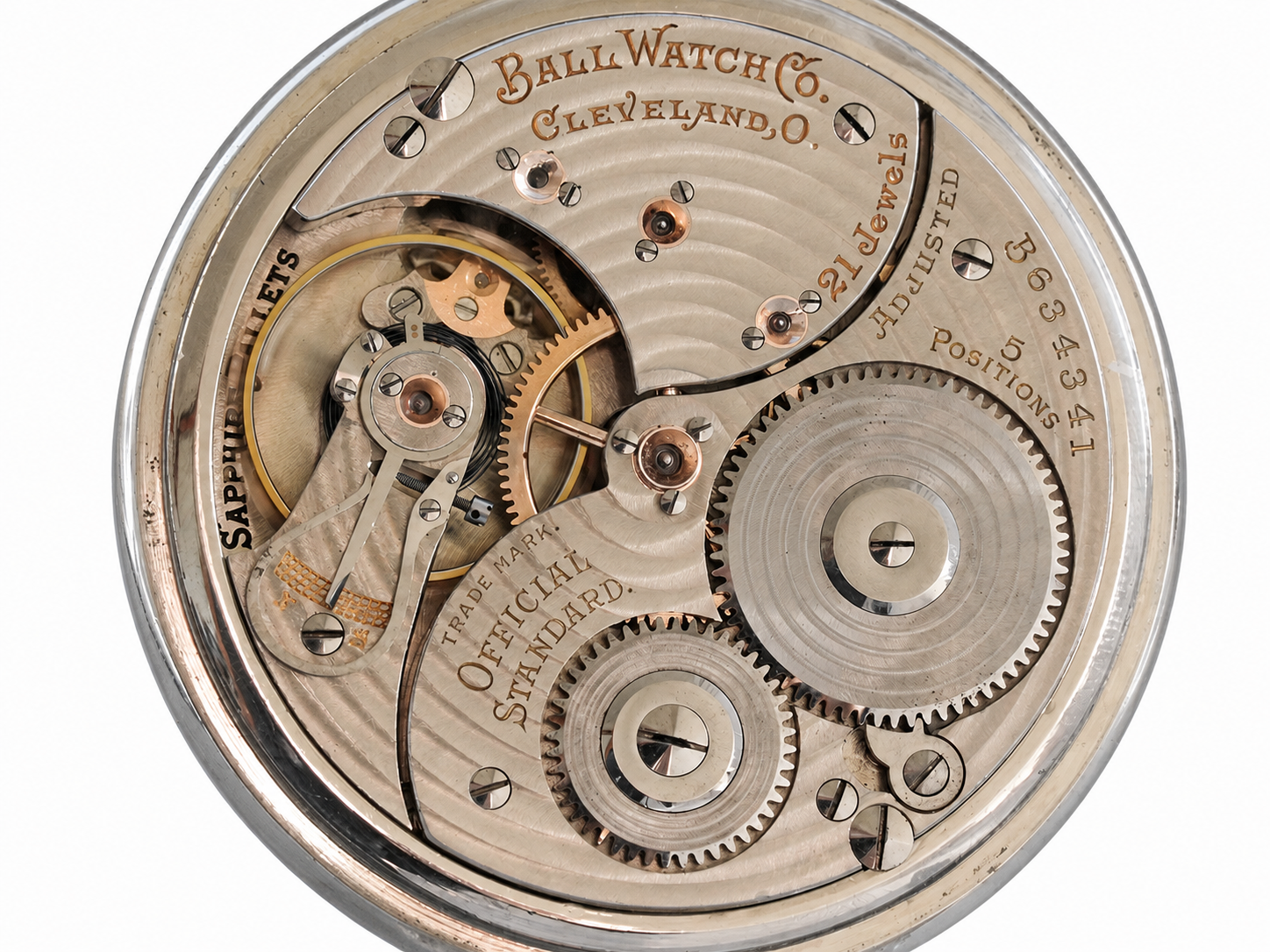
The watch here is a display case, which means it has a crystal at both ends — one over the dial and a second one in the back. The movement is on view the whole time, closed up or not. It's a lovely thing to own and it makes photographing a watch much easier, but it changes nothing about how the front bezel comes off.
As with the screw-on, the lever sits flush against the dial near the outer edge, around the five- or six-minute position.
Hunter Case
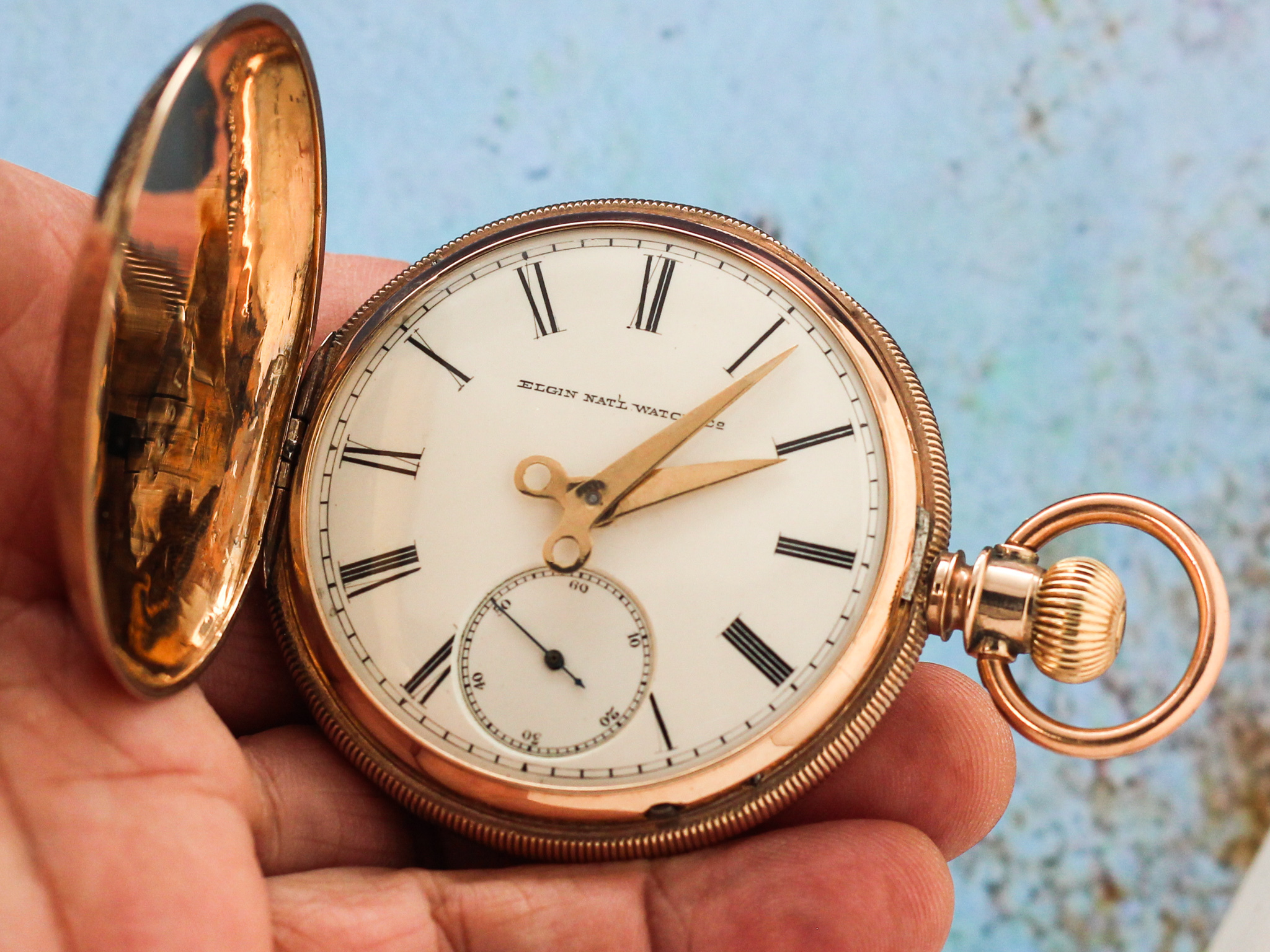
A hunter case has a hinged metal lid over the face, which is what makes it a hunter. The lid is the reason these watches survive in the condition they do — the crystal spent a century behind a slab of gold instead of rubbing against a pocket lining.
Do not pry a hunter lid. There's a catch, and it's released by the crown. Press straight down on the crown and the lid springs open on its own. If it doesn't, press a little more deliberately rather than harder — the catch is a shallow one and a worn case sometimes wants a firmer, more definite push. What it never wants is a knife.
Closing it is where the technique matters. Press the crown down and hold it down while you swing the lid shut, then release the crown once the lid is closed. Done that way the catch never engages under spring pressure — the lid closes silently and simply settles into place.
Let the lid snap shut against the catch instead and you get that satisfying click, but the click is metal striking metal. It's a tiny amount of wear every single time, and a century of it is why so many hunter lids no longer stay closed. Watch my thumb on the crown in the video; that's what it should look like.
On a hunter the lid opening gives you the dial, and on most of them that's all you need: the lever is right there at the dial edge, typically around the twenty-six-minute mark rather than at six. Hunter movements are laid out with the crown at twelve and the seconds at six, so the lever ends up somewhere different from where you'd look on an open-face watch. If you don't see it at first, work your way around the rim.
Notice how little the watch is handled in the video. That's the other advantage of a hunter: the lid does the work, so your fingers never go near the crystal or the dial. Open it, read it, close it, and the glass has been touched by nothing at all.
Setting the Time
Now that the dial is open, the rest is the same on every watch.
Find the lever at the dial edge and pull it gently outward. A thumbnail is the right tool. A toothpick works. Anything sharp or metal does not — you are working against an enamel dial, and enamel chips. There is no force involved here at all; the lever slides out with a light pull, and if it feels stuck it's dirty rather than locked.
With the lever out, turn the crown. Now the hands move. Set them forward to the time you want — going forward is gentler on the motion work than backing up, and it costs you nothing to go the long way around. If the watch is stopped, give it a wind first so it's running when you set it.
Then push the lever back in until it lies flush with the dial again. This part matters: if the lever is still standing proud, the bezel will not seat properly, and you'll be putting pressure on the crystal trying to close a case that can't close. Check it's fully home before you go any further.
Closing It Back Up
More watches are damaged here than on the way in, so it's worth slowing down.
Screw-on bezel. Set the bezel flat on the threads and turn it counterclockwise first, until you feel a small click. That click is the threads dropping into register. Now turn clockwise and it will run down smoothly. Starting clockwise from cold is how these get cross-threaded, and cross-threading a hundred-year-old gold-filled case is not something you want to have done. Snug it down firmly, then stop. It doesn't need to be tight.
Snap-on bezel. Line it up square and press down evenly around the rim until it snaps home. Press the metal, never the glass. Work around the circle rather than pushing at one point, or you'll seat one side and leave the other proud.
Hunter case. This one has a trick to it that's worth knowing. Press and hold the crown down, close the lid, and only then let the crown go. Snapping a hunter lid shut against the catch works, but it wears the case spring and the catch a little every time, and over a century of doing it that way is why so many hunter lids no longer stay shut. Hold the crown, close, release. Your case will thank you.
If There's No Lever
You've got the front open, you've looked around the dial edge, and there's no lever anywhere. Then it isn't a lever-set watch, and there are two other things it's likely to be.
Key set. On earlier watches — generally pre-1890s, and quite a few after — there's no crown mechanism at all. The crown is just a bow to hang the watch from, and everything is done with a small key that fits over a square steel arbor.
There are two arrangements, and it's worth knowing which you have before you go hunting for something that isn't there.
Two squares in the back. Open the back cover and you'll see two square arbors poking through the plate. One winds the mainspring, the other sets the hands. Both jobs are done from the back, and the dial never has to be uncovered at all. This is the more common of the two.
One square in the back. If there's only a single square back there, it winds the mainspring and nothing else. The setting square is on the front — a small square on the hand arbor at the centre of the dial, right where the hands are pinned. You have to get the bezel and crystal off to reach it, exactly as described earlier in this article, then fit the key over that centre square and turn.
So if you've opened the back of a key-wind watch, found one square, wound it happily, and can't work out how to move the hands — the answer is on the other side of the watch.
Pendant set. The ordinary arrangement, and the one every wristwatch uses: pull the crown straight out a click and turn. The winding crown becomes the setting crown. If the crown pulls out and the hands move, that's what you have, and it's always worth trying before you reach for a knife.
One oddity worth knowing about is the sidewinder. A hunter movement is built with the crown at twelve and the small seconds at six. Take that movement out of its hunter case and fit it into an open-face case — which was done often enough, usually because the original case was worn out, damaged, or worth more as scrap gold — and the dial ends up rotated. The crown now sits at three o'clock, and the seconds sub-dial sits at nine. That recasing is where the name comes from, and it's why a sidewinder looks wrong at a glance even when nothing about it is.
Everything here applies to a sidewinder exactly as written. The one difference is that the setting lever won't be where the case type led you to expect, so work your way around the rim until you find it.
A Last Word
None of this is difficult, and none of it should be nervous work. These watches were made to be opened, and the men who carried them for a living opened them constantly.
Under the railroad time service rules, a conductor or engineer compared his watch against a designated standard clock before every shift, logged the comparison on a form, and kept the watch within thirty seconds of correct. If it had drifted, the hands came back into line — which meant getting into the case. On a lever-set watch there was no other way to do it.
Take the extra second to grip the bezel and not the glass, hold the crown when you close a hunter, keep your fingers off the dial, and you'll do the watch no harm at all.
But if you're not comfortable opening it, don't. And if you get in and something doesn't look right — a lever that won't move, a bezel that won't seat, a movement that's been got at — stop where you are and take it to a local jeweler or watchmaker. Any decent bench will get a bezel off and a lever moving in a couple of minutes, and it costs a great deal less than putting right a dial someone slipped a screwdriver across.