Every pocket watch I sell has a paragraph about the movement: the jewels, the balance, the hairspring, the regulator, how it sets. Those few lines say a great deal about how a watch was built and what it was built for, but only if you know what the words mean. This article is the long version. It follows the power through a movement from the mainspring to the balance, one part at a time, the same way I see it every time I take one apart on the bench.
If you only need a quick definition, the companion Pocket Watch Movement Terms glossary has short definitions of every term, grouped by part of the watch.
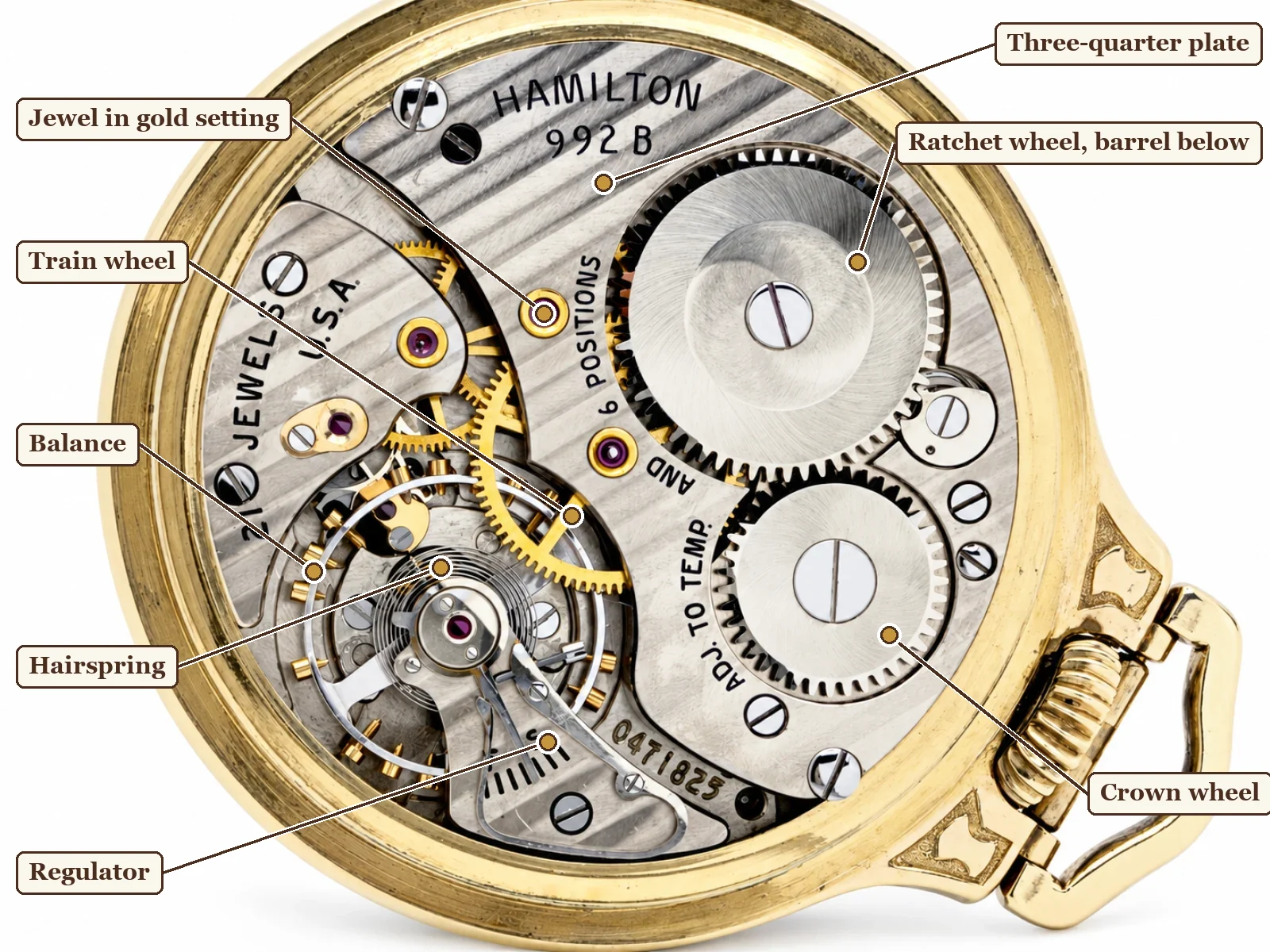
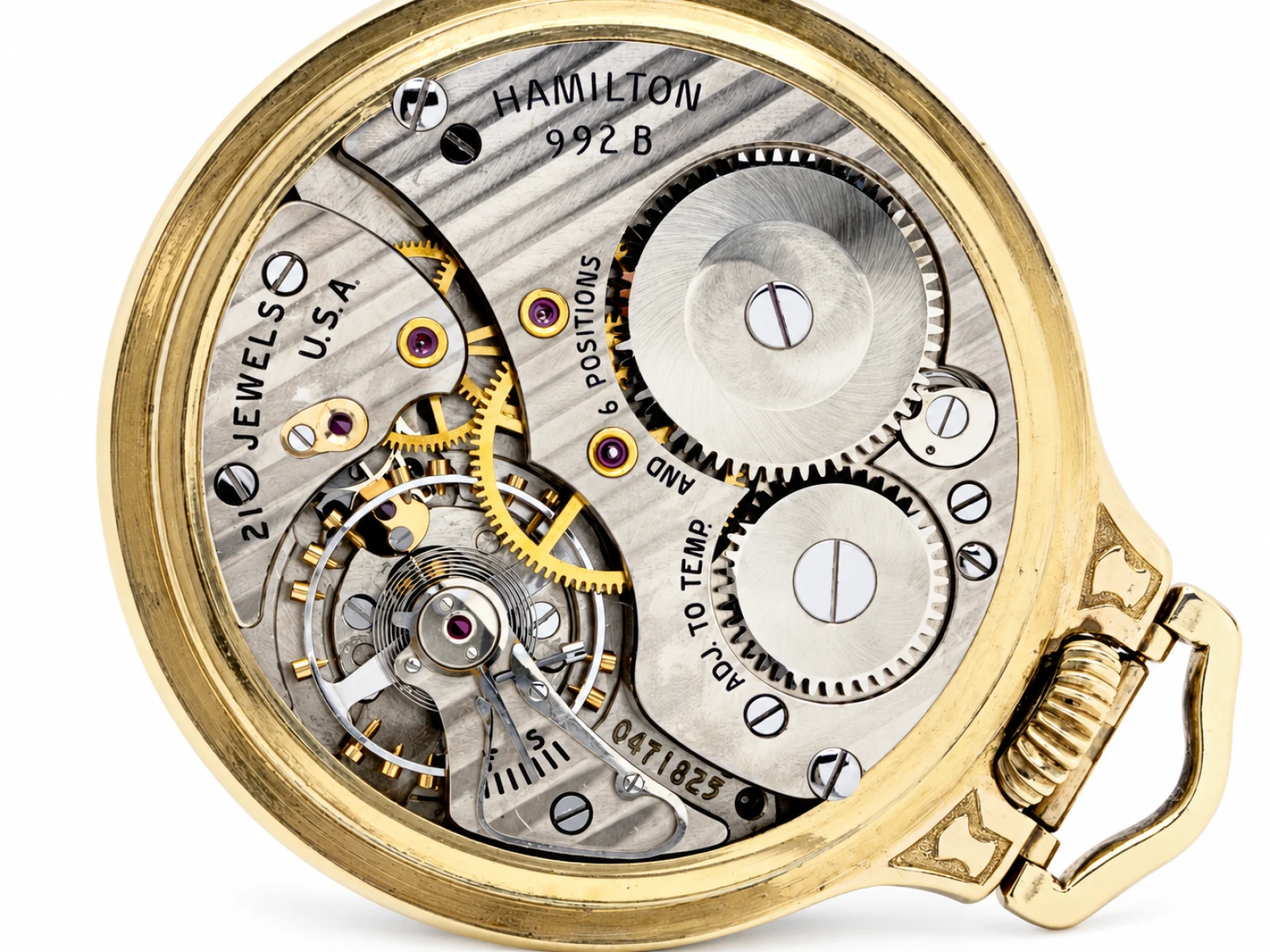
A Hamilton 992B from 1961, the last American railroad watch, with the main parts labeled. Every part named here is covered below.
The Big Picture
A mechanical watch does three jobs. It stores energy, it lets that energy out in small, exactly equal portions, and it counts those portions on the dial. Everything inside the case belongs to one of those jobs.
- The mainspring stores the energy when you wind the watch.
- The train, a row of gears, carries that energy toward the balance and turns the hands along the way.
- The escapement lets the train move forward one tooth at a time.
- The balance and hairspring swing back and forth at a steady rate and decide how often the escapement lets a tooth go. This is the part that actually keeps time.
- The regulator lets a watchmaker make that rate a little faster or slower.
The plates hold it all together, the jewels keep it from wearing out, and the winding and setting parts let you wind it and set the hands. That is the whole watch. The rest is how well each part is made.
The Mainspring: Where the Power Comes From
The mainspring is a long ribbon of tempered steel coiled inside a round drum called the barrel. When you turn the crown, the winding wheels turn the barrel arbor and wind the spring tight around it. A small spring-loaded click drops into the teeth of the ratchet wheel on top of the barrel, so the spring cannot unwind backward. That clicking you hear and feel as you wind is the click doing its job.
With the spring wound, it pushes against the inside of the barrel and turns it. Teeth around the outside of the barrel drive the rest of the watch. A fully wound American pocket watch will generally run a day and a half or more, and a railroad man wound his at the same time every day so it never ran low.
Mainsprings are under a great deal of tension, and in the days of carbon steel they did sometimes break. When one snapped, the barrel could spin backward hard enough to strip teeth in the train. Waltham's answer was the safety pinion, patented by Fogg in 1865: the pinion that the barrel drives is threaded onto its arbor, so a sudden backward jolt unscrews it instead of breaking teeth. You will see "Fogg's Patent" engraved on a great many Waltham movements, and other makers used safety pinions of their own. Later unbreakable mainsprings, such as Elgin's DuraPower and Hamilton's Dynavar, made breakage much less common.
The Train: Gears That Count the Time
The train is the row of wheels that runs from the barrel to the escapement. In an American pocket watch it nearly always runs in the same order:
- The barrel drives the center wheel, which turns once an hour. The minute hand rides on it, by way of the cannon pinion.
- The center wheel drives the third wheel.
- The third wheel drives the fourth wheel, which turns once a minute. The seconds hand sits on its arbor at the six o'clock position on the dial.
- The fourth wheel drives the escape wheel, the last wheel in the train.
Each wheel drives the small toothed pinion of the next, so the speed goes up and the force goes down at every step. By the time the power reaches the escape wheel it is very gentle, which is exactly what the balance needs. The hour hand is geared off the minute hand on the dial side by the minute wheel and hour wheel, which together make the twelve-to-one reduction.
When a listing mentions a gold center wheel or gold train, it means those wheels were made in gold alloy rather than brass. Gold does not tarnish, and it was a mark of a high-grade movement.
The Escapement: Letting the Power Out One Tick at a Time
Left alone, the mainspring would spin the train in a few seconds and be done. The escapement holds it back and lets it move forward one tooth at a time, and on every step it gives the balance a small push to keep it swinging. Almost every American pocket watch uses the lever escapement, which has three parts:
- The escape wheel, a steel wheel with fifteen specially shaped teeth.
- The pallet fork (also called the lever), which rocks back and forth. It carries two pallet stones, small polished jewels that catch and release the escape wheel teeth. At the other end is a notch, the fork slot.
- The roller, a small disc on the balance staff that carries the roller jewel (also called the impulse jewel), a tiny upright jewel pin.
The lever escapement in motion: the escape wheel (gold) is caught and released by the two pallet stones (red) on the rocking pallet fork. Animation by Mario Frasca, Wikimedia Commons, CC BY-SA 3.0.
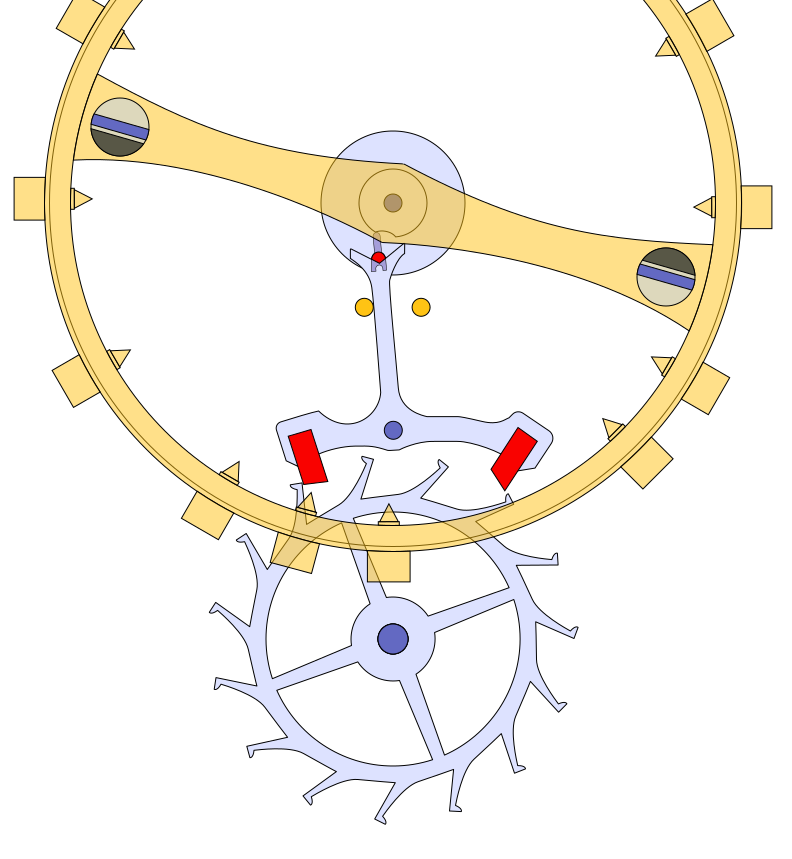
The whole escapement from above: balance and roller jewel (top), pallet fork and pallet stones (middle), escape wheel (bottom). Diagram by Fred the Oyster, Wikimedia Commons, CC BY-SA 4.0.
Here is one beat. The balance swings, and its roller jewel enters the fork slot and knocks the fork to one side. That moves a pallet stone out of the way and frees the escape wheel. The wheel turns a little, and as its tooth slides across the slanted face of the pallet stone it pushes the fork, and the fork pushes the roller jewel. That push is the impulse that keeps the balance swinging. A moment later the other pallet stone drops into the path of the next tooth and locks the wheel again. The balance swings on freely, comes back, and the same thing happens in the other direction.
The tick you hear is the escape wheel tooth landing on a pallet stone. Most American railroad-grade watches tick 18,000 times an hour, five beats every second. Watchmakers call that a quick train. Many earlier 18-size movements ran a slow train of 16,200 beats an hour.
Single Roller and Double Roller
Between beats, the fork has to stay put. If a jolt knocked it across while the balance was swinging free, the watch could stop or gain time. A safety roller guards against that. On a single roller escapement the roller jewel and the safety action share one disc. A double roller escapement gives the safety action its own smaller disc, which works more reliably. That is why the double roller became a standard feature of the railroad grades, and why it gets a mention in my descriptions.
The Balance: The Heart of the Watch
The balance is the wheel you can see swinging back and forth through the back of the watch. It is not driven around in a circle like the train wheels. It swings one way, stops, and swings back, and the time each swing takes is what the watch measures time by. The balance turns on a fine steel axle, the balance staff, whose pivots are about as thick as a human hair, and it sits under a bridge called the balance cock.
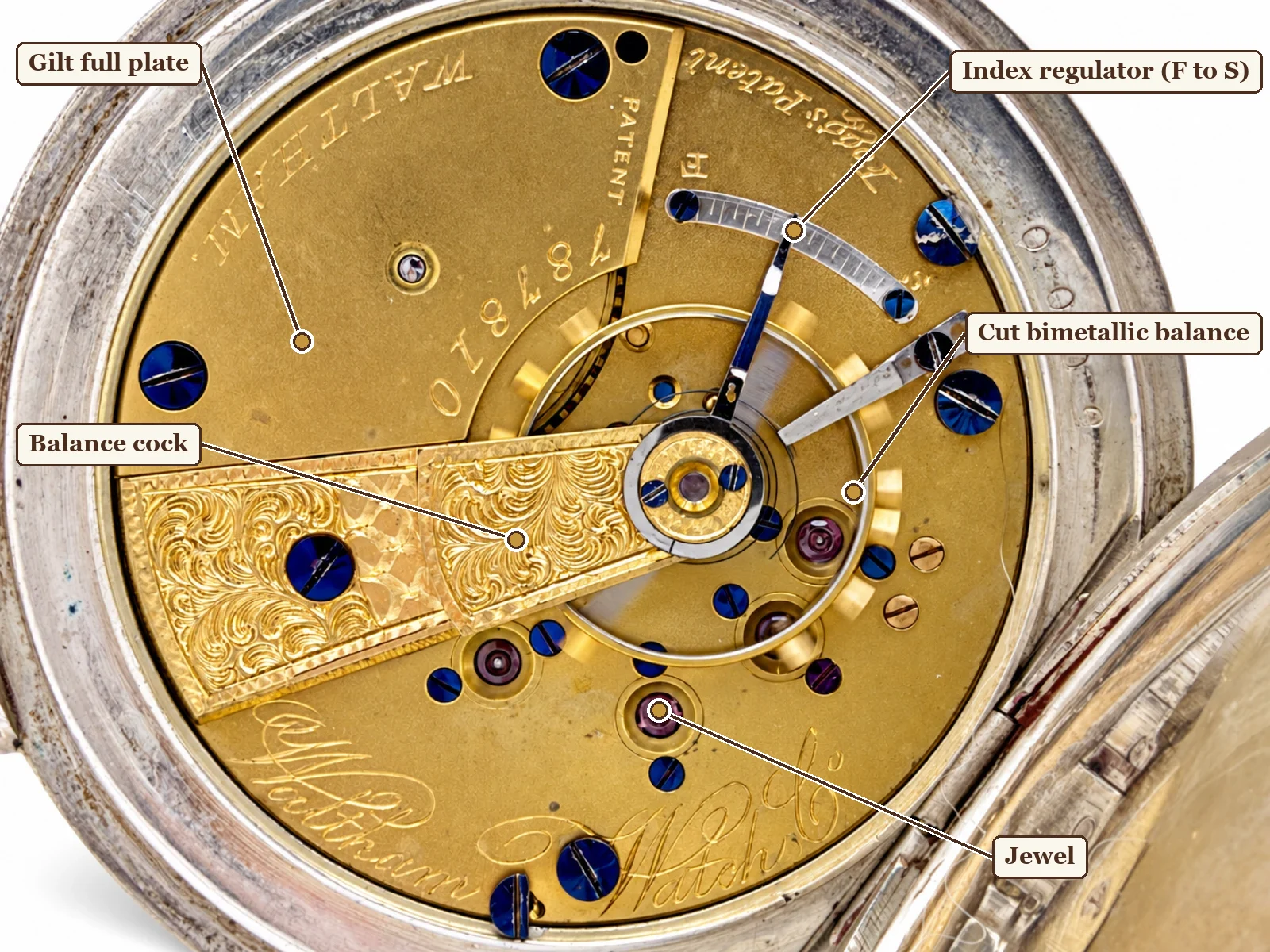
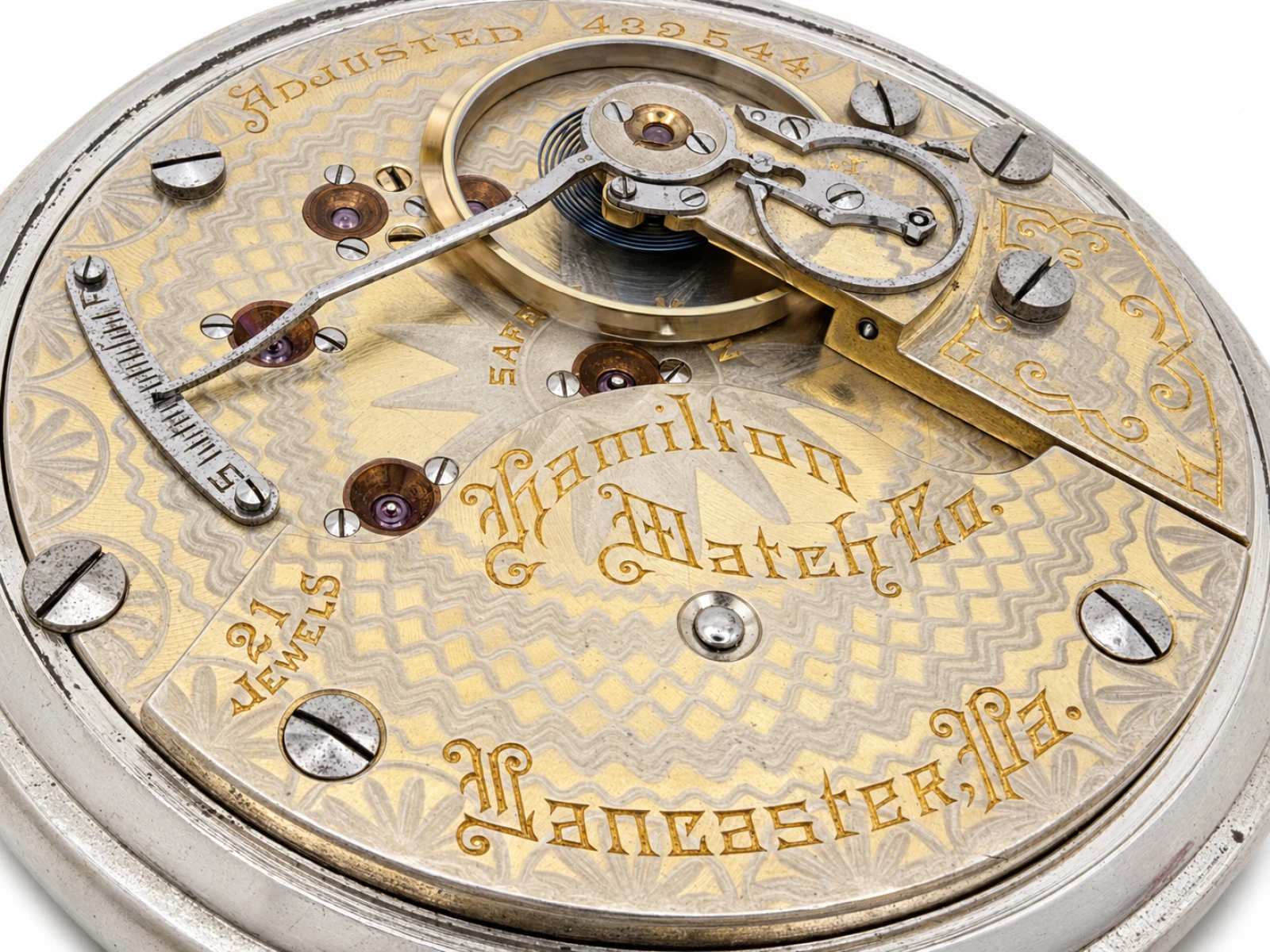
A Waltham Model 1857 from 1875: a gilt full plate movement with an engraved balance cock, a cut bimetallic balance and a simple index regulator.
The Cut Bimetallic Balance
Heat is the old enemy of a watch. As a steel hairspring warms up it gets weaker, and the watch runs slow. The fix, worked out in the 1700s and used in nearly every fine American watch of the 1800s and early 1900s, is the cut bimetallic balance, also called a split or compensating balance.
The rim is made of two metals fused together: brass on the outside and steel on the inside. It is cut through at two points near the arms. Brass expands more than steel in heat, so when the watch warms up, each loose end of the rim curls slightly inward. That makes the balance effectively smaller, and a smaller balance swings faster, which makes up for the weaker hairspring. In the cold, the opposite happens. When a listing says a watch is adjusted to temperature, it means the factory set this compensation by hand, moving screws along the rim until the watch kept the same rate hot and cold.
The balance screws around the rim do two jobs. They let the watchmaker poise the balance, so it is evenly weighted all the way around, and they let the rate be fine-tuned. Some grades carry a few timing screws (also called mean-time screws) that can be turned in or out for this.
The Solid Monometallic Balance
From the 1930s on, American factories had a better answer. Special alloys like Elinvar made hairsprings that hold their strength through heat and cold. With a hairspring that does not weaken, the balance no longer needs to compensate, so it can be a solid, uncut ring of one metal. Hamilton took up Elinvar around 1930 to 1931 and used it in the 992E. Its later 992B went on with a solid monometallic balance and Hamilton's own hairspring alloy. A monometallic balance is simpler, stronger and less fussy than a cut one, and it marks the last generation of American railroad watches.
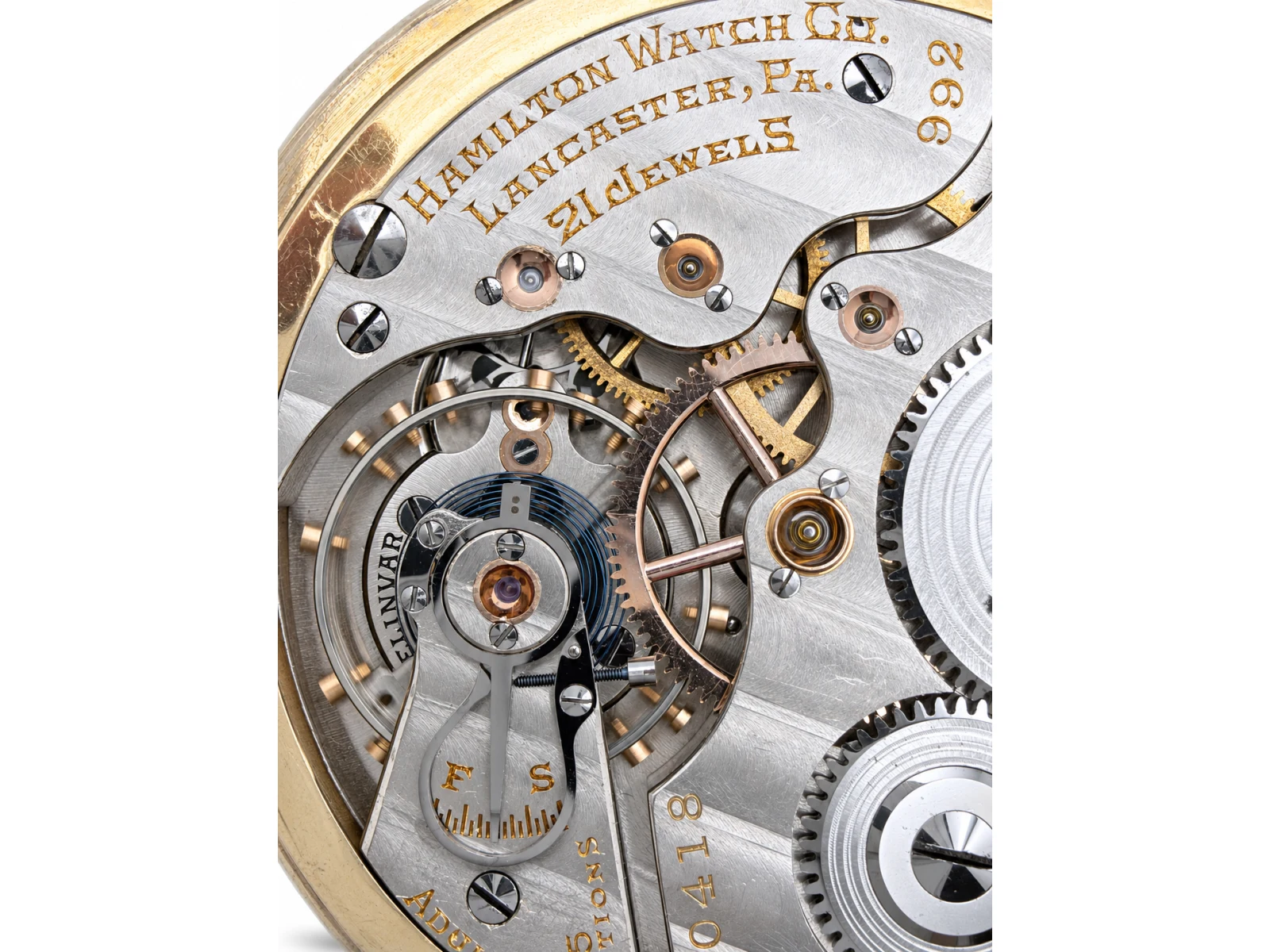
A Hamilton 992E from 1936. The balance is a solid ring, and "Elinvar" is engraved right beside it, naming the hairspring alloy that made the change possible.
The Hairspring: The Spring That Sets the Beat
The hairspring, or balance spring, is the fine coiled spring under the balance. Its inner end is pinned to a collet on the balance staff, and its outer end is held in a stud on the balance cock. As the balance swings, the hairspring winds and unwinds, and it pulls the balance back toward center each time. The strength of the hairspring and the weight of the balance together decide how fast the balance swings. Those two parts are the watch's time standard. Everything else in the movement just keeps them going and counts the swings.
Flat and Breguet Hairsprings
A flat hairspring is a simple spiral lying in one plane. It works, but because its outer end is fixed off to one side, the coils open and close a little off center as the spring breathes. That pushes sideways on the balance pivots and costs some accuracy, particularly as the watch changes position in the pocket.
Around 1795, Abraham-Louis Breguet in Paris solved this by bending the outermost coil up and over the rest of the spring and curving it back in toward the center. That raised outer coil is called an overcoil, and a hairspring made this way is a Breguet hairspring. It opens and closes evenly around the center, so the watch keeps steadier time whether it is lying flat or standing in a vest pocket. Nearly every American watch adjusted to positions has one. When you see "Breguet hairspring" in a listing, that is what it means.
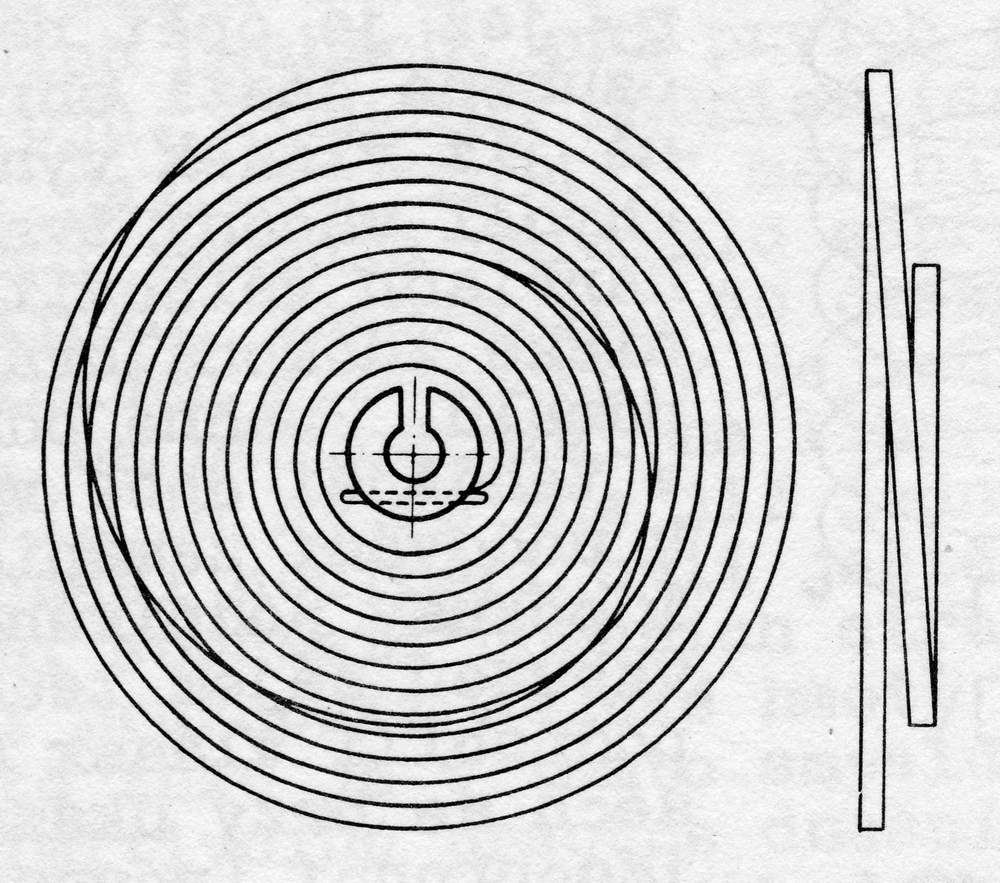
A Breguet hairspring from above (left) and from the side (right). The side view shows the outer coil lifted up over the spring before it curves back toward the center. Drawing from Hodinové stroje (1934), public domain, via Wikimedia Commons.
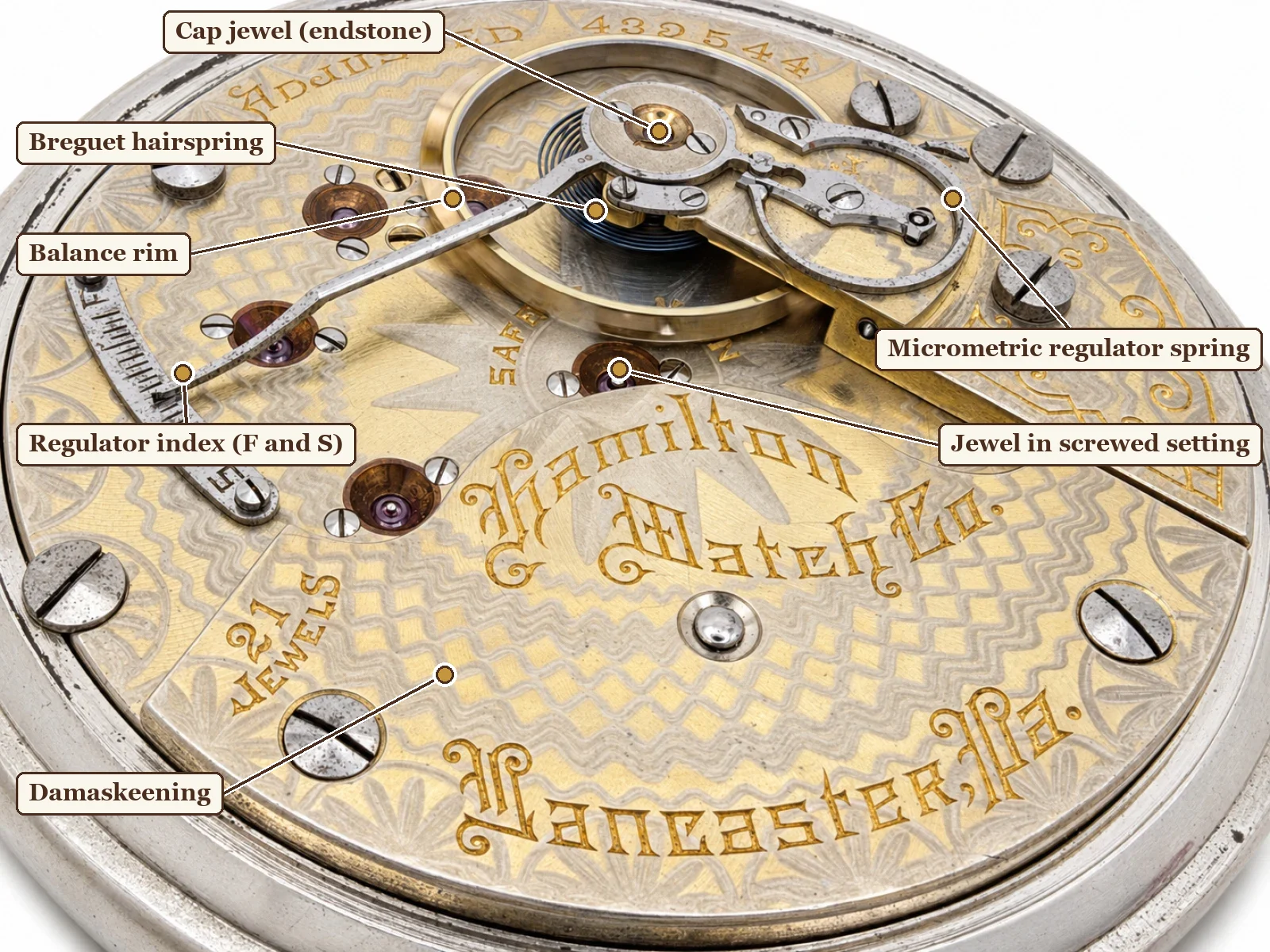
A Hamilton 940 from 1904. The blue Breguet hairspring sits under the balance cock, with a micrometric regulator alongside.
The Regulator: Fine-Tuning the Rate
Even a well made watch needs a way to be set a little faster or slower, and that is the job of the regulator. Two small curb pins on the regulator straddle the outer coil of the hairspring, close to the stud. Moving the curb pins along the coil changes the working length of the spring. Shorten it and the spring gets stiffer, the balance swings faster and the watch gains. Lengthen it and the watch loses.
The Index Regulator
The basic form is a long pointer, the index, that sweeps a small scale engraved on the balance cock. The scale is marked F and S for fast and slow on American watches, or A and R (avance and retard) on Swiss ones. The watchmaker nudges the index by hand. It works, but a nudge by hand is a coarse adjustment, and getting the last few seconds a day out of it takes patience.
The Micrometric Regulator
A micrometric regulator moves the index by a screw or a spring instead of by hand, so it can be set in very small, repeatable steps. American companies patented a great many designs, and you will see their names in my descriptions:
- Reed's whiplash regulator, patented in 1867 by George P. Reed of Boston, with a long curved spring arm and an adjusting screw. Hamilton, E. Howard, Illinois and many other American makers used it or a version of it.
- The Goldthwait regulator, used by Hamilton on grades such as the 940.
- The Church regulator, patented by Waltham's Duane H. Church in 1885 and improved in 1892, set by a fine star wheel.
- Webb C. Ball's regulator of 1896, found on some Ball and Elgin movements.
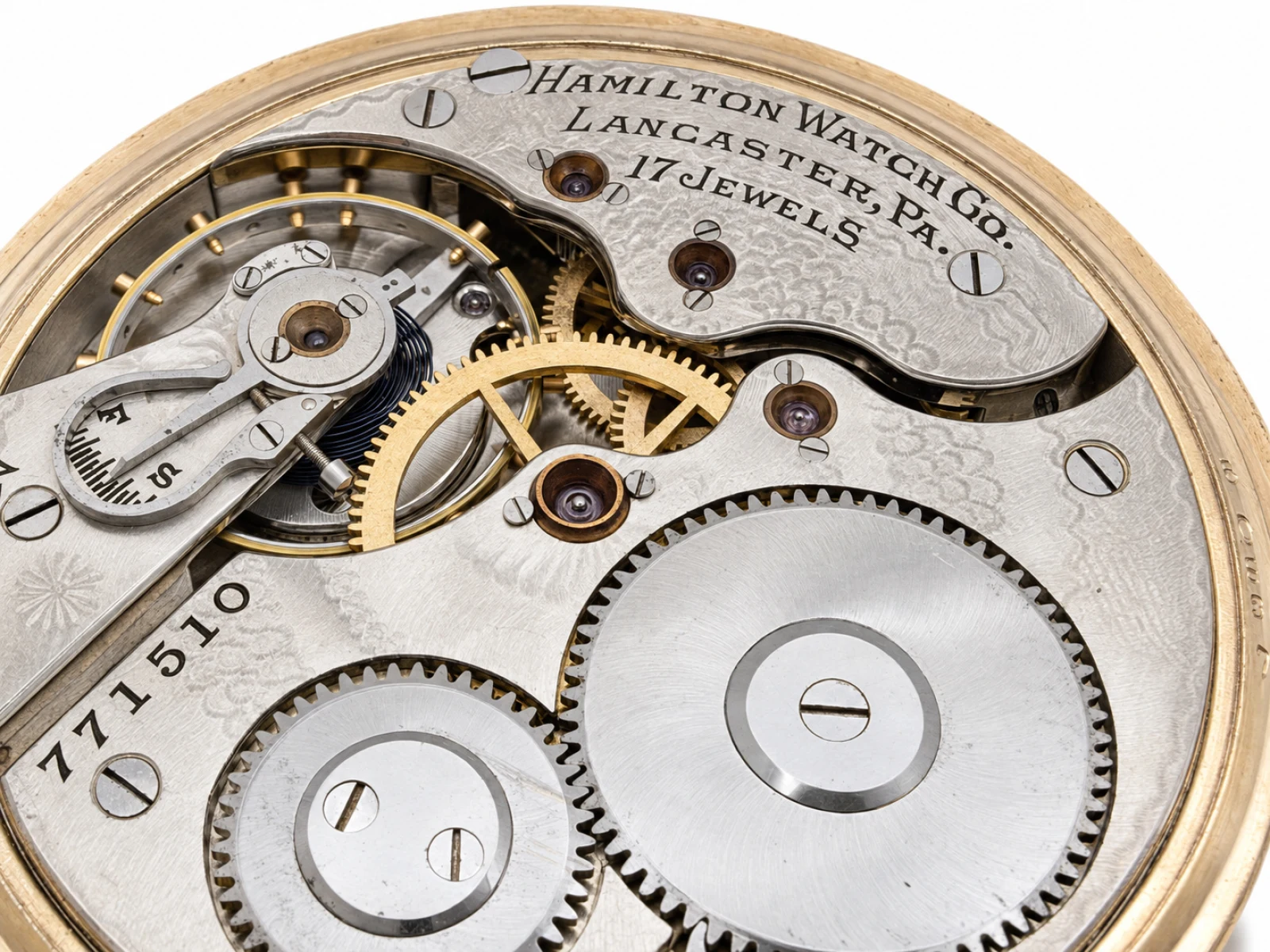
A Hamilton 974 from 1910 with a Reed whiplash regulator: the curved spring arm beside the balance, moved by a fine screw.
On a railroad watch that had to pass a time inspector's check, a micrometric regulator was a real advantage, and most railroad grades have one.
One thing worth knowing: the regulator is for fine-tuning only. If a watch is gaining or losing several minutes a day, moving the regulator is not the fix. It needs cleaning and servicing.
The Plates: The Frame of the Movement
All of these parts are held between metal plates. The bottom plate, under the dial, is the pillar plate. The parts are held on the other side by a top plate or by separate bridges and cocks. How that top side is laid out gives a movement its look.
- Full plate: one top plate covers nearly the whole movement, and the balance sits on top of it under its own cock. This is the classic American layout of the 1800s, used on most 18-size watches.
- Three-quarter plate: the top plate is cut away where the balance sits, so the balance can sit down level with the plate. That makes a thinner watch and lets a watchmaker reach the balance and escapement without taking the whole movement apart. Most 16-size railroad watches are three-quarter plate.
- Bridge model: instead of one top plate, the wheels are held by separate bridges. These are often the finest, most decorated movements a company made.
Gilt, Nickel and Damaskeening
Early American plates were brass with a gold wash, called gilt. From the 1870s and 1880s, the better grades moved to solid nickel plates, which stay bright and do not need plating, while gilt stayed on many lower grades into the early 1900s. American factories then decorated those plates with damaskeening, patterns of fine lines, waves and stripes cut by machine. It is an American specialty and one of the great pleasures of looking at these watches. A two-tone movement has a thin layer of gold over parts of the nickel, so the damaskeening shows in gold and silver bands.
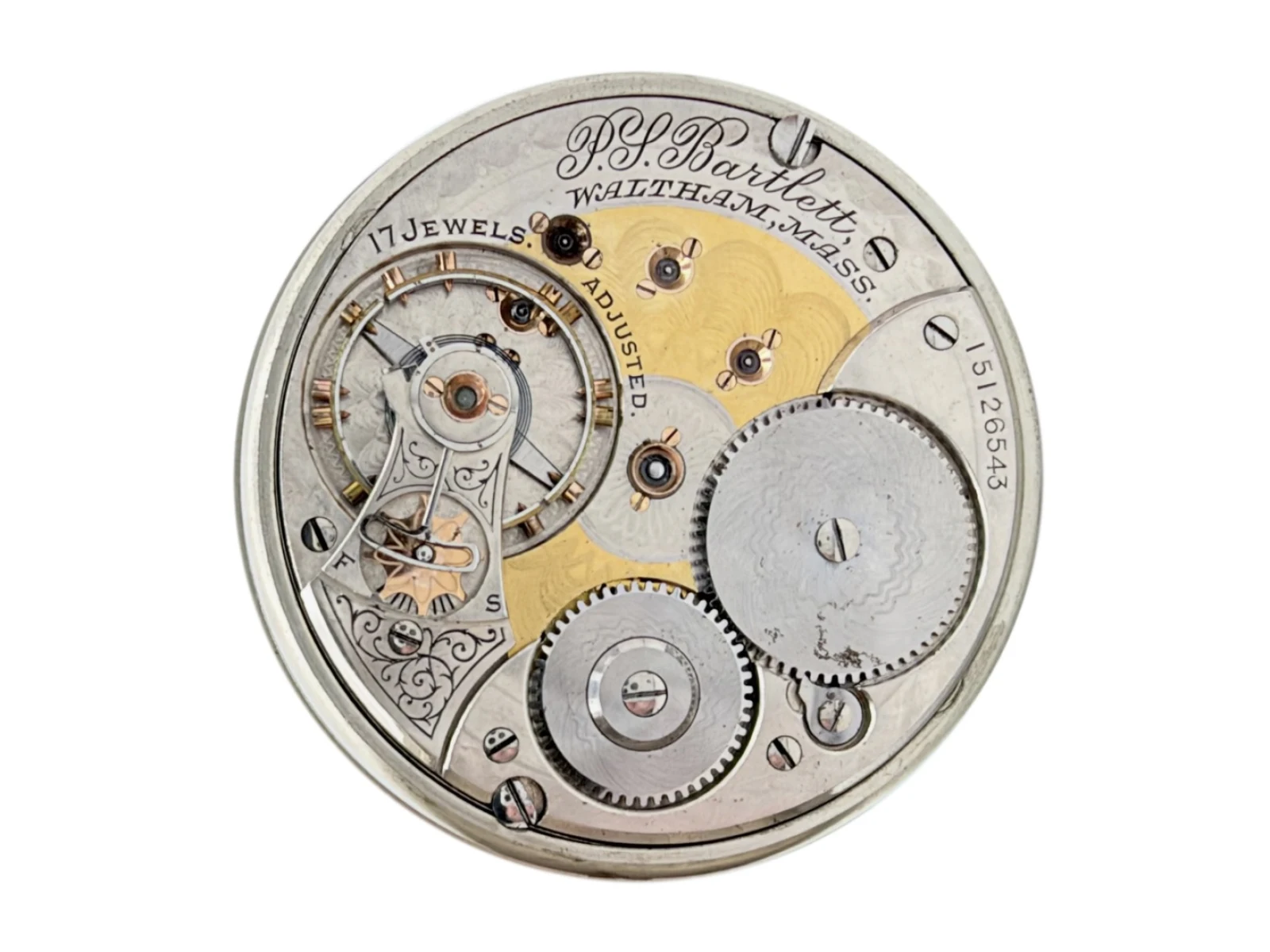
A two-tone Waltham P.S. Bartlett from 1906: nickel plates damaskeened with a gold center, so the pattern shows in gold and silver.
Jewels and Jewel Settings
Every wheel in a watch turns on pivots, thin ends of its arbor that ride in holes in the plates. Metal on metal wears. Polished ruby and sapphire do not, and they hold a tiny drop of oil in place. That is what jewels are for: they are bearings, not decoration. From the early 1900s on, most watch jewels were synthetic ruby or sapphire, which is just as hard as natural stone.
- A hole jewel is a ring jewel the pivot runs through.
- A cap jewel, or endstone, is a flat jewel set over the hole jewel. The tip of the pivot rests against it. Cap jewels go where friction matters most, on the balance first and, in the finer grades, on the escape wheel and pallet fork.
- The pallet stones and roller jewel of the escapement are jewels too, and they count in the total.
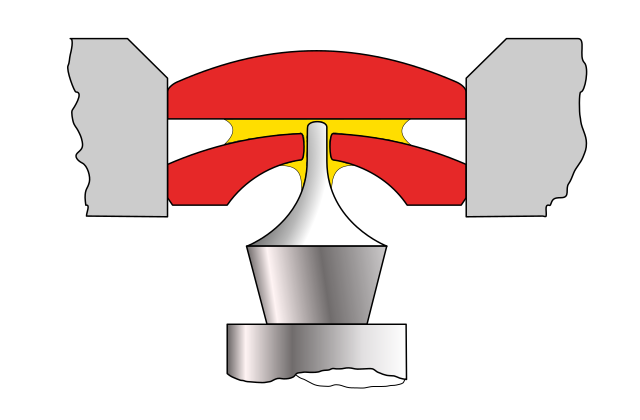
A pivot in a hole jewel, with a cap jewel (endstone) above it. The yellow is the drop of oil the jewels hold in place. Diagram by Chetvorno, public domain, via Wikimedia Commons.
What the Jewel Count Means
American jewel counts follow a pattern you can almost read off the plate:
- 7 jewels: the balance (two hole jewels and two cap jewels), the roller jewel and the two pallet stones.
- 11 jewels: adds hole jewels for the pallet fork and escape wheel.
- 15 jewels: adds the third and fourth wheels.
- 17 jewels: adds the center wheel. Seventeen jewels means every working pivot in the train runs in a jewel. It was the minimum under the early railroad standards of the 1890s. Later standards asked for more, and 21 jewels became the norm.
- 21 jewels: adds cap jewels to the pallet fork and escape wheel, where the escapement does its work.
- 23 jewels: usually adds jewels for the mainspring barrel arbor.
More jewels do not make a watch run faster or slower. They make it wear less and keep its rate more steadily over years of daily use.
Jewel Settings
How a jewel is held matters as much as how many there are. In a screwed setting, sometimes called a gold chaton, each jewel is mounted in a small gold collar that is held in the plate by one or two tiny screws. A watchmaker can lift one out and replace a damaged jewel without disturbing the plate. Raised gold settings around the jewels are one of the clearest signs of a high-grade American movement, and they are beautiful under the loupe. Lower grades set the jewels straight into the plate.
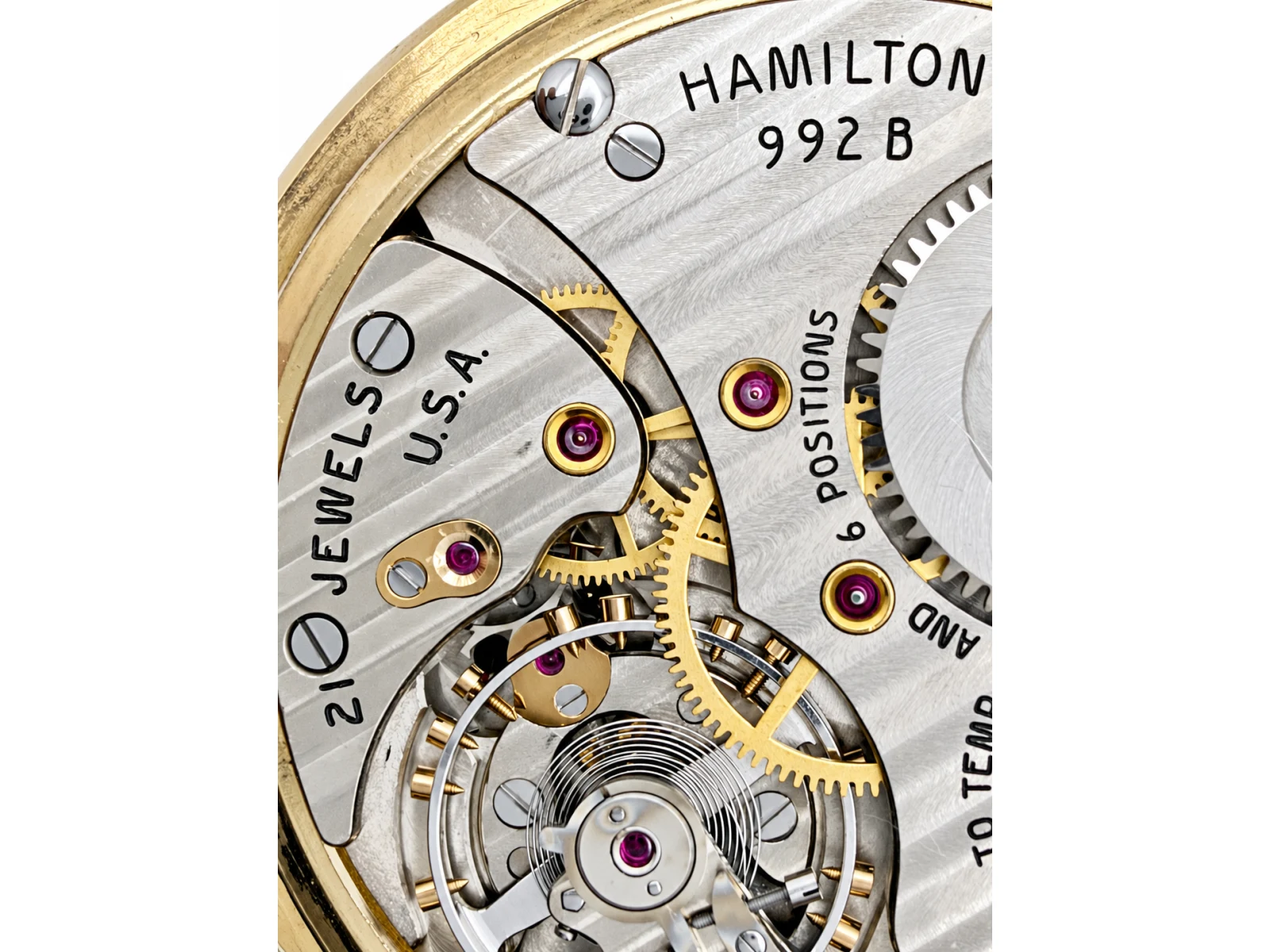
Jewels in gold settings on a Hamilton 992B. Each red jewel is a bearing for one pivot.
Winding and Setting
The last group of parts lets you wind the watch and move the hands. How a watch does this tells you a lot about when it was made and what it was meant for.
Key Wind and Key Set
The earliest watches wind and set with a key. You open the back, fit the key onto the square on the barrel arbor and wind. To set the hands, you open the front and fit the key onto the square at the center of the hands. Key wind watches were still made in America through the 1880s, and in small numbers after that.
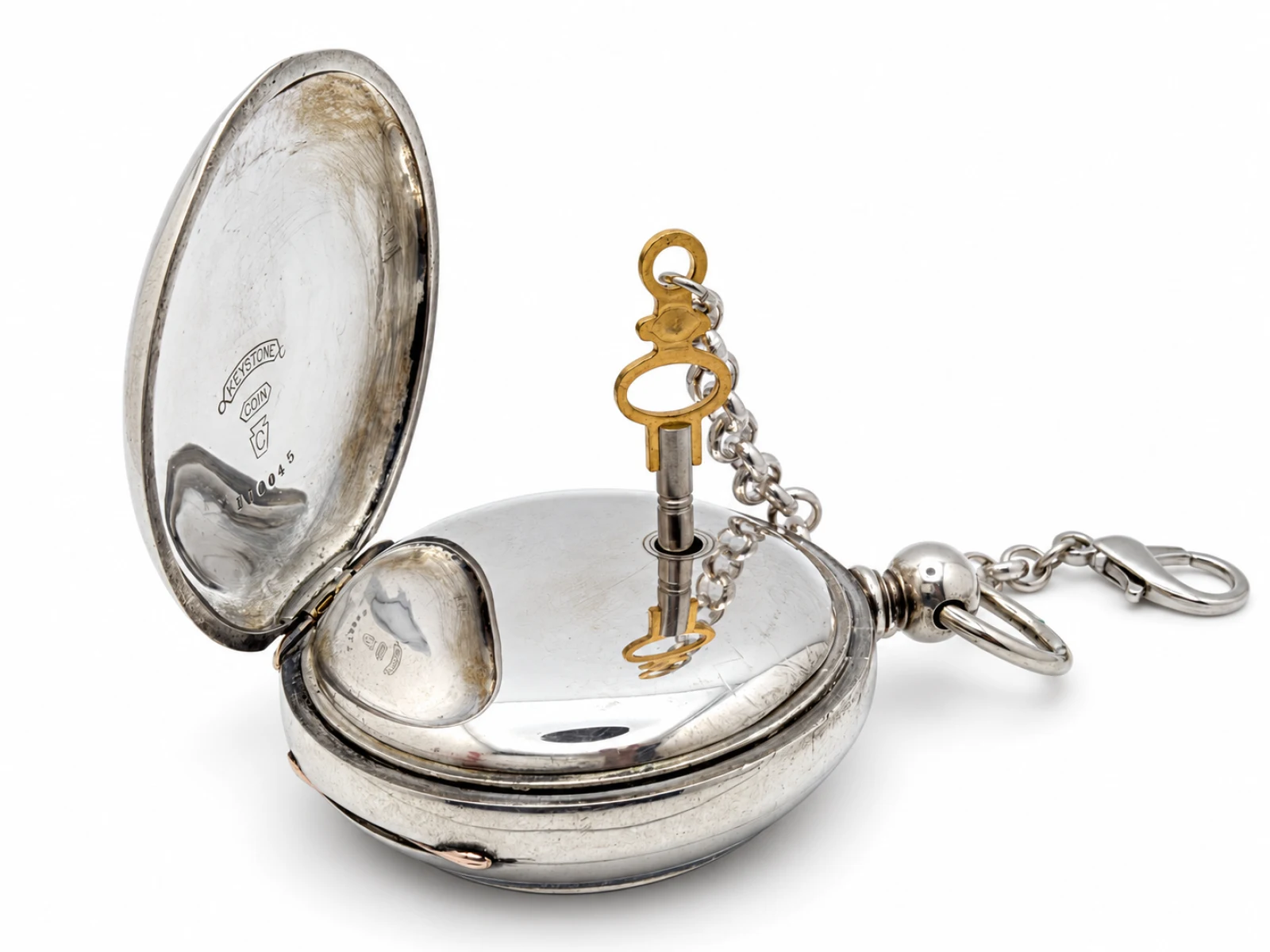
Key winding an 1878 Waltham P.S. Bartlett: the key goes through the dust cover onto the winding square.
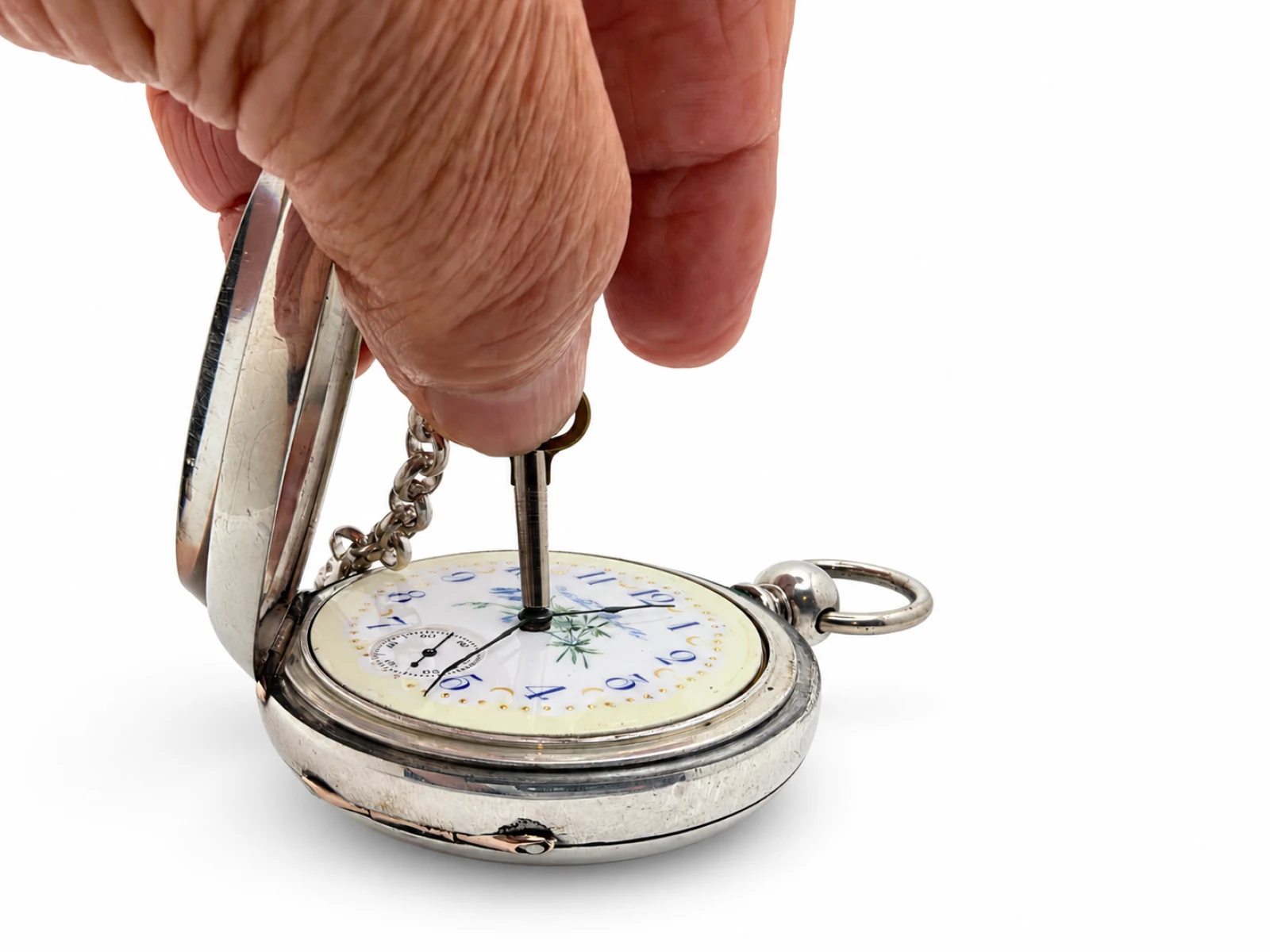
Setting the same watch: the key fits the square at the center of the hands.
Stem Wind and the Keyless Works
From the 1870s, American companies switched to stem wind: you wind by turning the crown. Inside, the crown turns the winding stem, and a sliding clutch (also called the castle wheel) on the stem decides where the power goes. In winding position the clutch turns the winding pinion, which turns the crown wheel and the ratchet wheel on the barrel. In setting position the clutch slides over to the setting wheels, which turn the minute wheel and cannon pinion, and the hands move. How the clutch gets shifted is the difference between the setting methods below.
Lever Set
On a lever set watch, the crown only winds. To set the hands, you remove the front bezel, pull out a small setting lever at the edge of the dial, turn the crown, then push the lever back and replace the bezel. The lever moves the clutch into setting position. Because you have to open the watch to do it, the hands cannot be moved by accident in the pocket. That is why the railroads required it, and why nearly every American railroad watch is lever set. I wrote a full step-by-step on how to open and set a lever-set pocket watch.

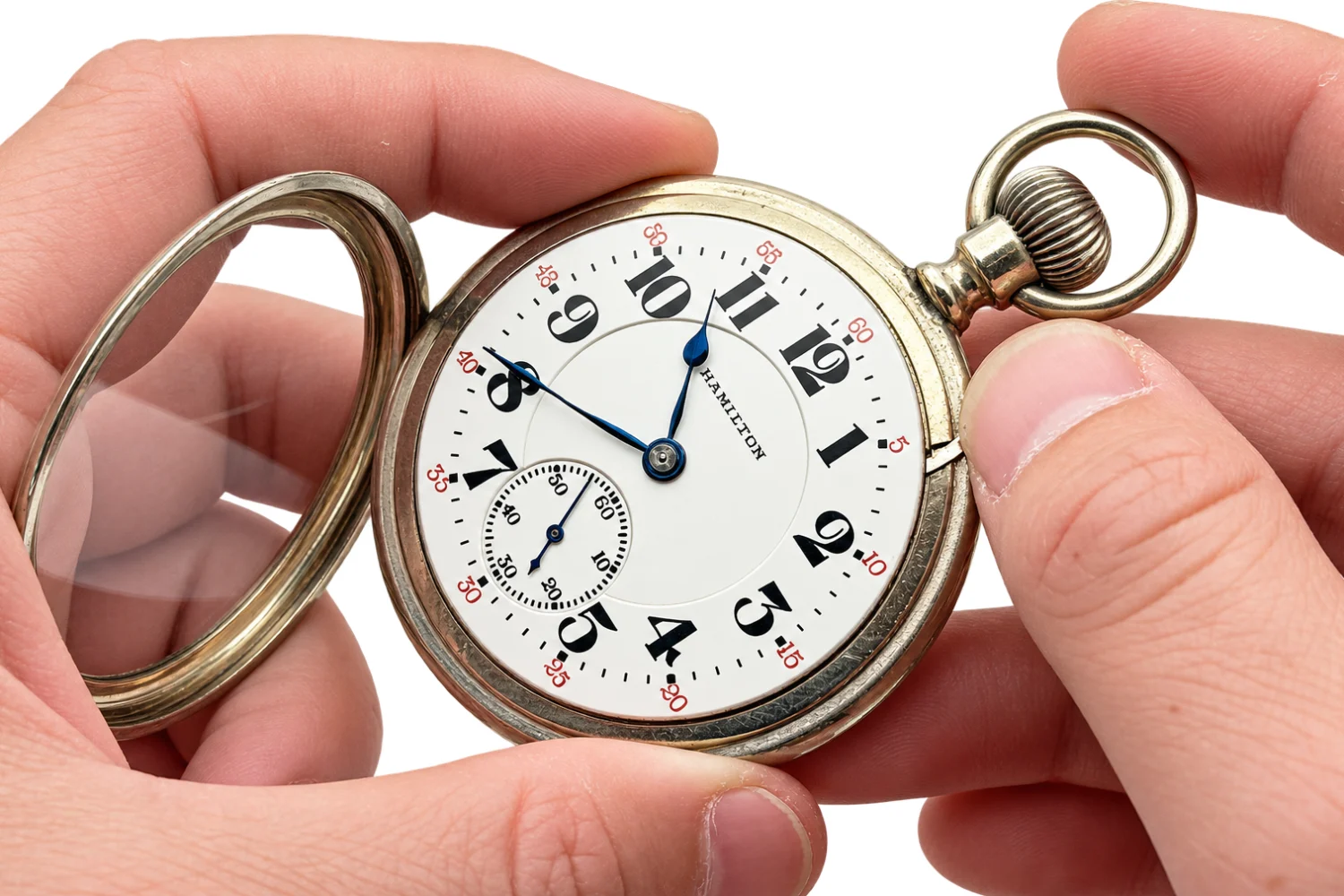
A Hamilton railroad watch with the bezel off and the setting lever pulled out under the thumb, just past the 1. Now the crown moves the hands.
Pendant Set (Stem Set)
On a pendant set watch, also called stem set, you pull the crown out to set the hands and push it back in to wind, the same way most wristwatches work. It is quick and convenient, which is why most dress and everyday watches set this way. It is also why the railroads did not allow it: a crown can be pulled out without anyone noticing.
Pin Set
On a pin set watch, a small pin or button sits beside the pendant. You hold it in with a fingernail while you turn the crown, and the hands move. Let it go and the crown winds again. Pin setting is found mostly on Swiss and other European watches, and on some early American stem-wind watches.
What "Adjusted" Means
The last term you will see in every railroad listing is adjusted. A watch keeps slightly different time depending on its position, the temperature, and how tightly the mainspring is wound. Adjusting is the slow hand work of correcting for those differences at the factory.
- Adjusted to positions: tested and corrected so it keeps the same rate in different positions. Five positions means dial up, dial down, pendant up, pendant right and pendant left. Six adds pendant down.
- Adjusted to temperature: corrected to keep the same rate in heat and cold, through the balance and hairspring described above.
- Adjusted to isochronism: corrected to keep the same rate whether the mainspring is fully wound or nearly run down.
The railroad standards called for adjustment to temperature and at least five positions. When a plate is engraved "Adjusted 5 Positions" or "Adj. to Temp. and 6 Positions," that is the factory telling you how much hand work went into it.
Putting It Together
Wind the crown and you tighten the mainspring. The barrel turns the center wheel once an hour, the fourth wheel once a minute, and the escape wheel feeds that power to the pallet fork one tooth at a time. Five times a second the fork gives the balance a small push and the hairspring brings it back. The regulator decides exactly how fast that happens, the jewels keep it from wearing, and the plates hold it all in place for a hundred years and more. When you hold a running pocket watch to your ear, that steady tick is all of it working together.
If you have a watch with a term in its description that is not covered here, or you want to know what is inside a watch you own, give me a call at (310) 486-0572. And if yours needs servicing, send me a few photos and we will sort it out.