A customer walked into my shop last week with a pocket watch his grandfather left him, asking two questions. What is it? And is it worth anything? He had the case open, pointed at a number engraved inside the case back, and told me he had already looked it up online. His answer was off by about forty years.
Here is the first and most important thing to know about identifying an Elgin pocket watch: the number on the case is not the number that tells you what you have. The number on the movement is. In many years of doing this, I have seen more good watches misidentified because of that one mistake than I can count.
So let's walk through this the right way. By the end of this guide you will know exactly where to look, what to write down, and how to turn a serial number into a year, a grade, and a real sense of what the watch is worth. I will also tell you what the serial number cannot tell you, because that part gets glossed over in almost every guide out there, and it is the part that actually matters at purchase time.
Step One: Open the Case and Find the Movement Serial
You are going to encounter two separate serial numbers on any Elgin pocket watch. One is stamped on the case. The other is engraved on the movement itself. They are almost never related.
Elgin was a movement maker. They shipped movements to jewelers, department stores, and private-label sellers who then married them to cases supplied by firms like Keystone, Philadelphia Watch Case Co., Fahys, Illinois Case Company, and plenty of others. So a 1906 Elgin Veritas movement might sit inside a 1925 Wadsworth case. The case serial tells you about the case. The movement serial tells you about the watch.
To get to the movement, you need to open the back. On most Elgin pocket watches this is a screw-down back cover on the side opposite the dial. Modern collectors use a watch case knife or a rubber ball; do not pry it with a screwdriver or a coin. If the case is snap-on, there is a small notch you can use. If you are nervous about this, stop and bring it to a watchmaker. A scratched case back loses value immediately.
Once you have the back off, you will see the movement. The serial number is engraved directly on the movement plate, usually in large, clearly visible digits. On Elgin movements, this is most often on the top plate near the balance wheel. Write it down. Double-check every digit. A single transposed number throws the whole identification off.
Step Two: Look Up the Serial Number
The single best free resource on the planet for this is pocketwatchdatabase.com. Type the serial number into their search, and it will return the manufacture year, the size, the jewel count, the grade number, the model, the production run total, and often a picture of the plate layout. No registration required. No cost.
There are other lookup sites (elginnumbers.com, elgintime.com, a handful of NAWCC threads), and they are all fine as backups. But pocketwatchdatabase is the one I pull up at the shop a dozen times a day, and it is the one I trust.
What the lookup gives you is a factual snapshot of what left the factory in Elgin, Illinois. Manufactured in 1917. Grade 374. 21 jewels. 16 size. Father Time railroad grade. That is the bones of your identification. Everything else is interpretation.
A Quick Note on Elgin Serial Number Ranges
The very first Elgin pocket watch was given serial number 101, made in 1867. From there, serial numbers ran essentially continuously up into the tens of millions. Elgin produced roughly 60 million watches over its 100 years of operation, which was half of all American-made pocket watches ever produced (dollar watches excluded). When the factory finally closed in 1964, it closed as the largest watchmaker America ever had. So whatever Elgin serial number is in your hand, odds are someone already catalogued the year it was born.
Step Three: Decode the Grade
Once the database gives you a grade number, the real collecting story begins. Elgin produced hundreds of distinct grades across its run. Most of them are dress or utility movements. A small fraction are the prized railroad grades, and within those, certain names carry serious weight.
Here are the grade families you need to know:
B.W. Raymond
Named after Benjamin W. Raymond, the former mayor of Chicago who was one of Elgin's founders, the B.W. Raymond line runs nearly the entire arc of the company's pocket watch production, from the 1870s all the way through the final railroad movements of the 1950s. Grade 571, one of the last and most collectible B.W. Raymonds, was produced well into the mid 20th century and rivaled Hamilton's Grade 992 in both popularity and total production numbers, with roughly 563,000 Grade 571s produced. I currently have a Grade 571 B.W. Raymond in the shop, housed in the streamline Style 3055 case. Here it is. 21 jewels, with the B.W. Raymond name printed directly on the dial, which is a feature you don't always see. Pick it up and it feels every bit as railroad-grade as it is.
Veritas
Veritas, Latin for "truth," was Elgin's answer to Hamilton's top-tier railroad work. Every Veritas grade carried either 21 or 23 jewels, adjusted to temperature, isochronism, and five positions. They represented the pinnacle of Elgin's railroad production roughly from 1901 through the mid-1920s. Grade 239, Grade 214, Grade 376, Grade 453 with the up/down wind indicator, Grade 478; these are the names that keep serious American collectors awake at night. In my honest opinion, the Elgin Veritas is the single most undervalued railroad movement in American watchmaking. Tier for tier, they match Hamilton's Grade 950 in finish and accuracy, and you can still find a good one for considerably less.
Father Time
Father Time was Elgin's slightly more accessible railroad grade, a step down from Veritas on paper but a world-beater in its own right. Grade 252 and Grade 374 are both Father Time movements, and they held up beautifully in railroad service for decades. The Grade 374 is a great example of what Father Time was all about: a 21-jewel 16-size railroad movement, often fitted with the up/down wind indicator, produced in genuinely low numbers. I have a rare Grade 374 Father Time with the wind indicator sitting on the bench right now, manufactured in 1917. Total production for this variation was only about 11,000 pieces. Worthy of your careful consideration if Father Time is on your list.
G.M. Wheeler
Named for another founder, George M. Wheeler, this was Elgin's mid-grade line. Generally 17 jewels, well-finished, reliable. Not railroad-certified but handsome and perfectly good as a dress or daily watch.
Dress and Utility Grades
Elgin produced enormous numbers of 7-jewel and 15-jewel dress watches, ladies' grades, and utility grades. Grade numbers in the hundreds (291, 303, 312, 478, 479) are common in this category. They can be absolutely lovely, especially when housed in a solid gold or multi-color gold-overlay case, but they will not command railroad-grade prices because they were not railroad-grade watches. Buy them for what they are: handsome period timepieces at a fair price.
Step Four: Identify the Size and Model
American pocket watches use an old sizing convention that runs backward from how you might expect. A "size 18" movement is larger than a "size 16," which is larger than a "size 12," and on down the line. Most Elgin railroad grades after about 1900 were 16 size, which became the industry standard under the Railroad Standards. Before that, 18-size dominated. Size 12 was for gentleman's dress watches. Size 6 and 0 were ladies' grades.
The database lookup will tell you the size. What you want to pay attention to is whether the size matches the pretensions of the grade. A 16-size Veritas is a proper railroad watch. A 12-size "railroad-style" marketing piece is just a dress watch with a bold dial.
Step Five: Read the Dial
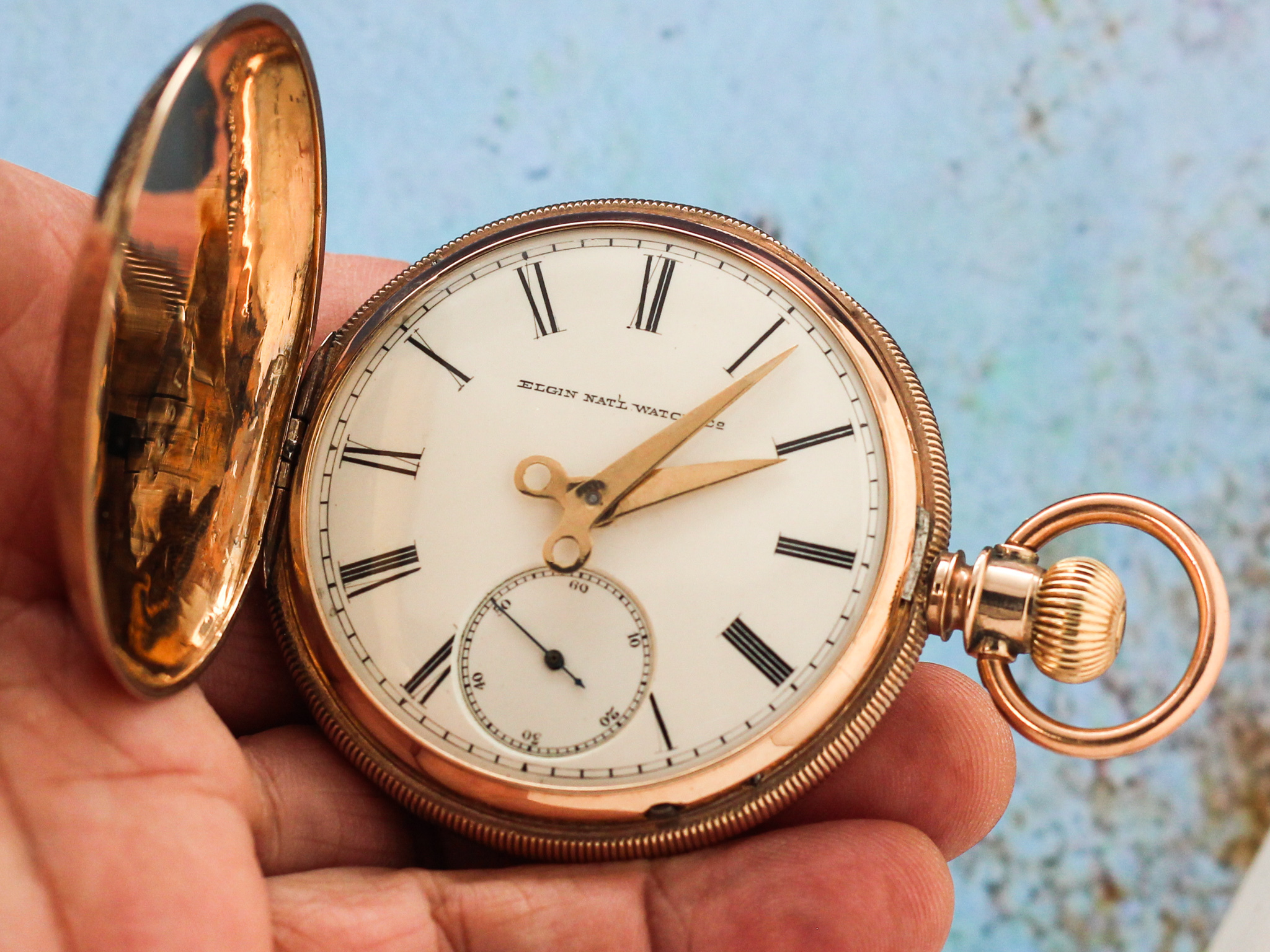
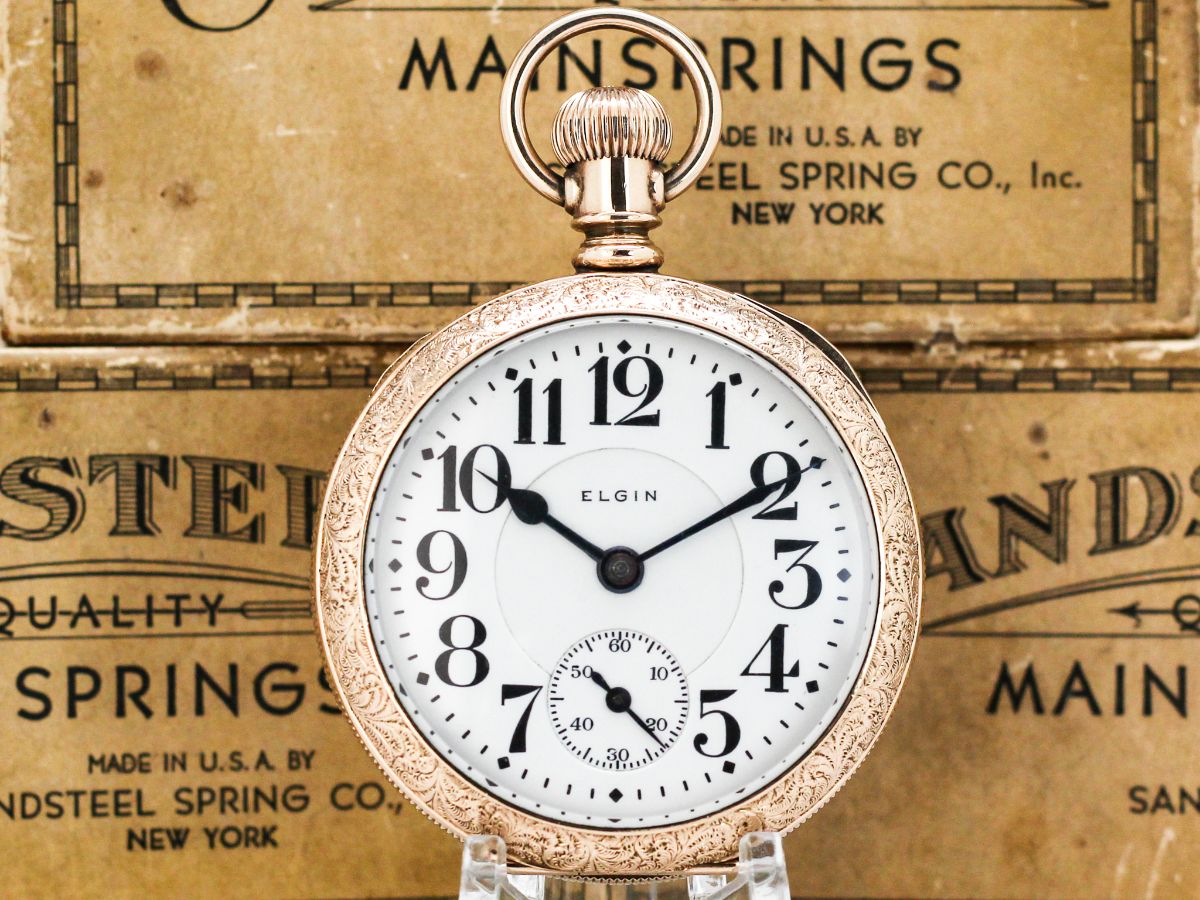
Most Elgin dials are enamel, heavily fired and remarkably durable. They will either carry "Elgin" across the top, the grade name ("B.W. Raymond," "Veritas," "Father Time"), or occasionally a private label from the jeweler who sold the watch (South Bend, Montgomery Ward, and private railroad companies all commissioned private dials).
What I look for under the loupe, every single time:
- Hairlines. Tiny cracks in the enamel that catch the light. A few are acceptable. A spider web of them kills the value.
- Chips. Usually around the winding arbor hole or the seconds bit. Chips are worse than hairlines. A chipped dial is a replaced dial waiting to happen.
- Repaints. A repainted dial can look fine at arm's length and terrible under 10x magnification. You will see fuzzy numeral edges, uneven ink density, and the word "Elgin" sitting slightly off-axis from the minute track. A repainted dial cuts value by half or more.
- The Montgomery or Boxcar layout. On railroad-grade dials, the numerals will be bold Arabic, and a proper Montgomery dial will carry the marginal minute numerals around the outside. Boxcar is similar but uses slightly squared numerals. Both are desirable.
Step Six: Understand the Case
This is where most beginners get tangled up, so read this twice. The case was almost never made by Elgin. Elgin made movements. The case, which is what most people actually see and handle, was supplied by a separate case company and sold either as a complete watch by the jeweler or as a replacement years later.
What this means practically: the case serial does not tell you when the watch was made. The case material (gold-fill, silver, solid gold, nickel) does not tell you the grade of the movement inside it. And over a hundred-year service life, many cases have been swapped. A Veritas movement that started life in a gold-fill case may now sit in a screw-back nickel case that was installed in 1935.
The case still matters, of course. A solid 14k or 18k gold case adds significant value. A rare case style (Keystone Supreme Bulldog, the original "clear back" display case, or the Hamilton Model 10 for Hamilton movements) adds collector value. But the identification of the watch itself flows from the movement, not the case.
Case Markings to Note
Look inside the case back for:
- Case maker's name or trademark (Keystone, Wadsworth, Fahys, Illinois Case Co., Dueber, Crescent)
- Gold content stamp: 14k, 18k, "GF" (gold-filled), "10 year" or "20 year" warranty stamps common on gold-filled cases
- Case serial number (different from movement serial)
- Style or model name
Write these down alongside the movement info. When you call me or send photos about a watch you're looking to sell, this is the information I ask for first, in exactly this order.
What the Serial Number Cannot Tell You
Here is where every other guide on the internet stops. But this is the part that actually decides what the watch is worth at the moment of sale, and it is the part I cannot stress enough.
The serial number tells you what the watch was when it left the factory. It tells you nothing about what happened to it in the hundred years after. Specifically, the serial will not tell you:
- Is the movement running? A pristine-looking 1917 Veritas may have a broken balance staff, a snapped mainspring, or a corroded escape wheel. Until it is serviced and tested on a timing machine, you don't know.
- Has the dial been refinished? Repaints are common and hard to spot in photos. Under the loupe you can tell.
- Is the case original to the movement? Often it is not. Worth checking against period catalog references.
- What's the overall wear? Heavy polish on the case, worn engraving, a beat-up crown. These things compound.
- Has it been serviced recently? An Elgin last oiled in 1965 is a watch in trouble. The old oils thicken, the mainspring set takes over, accuracy walks off a cliff.
In my shop, every watch gets a full inspection before I price it. Movement cleaned and oiled with modern synthetics. Accuracy verified on a timing machine across multiple positions. Dial examined under magnification for repaints or hairlines. Case checked for originality to the movement. Crown and crystal evaluated. Then, and only then, do I put a number on it. The serial number lookup is step one of a ten-step process.
How I Use the Serial Number When Jeff is Buying
If you are trying to sell me a watch, the first thing I ask for is a clear photo of the movement with the serial number legible. That one photo tells me more than a dozen exterior shots. From that I can pull up the grade, year, original configuration, and get a solid opening estimate inside of two minutes.
But the price I actually offer depends on the things the lookup cannot see. I want photos of the dial straight-on, any engraving on the case, the crown, the back cover, and anywhere the case shows wear. A Grade 239 Veritas with an unmolested dial and original case is one conversation. The same movement in a banged-up swapped case with a repainted dial is a different one.
If you've got an Elgin sitting in a drawer and you want to know what it is, this is my invitation. Send me a few photos of the movement and dial and I'll tell you what it is, what it's worth today, and whether it's something I'd like to buy. No pressure either way. Even if you're just curious, I am happy to put a number on it.
Servicing an Elgin You Already Own
If the identification tells you you've got something real, the next question is almost always about getting it running properly. Elgins were built to be serviced. Every railroad-grade movement was designed from the ground up with the expectation of being cleaned, oiled, and regulated every three to five years for the length of its working life.
An Elgin that has been sitting in a drawer for thirty years is almost certainly running on dried oil. You can feel it when you wind it: a little stiffness, a hesitation. The watch may still run, but it is not running right, and continued use without service is actively grinding the pivots. Don't keep winding a watch in that state.
If you've got an Elgin that needs work, send me photos or give me a call at (310) 486-0572. I've been servicing American pocket watches for over thirty years. Every watch that leaves my bench gets modern synthetic lubricants, a full clean, regulation across multiple positions, and a one-year guarantee.
Mini-FAQ
Where is the serial number on an Elgin pocket watch?
The serial number that identifies the watch is on the movement, engraved directly on the top plate, usually near the balance wheel. You find it by opening the back of the case. The other number you might see, stamped inside the case back, is the case serial. It identifies the case maker only, not the Elgin movement or its year of production.
What year was my Elgin pocket watch made?
Write down the movement serial number and enter it at pocketwatchdatabase.com/search/serialnumber/elgin. The lookup returns the manufacture year along with grade, size, and jewel count. Elgin serials begin at 101 (1867) and run up into the tens of millions, so virtually any Elgin pocket watch you encounter is in the database.
How do I tell if my Elgin is a railroad grade?
Railroad-grade Elgins meet the General Railroad Timepiece Standards set in the years following the 1891 Kipton train disaster. They carry a minimum of 17 jewels (21 or 23 on the best grades), are adjusted to at least five positions and temperature, feature lever-set time setting (you pull a small lever out from under the bezel to set the hands, rather than pulling out the crown), have an open-face case (no cover over the dial), a enamel dial with bold Arabic numerals, and carry one of the railroad grade names: B.W. Raymond, Veritas, Father Time. The database lookup will confirm railroad certification definitively.
Are Elgin pocket watches valuable?
It depends entirely on grade, condition, and case. A 7-jewel Elgin dress watch from the 1920s in average condition might be a 50 to 150 dollar watch today. A pristine Veritas or Father Time in original case with a clean dial can run into the low four figures and, in rare configurations, well above. A boilerplate lookup gives you the factory configuration; condition and originality do the rest.
Is the case original to my Elgin movement?
Often it is not. Case swaps were routine over a hundred-year service life. Original pairings are confirmed by matching the watch to period catalog photos, checking the case style against the movement grade and year, and looking for consistent wear patterns between case and movement. If the movement shows heavier wear than the case, or vice versa, the pairing is suspect. For a real identification, I'd rather see clear photos than make guesses from text.
A Last Word
Identifying an Elgin pocket watch by serial number is the beginning of understanding what you have, not the end. The database will give you a year, a grade, and a name. Beyond that, every watch tells its own story, and that story lives in the dial, the case, the movement's service history, and the condition of parts you cannot see from a serial lookup alone.
If you're stuck, curious, or ready to buy or sell, the phone still works: (310) 486-0572. Send photos, ask questions. I've been doing this a long time, and I'd rather spend ten minutes on the phone getting you a real answer than watch a good Elgin get misidentified and sold for pennies. Drop me a line either way.
Happy collecting.