If you're about to buy your first Elgin pocket watch, let me save you some time. Thirty years of doing this has taught me a few things I wish someone had told me when I started, and I'd rather you spend your money on the right watch than learn the hard way.
Elgin made an estimated 60 million watches between 1867 and the 1950s. That's more than any other American watch company, and it's the reason Elgin is both the best place to start collecting and the easiest place to get stuck with something that looks right but isn't. This guide is what I tell customers when they walk into the shop with that same question: where do I begin, and what's worth buying?
Start with this: not every Elgin is a great Elgin
Elgin made magnificent railroad-grade movements that are a wonder to hold in your hand. They also made a lot of low-jewel gentlemen's watches that were perfectly fine in 1915 and are, honestly, perfectly unremarkable today. Both say "Elgin" on the movement. Both are authentic. But they are not the same watch.
The difference lives in the movement. Jewel count, grade name, size, those three numbers are what separate a $200 watch from a $3,000 watch. Learn to read them and you'll never get taken advantage of, whether you're buying from me, another dealer, or someone's estate sale.
A quick history, the part that matters
The Elgin National Watch Company was founded in 1864 by a group of Chicago businessmen who wanted an American answer to Swiss dominance. They set up in Elgin, Illinois, forty miles northwest of Chicago, and by the 1880s they were producing watches at a scale that rivaled the mighty Waltham. At their peak the Elgin factory covered 17 acres and employed over 4,000 people.
What matters for a collector is timing. When the General Railroad Timepiece Standards were codified in 1893, accuracy within 30 seconds a week, open face, lever set, size 16 or 18, minimum 17 jewels adjusted to five positions and temperature. Elgin was already building to that standard. They became, alongside Hamilton and Waltham, one of the three American companies whose railroad movements you could trust on a main line carrying 200 passengers.
Their last railroad-grade movements, the final B.W. Raymonds from the early 1950s, are, without exaggeration, the last chapter of American railroad watchmaking. Hold one and you're holding the end of an era.
The grades worth knowing
Veritas, the flagship
Veritas means "truth" in Latin, and it's the name Elgin gave their top railroad-grade line. These are 21 and 23-jewel movements, 18-size and 16-size, with strengthened frames, heavier balances, and adjustment to five or more positions. In my opinion the Veritas is the single most undervalued name in railroad-grade collecting right now. Compared to the Hamilton 950 or the Waltham Vanguard at similar jewel counts, the Veritas tends to trade for a bit less, and the build quality does not reflect that discount.
The Grade 214 (23 jewels, 18-size) and the Grade 376 (23 jewels, 16-size) are the ones to chase. Both are serious railroad watches. Both are increasingly hard to find in good condition.
Father Time, the workhorse
If the Veritas was Elgin's Sunday-best railroad movement, Father Time was their every-day railroad movement. Most Father Time grades are 21 jewels, 18 or 16-size, and they were the watches actual engineers and conductors carried on their shifts. I always tell new collectors who want a real railroad watch without paying flagship money: start here.
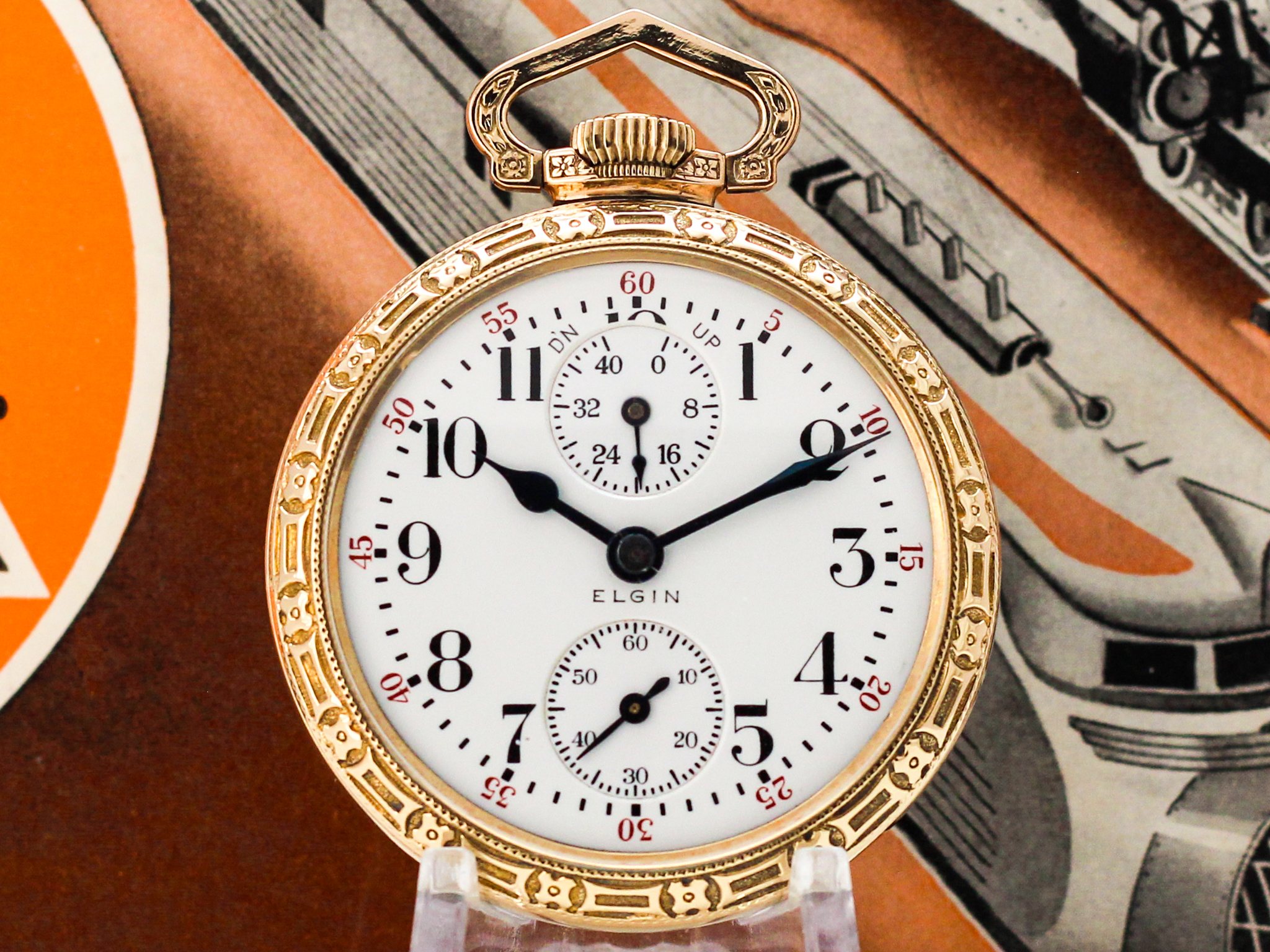
The 374 with the Up/Down Wind Indicator is a specific favorite of mine. The wind indicator, a small dial on the movement that shows how much power is left in the mainspring, was only ever installed on the highest-grade watches. It's a detail a working railroader would have loved, and it's the kind of complication that makes a collection feel alive.
I've got one in the shop right now: this rare Father Time Grade 374 with the Up/Down Wind Indicator. 21 jewels, 16-size, $2,750. If wind indicators are your thing, they don't come around often.
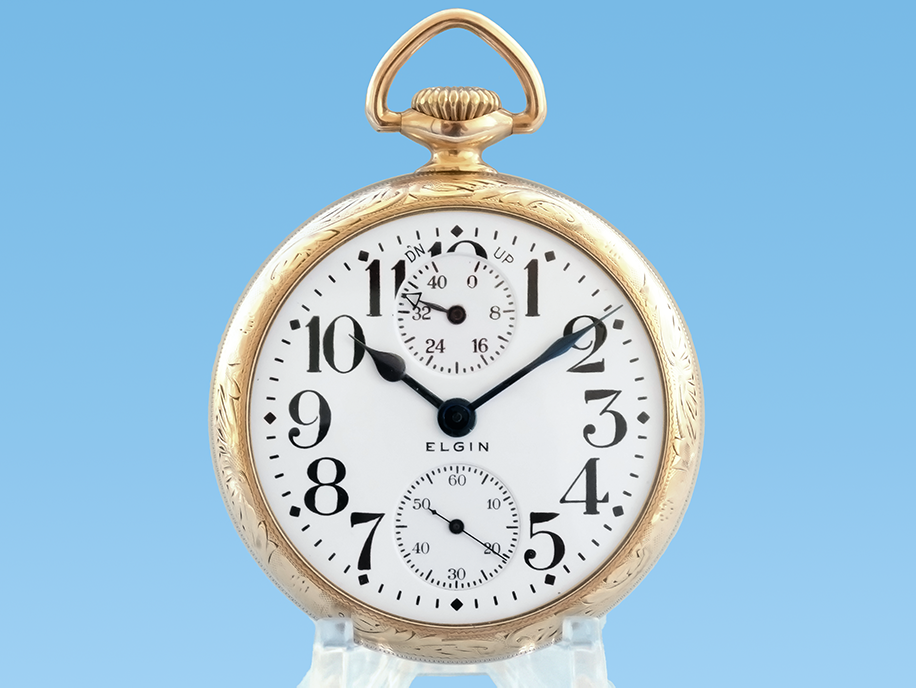
B.W. Raymond, the founder's name
Benjamin W. Raymond was the Chicago mayor who helped found the company, and when Elgin put his name on a movement they meant it. The B.W. Raymond line ran almost the full history of Elgin production, from the 1870s right through to the final railroad watches in the 1950s. That makes it one of the most fascinating lines to collect. You can trace American watchmaking's entire Golden Age across a single name.
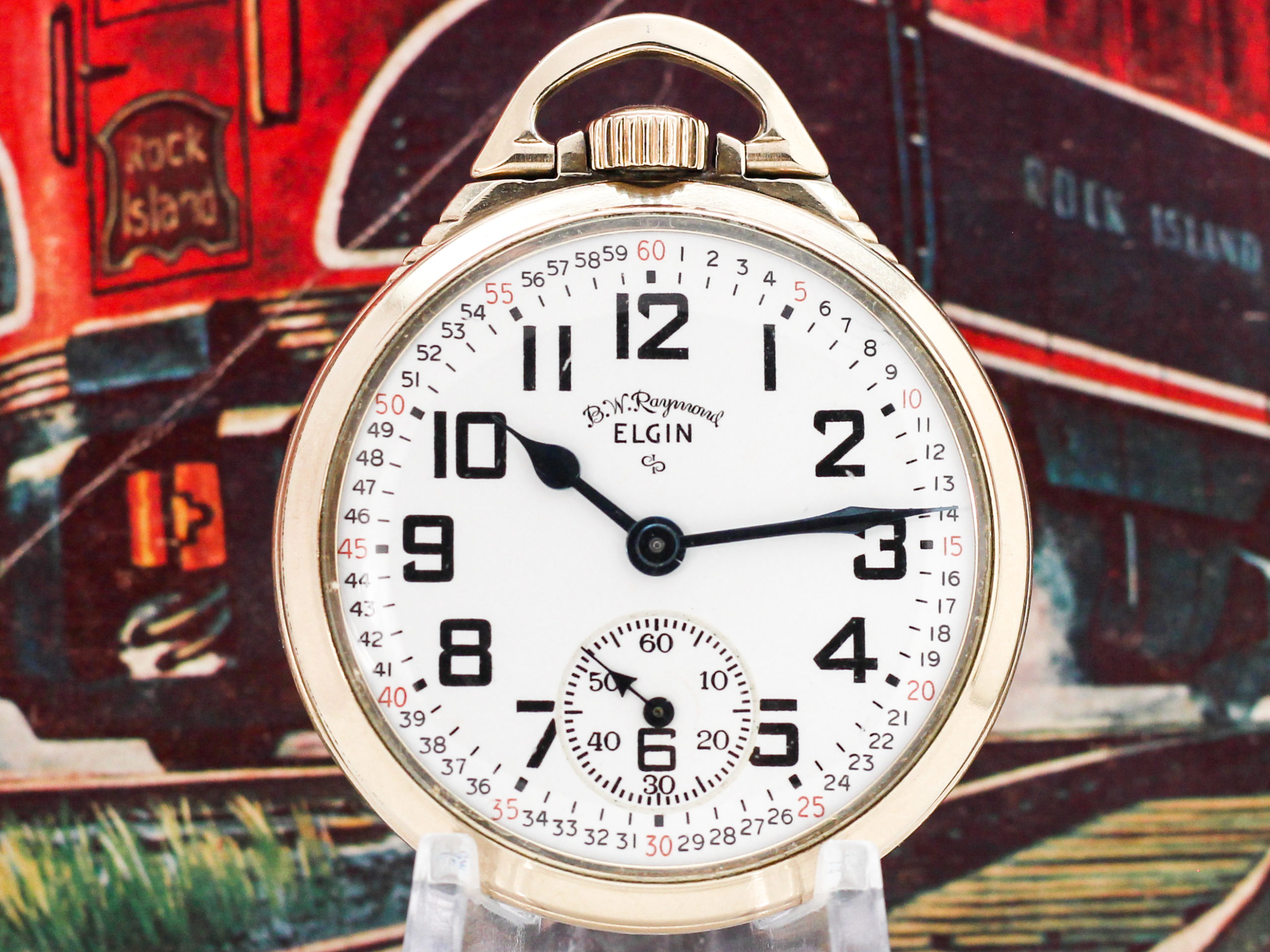
The Grade 571 is the one that gets me. Produced in 1952 and 1953 in very small numbers, 21 jewels, 16-size, housed in the Streamline case, and stamped at the very end of American railroad-grade production. When I say holding one of these is holding the last chapter of American watchmaking, I mean it literally.
I have one right now. Serial P803373. $1,750. If you want a railroad-grade Elgin with actual historical finality, that's the watch.
G.M. Wheeler, the dress watch with a pedigree
Named after an early Elgin master watchmaker, the G.M. Wheeler grade is Elgin's gentleman's dress movement. Not railroad-grade, usually 15 to 17 jewels, smaller sizes like 12s, often cased in solid gold. If you're buying for elegance rather than for the rails, the Wheeler is a beautiful thing and typically more affordable than a railroad grade.
What to look for when you're handling one
The movement first, always
Pop the back. I know that sounds obvious to someone who's been at this, but I still meet people who've bought a watch based on the case alone. The movement tells the whole story, grade name, jewel count, serial number, adjustment marks. A beautiful gold case with a tired 7-jewel movement inside is a pretty paperweight. A plain nickel-silver case with a serviced 23-jewel Veritas inside is a real watch.
Under the loupe, look at the plates. Damaskeen patterns, those swirling swirl lines, should be crisp. Screws should be clean and bright. Jewel settings should sit flush. If a movement looks wiped-down and dull, someone's been at it with the wrong cloth and it's probably been apart at least once.
The dial
Original dials hold a premium. Period. A hairline crack on an otherwise original porcelain dial bothers me less than a badly repainted "restored" dial. Refinished dials flooded the market in the last decade, and I can spot a bad repaint at ten paces. The good news is that pristine original Elgin dials, cared for since day one, still exist. Those are the ones worth chasing, and those are the ones I keep in the shop.
The case
Elgin movements were sold without cases, the watchmaker and customer selected the case separately at point of sale. So case and movement don't have to be "matched" in any serial-number sense. What you want is a case appropriate to the grade (railroad-grade movement deserves a railroad-appropriate case), no major dings, tight hinges, and a crown that pulls and pushes with purpose. Keystone, Wadsworth, and Star were the gold-standard case makers.
The serial number check
Every Elgin movement has a serial number engraved on one of the plates. Look it up, the Pocket Watch Database is the canonical resource, free, accurate. It will tell you the grade, the year produced, the size, and the jewel count the watch left the factory with. If what the dial says doesn't match what the database says, that's a conversation.
What you should expect to pay
Here's what the market looks like as I write this in spring 2026:
- Entry-level gentleman's watches (7–15 jewels, smaller sizes): $150 to $400 for a clean, running example.
- G.M. Wheeler and similar dress grades in solid gold: $600 to $1,500 depending on case weight and condition.
- Father Time and mid-tier railroad grades: $900 to $2,500. The 374 with a wind indicator sits at the top of that range.
- B.W. Raymond in standard cases: $1,200 to $2,500. Late-production examples like the 571 are a specific collector's market and harder to price casually.
- Veritas, all grades: $1,500 to $5,000+ depending on jewel count, case, and condition. Exceptional 23-jewel examples in solid gold can go higher.
One thing I'll say bluntly: compared to a Swiss luxury watch, every one of these is a bargain. A fully serviced, 100-year-old railroad Elgin that keeps time to within 30 seconds a week costs less than an entry-level Tudor. That is not going to last forever.
Looking to sell instead of buy?
If you've got an Elgin sitting in a drawer, inherited, estate, bought years ago and never wound. I buy watches every week. I pay what they're worth because I sell to collectors who know the difference between a 7-jewel gent's watch and a 23-jewel Veritas. No lowballing, no hard sell, no back-and-forth. Send me a few photos through the site or give me a call at (310) 486-0572 and I'll get you a number the same day, most of the time inside an hour.
Need one serviced?
An Elgin that hasn't been touched in twenty years probably isn't broken. It's just thirsty. The oils dry out. Dirt works in. A mainspring loses some of its fire. A proper service (full disassembly, ultrasonic cleaning, new oil, re-timing on a timegrapher) brings it right back. I service Elgins every week in the shop. Send me photos of what you've got or call (310) 486-0572 and we'll talk about what it needs.
Frequently asked questions
How do I know if my Elgin is railroad-grade?
Minimum 17 jewels (most railroad grades are 21 or 23), open-face case, lever-set (not pendant-set), size 16 or 18, adjusted to at least 5 positions and temperature, and the grade name itself. Veritas, Father Time, B.W. Raymond are the giveaways. A G.M. Wheeler or an unnamed 15-jewel grade is almost never a railroad watch, no matter how pretty the case is.
What's the difference between 16-size and 18-size?
Size refers to the diameter of the movement. An 18-size is about 1.77 inches across, a 16-size is about 1.71 inches. Early railroad watches were mostly 18s. Starting around 1905 the 16-size became the new standard because factories could hit railroad accuracy in a smaller package. For a collector, 18-size watches have more physical presence in the hand. 16-size are a bit more wearable if you actually carry one. Both are equally valid. It's a personal call.
Will a 100-year-old Elgin still keep good time?
A properly serviced one? Absolutely. I've got Elgins on my own bench right now running within 10 seconds a day, and some within 2 seconds. These were built to last. The key word is "properly serviced", oil dries out, pivots wear, and a watch that hasn't seen a watchmaker in thirty years is probably running on fumes. Get it serviced, and a good Elgin will outlive you.
Is it better to collect Elgin or Hamilton?
This is the most common question I hear. My honest answer: collect what catches your eye. Hamilton made fewer, higher-end movements. Their 950 and 992B are legendary, and they command premium prices. Elgin made a much wider range, which means more variety and more affordable entry points. Plenty of serious collectors own both. If you want a canvas that spans the full Golden Age of American watchmaking, Elgin gives you that. If you want the absolute top of the railroad-grade pyramid on a single name, Hamilton is hard to beat.
Should I buy a serviced watch or one that needs work?
Almost always a serviced one, especially if you're starting out. A watch that's been through my bench, or any reputable watchmaker's, comes to you running, timed, and ready to carry. A project watch can be a great deal if you know what you're getting into and you have a watchmaker you trust. If you don't yet, buy serviced. You'll save the headache and probably the money.
Happy collecting. If any of this raises questions, specific grades, specific watches, whether something you own is what you think it is, you know where to find me.