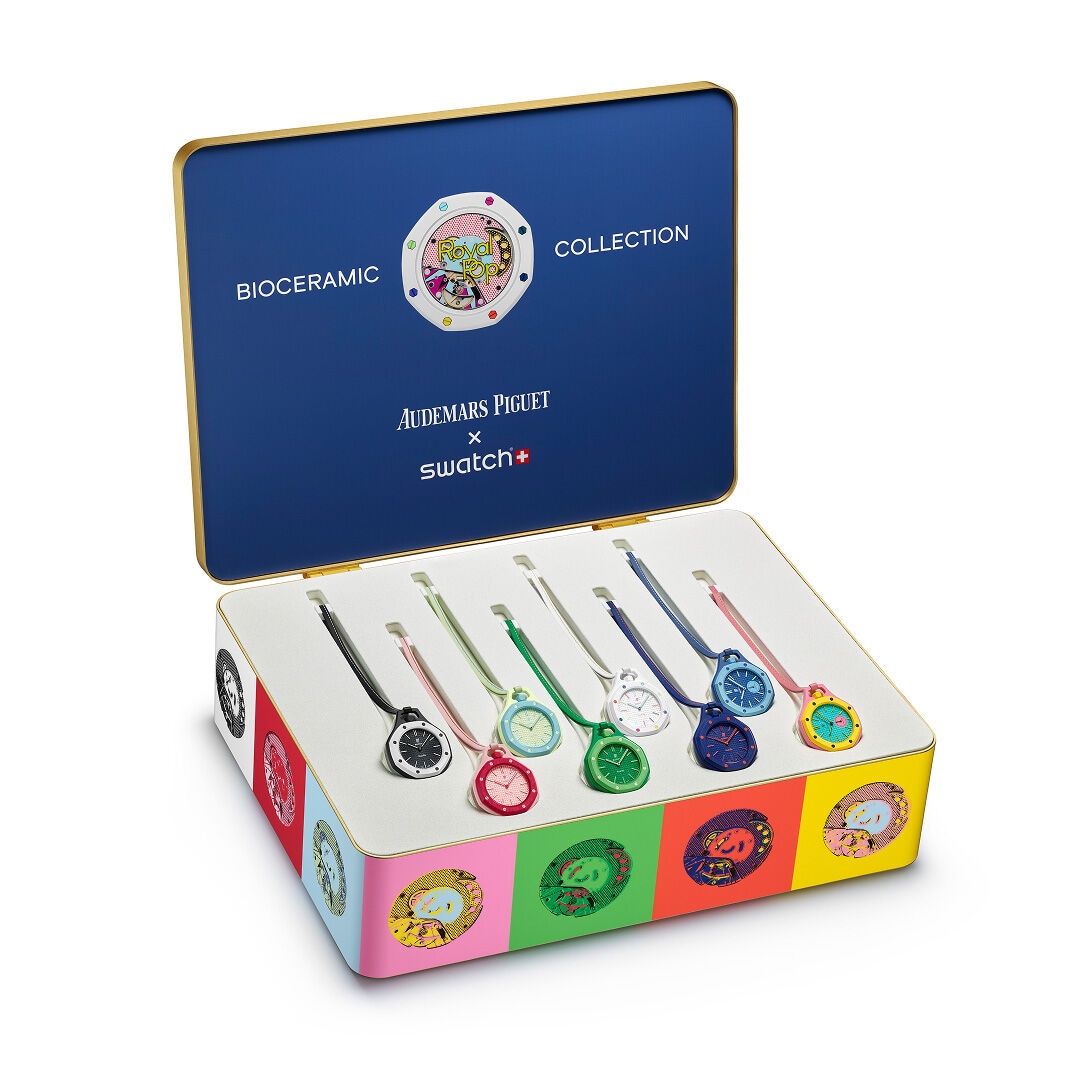
Something you might not notice in all the noise around the new Audemars Piguet x Swatch "Royal Pop" is that it is, of all things, a pocket watch. After weeks of teasers that had the whole watch internet bracing for another wrist drop in the MoonSwatch mold, the two brands instead handed everyone a 40mm Bioceramic octagon on a calfskin lanyard. Eight colors. A hand-wound SISTEM51 inside. $400 retail. And, quietly, a reference number on the back that points straight back to the 1970s.
I do not sell new Swiss watches. I buy, service, and sell vintage American ones. But I have been watching this rollout closely, because the Royal Pop is one of the rare modern releases that actually sends people back to the history I care about. Specifically, it sends them back to a chapter most folks have never heard of: Audemars Piguet's octagonal pocket watches from the late 1960s and 1970s. And once you see the line that runs from those rarities to the new Swatch, the contrast with what was happening in Lancaster, Pennsylvania and Elgin, Illinois at the same time becomes the more interesting story.
The 5697 Connection: Why an Octagon in Your Pocket
Everyone knows the Royal Oak as Gérald Genta's 1972 wristwatch. The octagonal bezel, the eight hexagonal screws, the tapisserie dial. What gets forgotten is that AP carried that geometry over to pocket watches almost immediately. Through the 1960s and 70s, the manufacture quietly produced a run of ultra-thin polygonal and octagonal pocket watches, culminating in a reference that long-time AP collectors recognize on sight: the 5691, later renumbered 35691 in the mid-1980s. It was, in essence, the first time the Royal Oak design language stepped away from the bracelet and lived as its own object.
That 1970s 5691 is the seed of the new Royal Pop. The case measures 44mm, sits ultra-thin in a waistcoat pocket, has the same octagonal bezel punctuated by eight hexagonal screws, and carries the classic Petite Tapisserie dial with gold sword hands. The brand has also produced related references like the 5690 in yellow gold, with the same family logic: clean, formal, angular, manual-wind. These were not promotional pieces. They were quiet expressions of AP's belief that a great case shape does not need a wrist to justify itself.
So when Audemars Piguet stamped the new Swatch collaboration with the reference 5697, that was not a random number. It is a direct nod to a model line that AP has been producing in very small quantities for decades, and the very first time the brand has licensed the Royal Oak silhouette to anyone outside its own production. That detail is the whole reason to take the Royal Pop seriously rather than write it off as a streetwear stunt.
The Modern Specs: Eight Colors, Two Layouts, One New Movement
For the collectors who like the granular details: the Royal Pop comes in two case formats. The Lépine style, with the crown at 12, is offered in six colors and shows hours and minutes only. The Savonnette style moves the crown to 3 and adds a small seconds sub-dial. Eight colorways total, each named for the word "eight" in a different language, in a nod to the eight visible screws on the Royal Oak bezel.
The case is 40mm across and 8.4mm thick on its own, expanding to roughly 44.2mm by 53.2mm once it snaps into its clip holder. Bioceramic shell, sapphire crystals front and back, Super-LumiNova Grade A on the hands and indices. The movement is the headline: a brand-new hand-wound version of Swatch's SISTEM51, with 15 active patents, a 90-hour power reserve, a Nivachron anti-magnetic balance spring, and laser-based precision adjustment performed at the factory. The barrel doubles as a power-reserve indicator visible through the caseback. Gold when wound, gray when it is time to wind again. Cute, and actually useful.
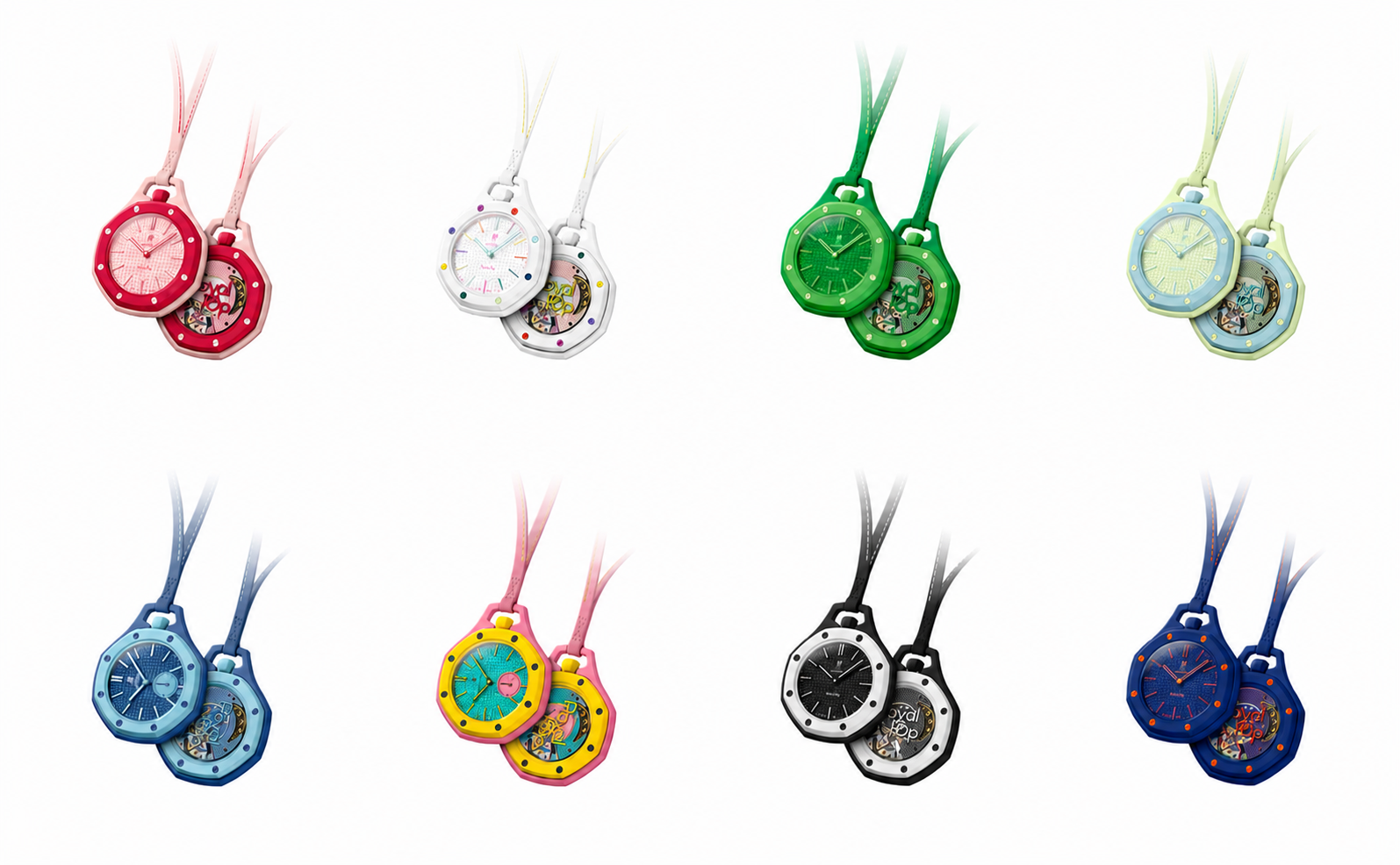
Retail is $400 for the Lépine, $420 for the Savonnette, in-store only at selected Swatch boutiques, one per person per store per day. Audemars Piguet has committed 100% of its proceeds to an initiative supporting the preservation of watchmaking savoir-faire. That last detail is the one that, to me, lands the project with some grace. AP did not need the money. They are spending the goodwill instead.
The Horological Contrast: Ultra-Thin Switzerland vs. the Engines of the Rail
Here is where I get to talk about the watches I actually love. While AP was hand-finishing those polygonal pocket watches in Le Brassus in the 1970s, the chapter that defined American horology was already a generation behind it, but it had been writing the rules for precision the entire industry still measures against. The American pocket watch was not designed to be ultra-thin. It was designed to keep a freight train on the right side of a single-track switch in the dark.
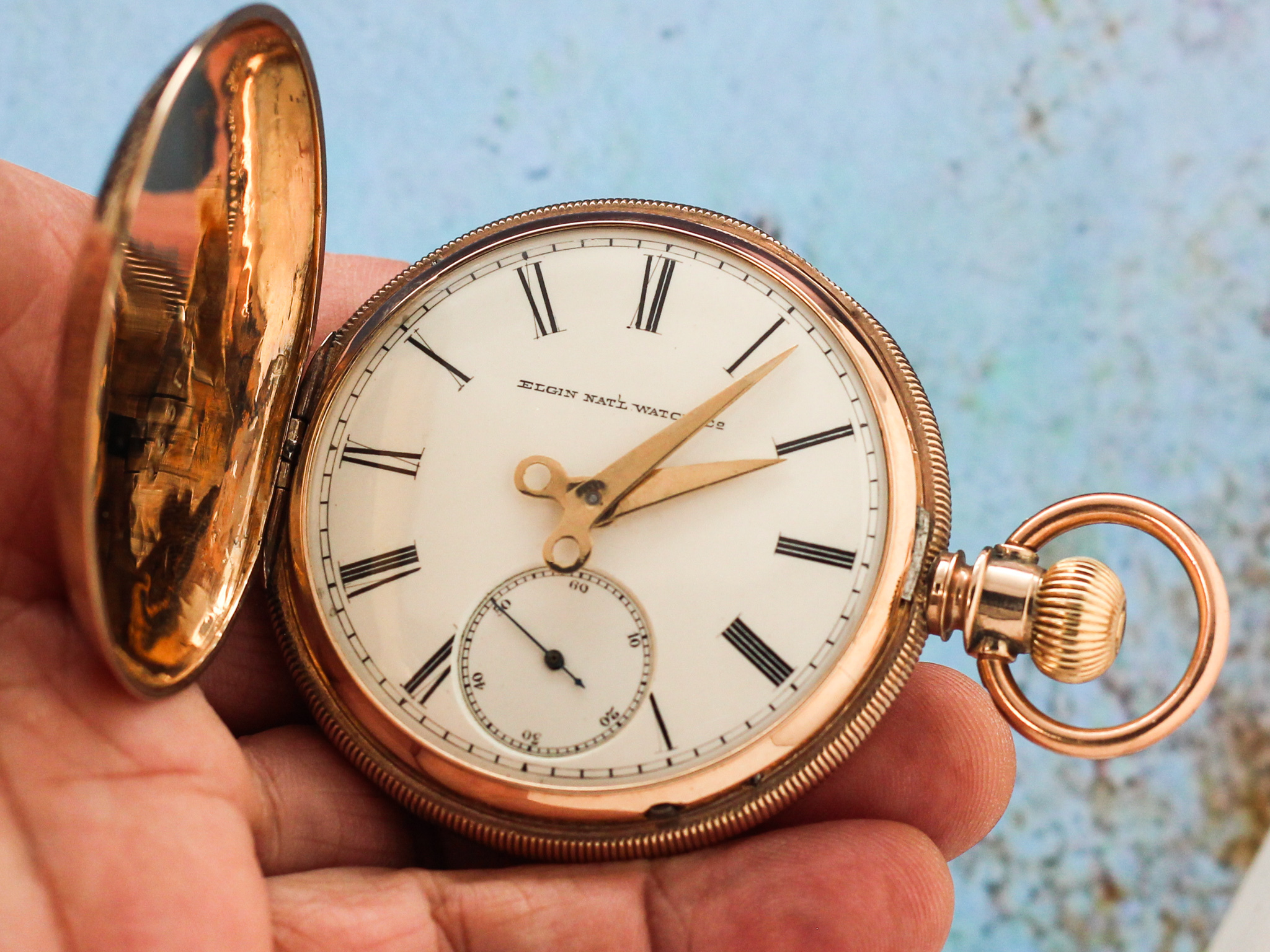
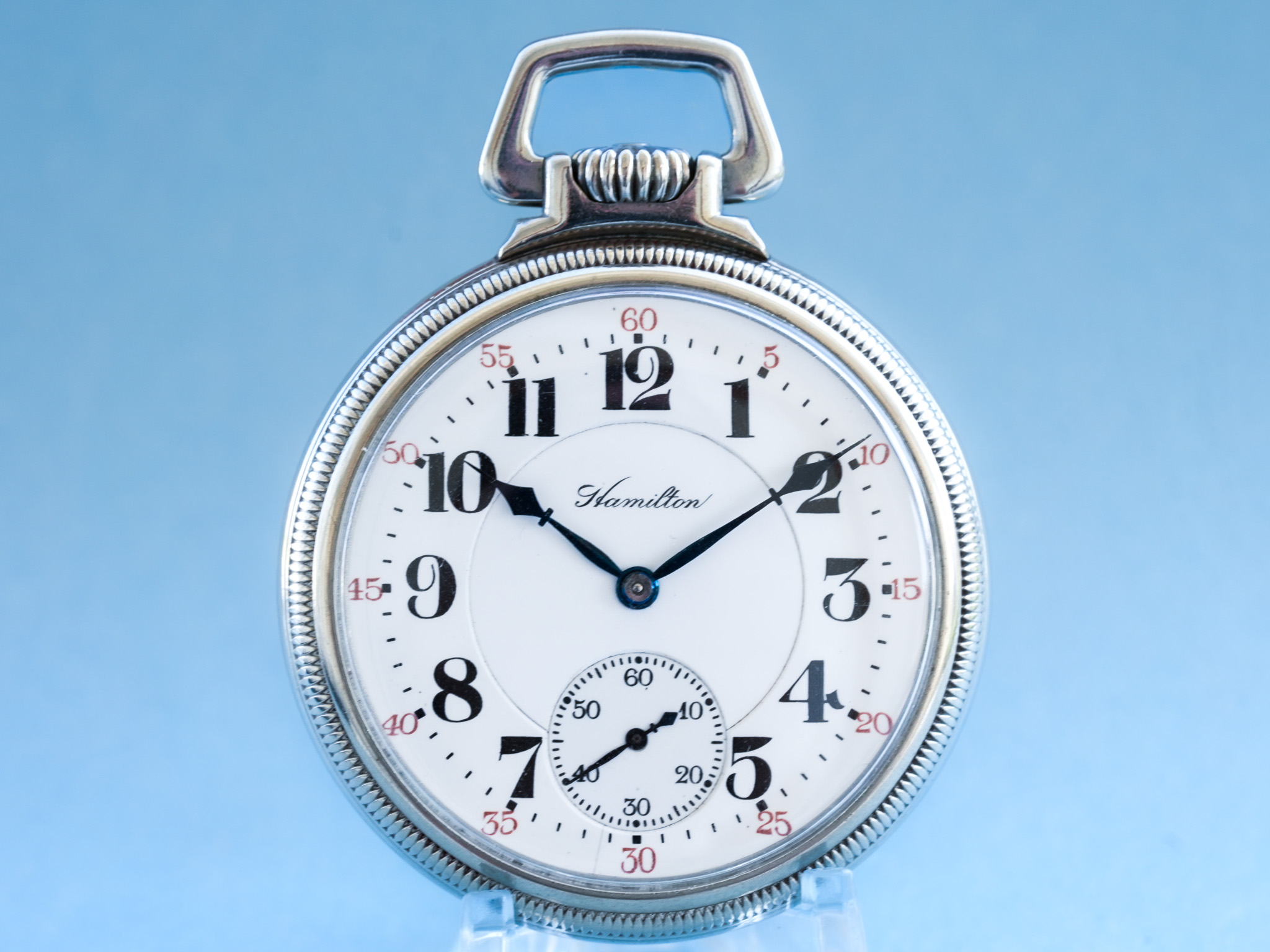
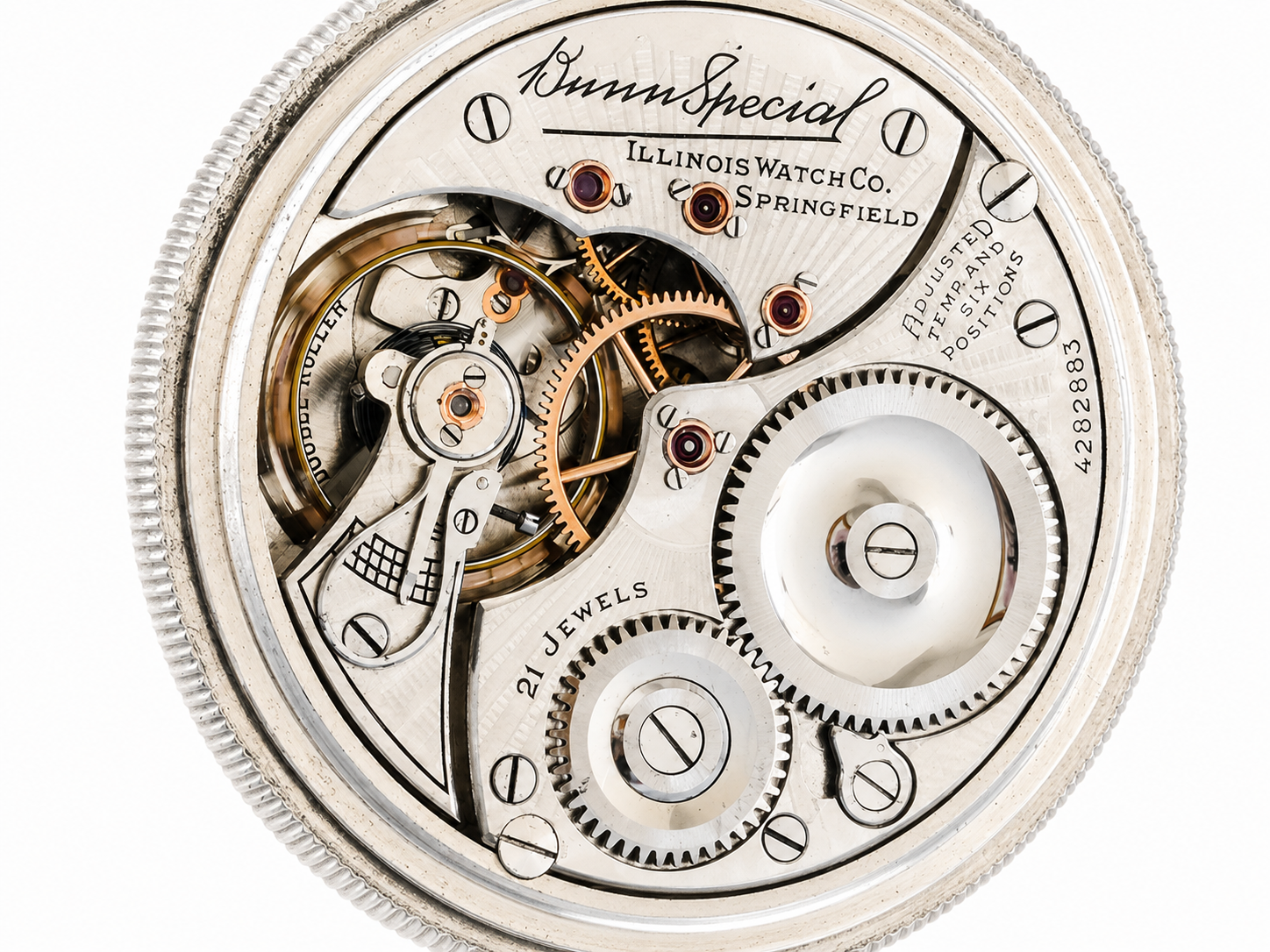
Look at a 1929 Hamilton 992E, a 1928 Hamilton 950, or a 1923 Illinois Bunn Special and you are looking at a different design philosophy entirely. These are 16-size railroad grades, 21 to 23 jewels, with gold jewel settings, mar-free screws, micrometric regulators, and Elinvar or Invar hairsprings engineered specifically to resist temperature and magnetism long before "anti-magnetic" was marketing copy. The standard they had to meet, the General Railroad Timepiece Standards, required them to run within 30 seconds a week. A week. In a coal-dusty pocket, on a moving train, in summer or winter.
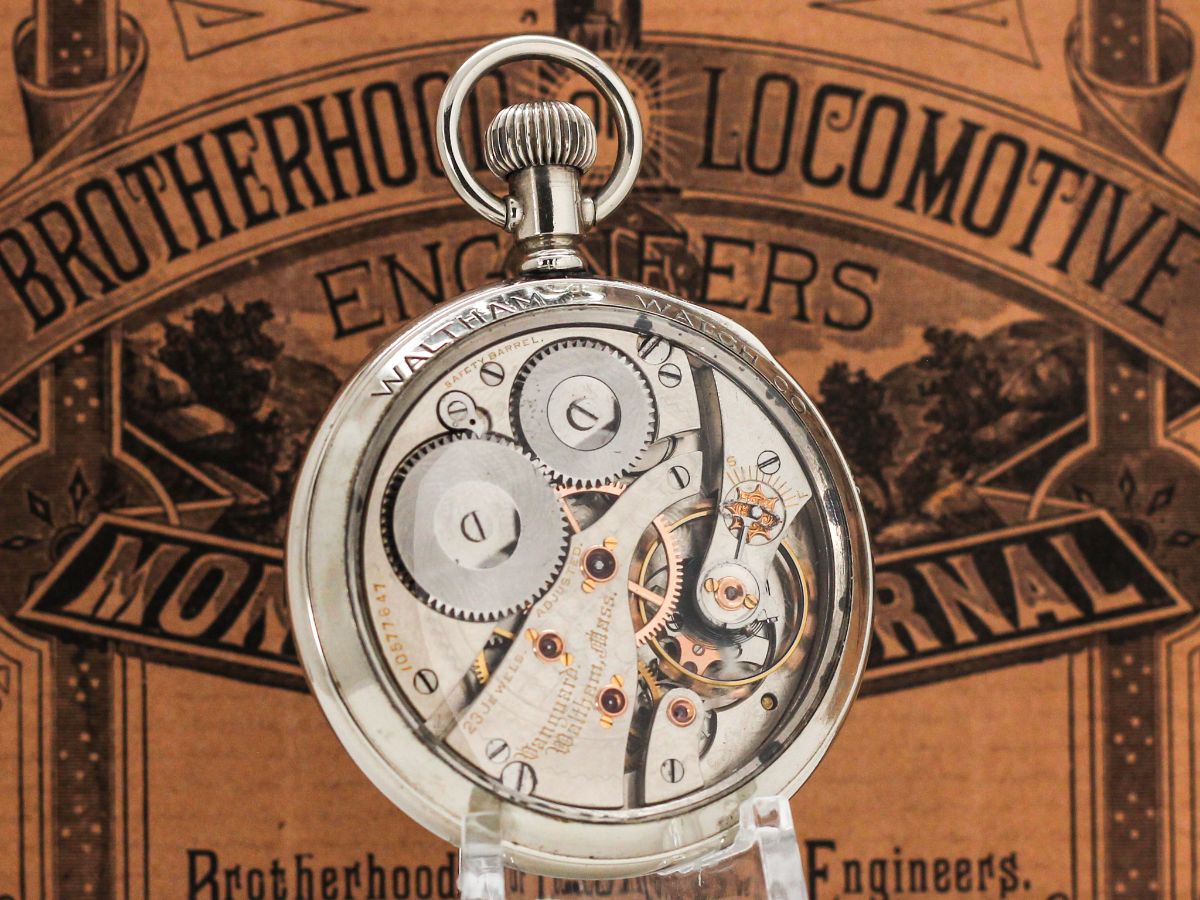
I have one of those Hamiltons in the case right now: a 1940 Hamilton 992E with the Elinvar hairspring, housed in a Model 10 case. 1940. The year Roosevelt won a third term and the Battle of Britain unfolded in the skies over Kent. The Elinvar alloy in that hairspring was a horological breakthrough patented by Charles-Édouard Guillaume, who had won the Nobel Prize in Physics for that family of alloys in 1920. The same problem AP and Swatch are solving today with their Nivachron, Hamilton was solving in Lancaster, Pennsylvania nearly a century ago, with a hairspring you can see through the open caseback.
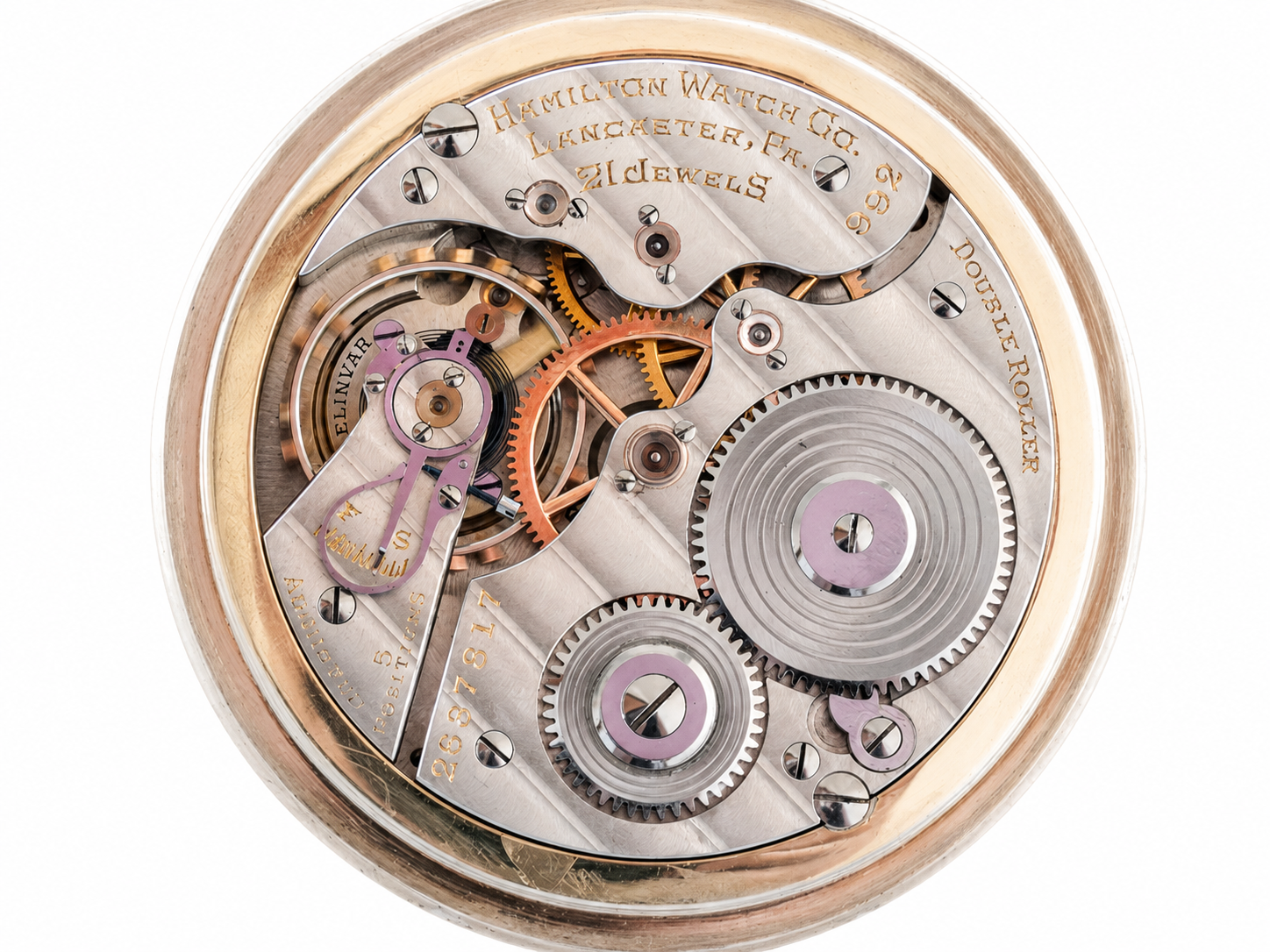
That is the through-line of these American watches. They fueled the industrialization of this country and the synchronization of a continent. The transcontinental railroad, the telegraph, the war effort, the modern banking day; none of it works without a man on a depot platform who knows, to the second, what time it is. AP's 1970s pocket watches were beautiful objects of taste. The American railroad grades were the precision instruments that taught a country how to be on time.
A Word on Craftsmanship Then
Take the 1923 Illinois Bunn Special housed in its original salesman display case. The damascening across the plates was hand-applied. The jewel settings are gold, screwed into the plate rather than pressed in. The regulator is a micrometric design that lets you adjust rate in fractions of a second per day. To finish a movement at this level today, with this much hand-work per piece, would put a watch into a price tier the Royal Pop is not interested in playing in, and frankly that most modern Swiss houses no longer try to occupy at all in production volume.
The Collector's Dilemma: Hype vs. Heritage
So here is the question I have been getting from friends and customers all week. Is a $400 Bioceramic Royal Pop a better buy than a $1,500 to $3,000 restored American railroad watch from the golden age?
The honest answer is that they are not the same purchase. The Royal Pop is, as Swatch and AP have been transparent about, a styling object with a mechanical heart. It is going to be fun. It will probably hold value reasonably well for a year or two on the secondary market, the way MoonSwatches did, and then settle somewhere. The SISTEM51 is a genuinely clever movement, but it is built for assembly-line economics, not for service over generations. When something goes wrong with one, you typically swap the movement rather than rebuild it.
A serviced 1927 Hamilton 992 with a Montgomery dial at $1,450, or a 1940 992E at $2,295, is the opposite proposition. These movements have already been running for nearly a hundred years. Cleaned, oiled, adjusted in multiple positions, they will keep running for another hundred. They were designed to be rebuilt. The jewels can be replaced. The mainspring can be replaced. The hairspring can be re-formed. There is no proprietary cassette to fail and become unobtainable.
If you want a colorful object to clip to a tote bag, the Royal Pop is wonderful at being a Royal Pop. If you want a mechanical pocket watch that is going to outlive both of us and tell a story rooted in the years it was made, the math points somewhere else.
If the AP Octagon Sent You Down the Rabbit Hole
Plenty of folks who lined up for the Royal Pop will, a year from now, want to know what a "real" antique pocket watch feels like in the hand. Heavier than they expect. Warmer. Quieter on the wind. Here are a few from the case that I think speak the loudest, each with a year of manufacture that anchors it to something worth remembering.
The 1928 Hamilton 950 at $2,750. The 950 is a 23-jewel railroad grade, the top-tier Hamilton of its era. 1928 was the year Alexander Fleming discovered penicillin and Amelia Earhart became the first woman to cross the Atlantic by air. The 950's movement decoration, with its gilt highlights and gold jewel settings, is the kind of finish AP collectors will recognize instantly as the same vocabulary the manufacture was applying to its own pocket watches forty years later.
The 1912 Illinois 23-jewel Bunn Special with the rare Ferguson dial at $3,250. 1912 was the year the Titanic went down and New Mexico became a state. The Ferguson dial, with its bold outer ring of minute graduations and smaller inner ring of hours, was designed for absolutely unambiguous reading to eliminate errors in time-telling at a glance. This is what "legibility" meant before lume coatings and Super-LumiNova: a printer who understood how the eye actually finds a numeral on a moving train.
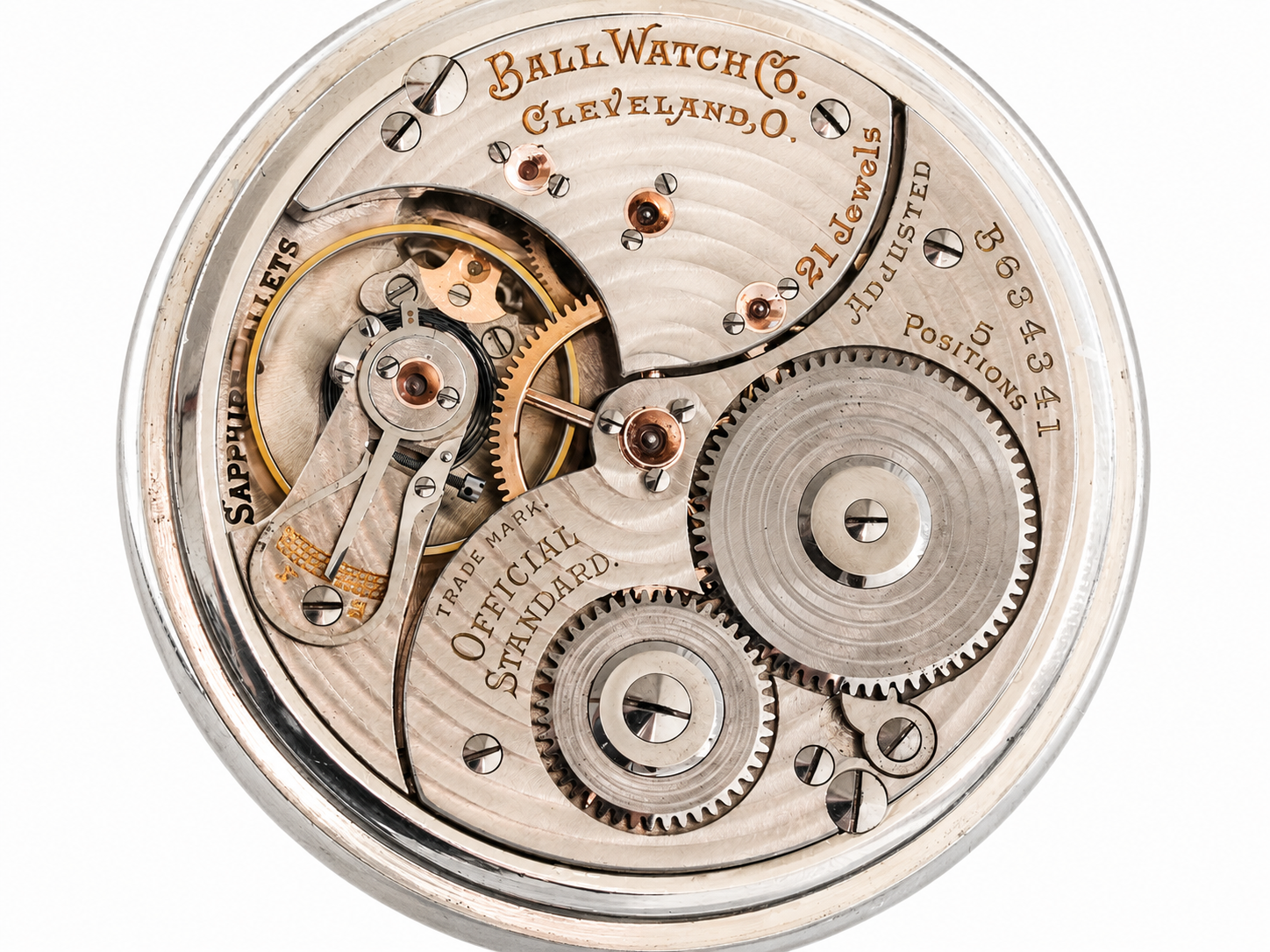
The 1929 Ball Hamilton 999P at $3,475. Webb C. Ball did not manufacture pocket watches. He set the inspection standards that the rail lines themselves adopted after the 1891 Kipton, Ohio collision, then partnered with Hamilton, Waltham, and Illinois to produce watches that met those standards under the Ball name. 1929 was the year the market crashed in October, and yet here is a watch from that year, made to a standard that has not been improved upon in the railroad context since.
If Your Watch Needs Help
If you already own a vintage pocket watch, American or Swiss, and it has been sitting in a drawer because the second hand stopped moving years ago, that is what my bench is for. Cleaning, lubrication, mainspring replacement, hairspring work, dial restoration when it is warranted. I service the kind of movements that were built to be serviced. Send me a note through the repair form and I will tell you honestly whether the watch is worth the work, what it will cost, and roughly how long it will take. No hard sell. Some watches deserve to be brought back. Some are better as sentimental keepsakes left as they are.
A Final Thought on the Octagon
The Royal Pop is a clever, generous project. AP gave up some control of its most iconic silhouette for the right reasons, and Swatch built a small mechanical object that will probably get more young people interested in mechanical watches than any single piece of marketing did this decade. I am glad it exists. I am especially glad it took the form of a pocket watch, because that has been a quietly returning conversation in collecting circles for the last few years.
But if the Royal Pop is the door, the American golden age of pocket watches is the room on the other side. Hamilton, Illinois, Elgin, Waltham, Ball; these makers built the instruments that synchronized a continent, and the best of them are still running. The finishing on those movements is, frankly, nothing short of incredible, and if produced today would put each one in a price tier that would surprise everyone. They were the computers of their day, performing complex mechanical calculations in real time, in your pocket, on a moving train. The Royal Pop is a wink at that history. The watches in my case are the history itself.
Frequently Asked Questions
Is the AP x Swatch Royal Pop actually a Royal Oak?
It carries Royal Oak design codes: the octagonal bezel, the eight hexagonal screws, the Petite Tapisserie dial pattern, the vertical satin finishing. But it is a pocket watch, not a wristwatch, and it specifically references AP's 5697 designation, which traces back to AP's own line of octagonal pocket watches from the 1960s and 70s, especially the reference 5691. It is a tribute to that quieter chapter of AP's history, not a budget Royal Oak wristwatch.
How does the SISTEM51 compare to a railroad-grade American pocket watch movement?
They are aimed at different things. The SISTEM51 is a genuinely innovative modern caliber, 100% automated in assembly, with 51 components and patents to its name. The American railroad grades from Hamilton, Illinois, and Waltham used 21 to 23 jewels, hand-adjusted regulators, hand-finished plates, and were designed to be opened, serviced, and rebuilt indefinitely. One is built for affordable mass production; the other was built so a watchmaker a hundred years later could still make it sing.
Will a vintage American pocket watch keep accurate time?
A properly serviced railroad-grade pocket watch, cleaned and oiled and adjusted, will typically run within a few seconds a day. Many will hold close to the original General Railroad Timepiece Standard of 30 seconds a week. The watches I sell are all serviced, oiled, adjusted for accuracy, and guaranteed for one year from the date of purchase.
Are pocket watches actually coming back?
In a real way, yes. The Royal Pop landing as a pocket watch rather than a wristwatch is part of a broader conversation about how mechanical objects can fit into modern life. A pocket watch lives on a desk, on a chain, in a jacket pocket, on a lanyard. It is a quieter relationship with time than a wristwatch. Antique American pocket watches scratch that itch with an extra hundred years of provenance.
I have an old pocket watch I want to sell. What do I do?
Take a few clear photos of the dial, the case, and especially the movement (the inside, with the back open), and reach out. I am always looking for honest, well-preserved American pocket watches: Hamilton, Illinois, Elgin, Waltham, Ball, Howard, Hampden, South Bend. Use the sell-your-watch form or call me directly at (310) 486-0572 and we can talk it through. Whether you are hunting for a Royal Pop or you want to handle the American railroad watches that set the world's standard for precision, I am happy to talk horology.