 Available
Ball Railroad Grade
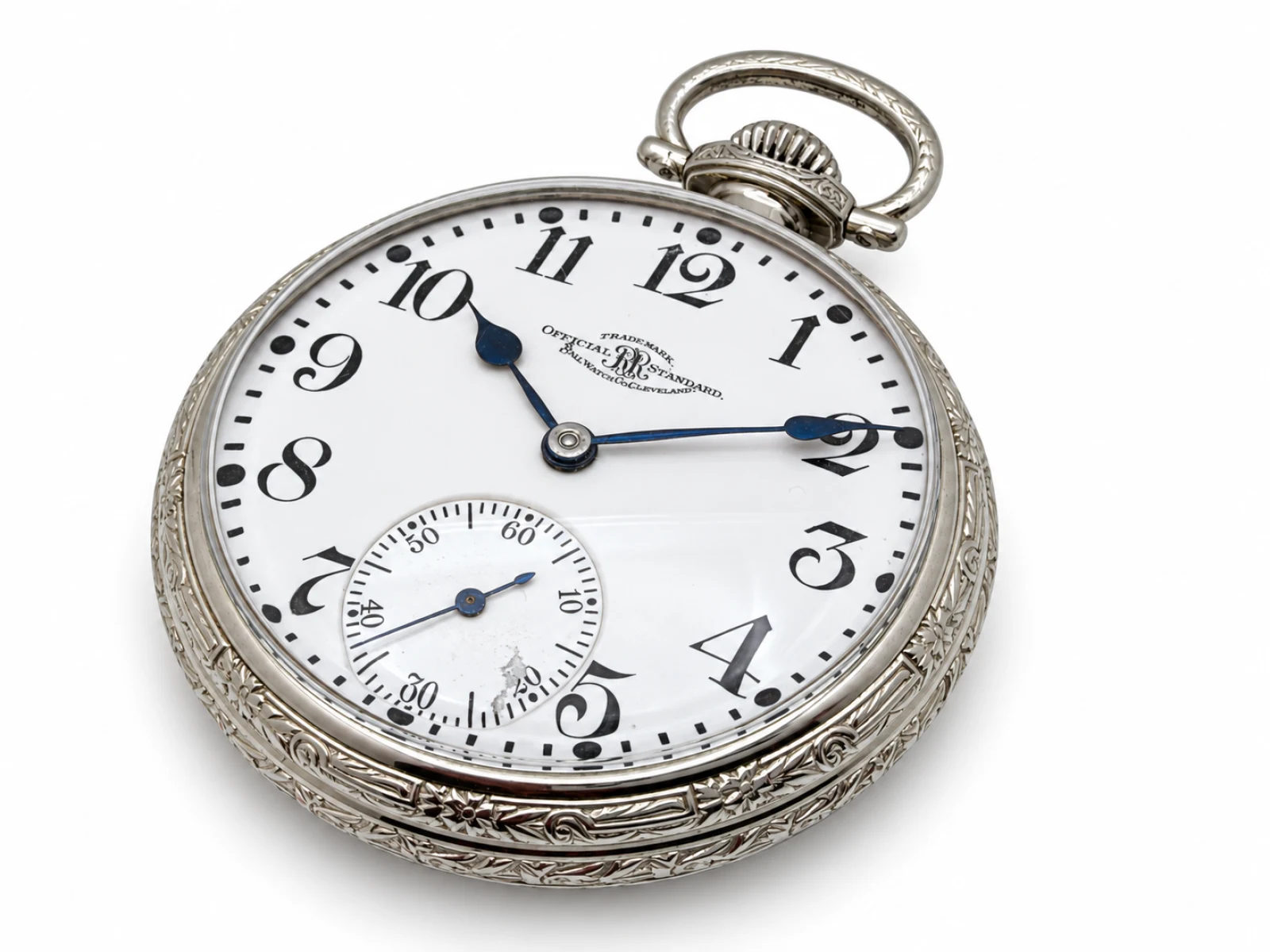
Ball-Waltham Official Standard 21 Jewel Railroad Pocket Watch (1920)
21 jewels in gold screw-set settings, adjusted to 5 positions, 14K white gold-filled Wadsworth Case
About this Ball-Waltham Official Standard Railroad
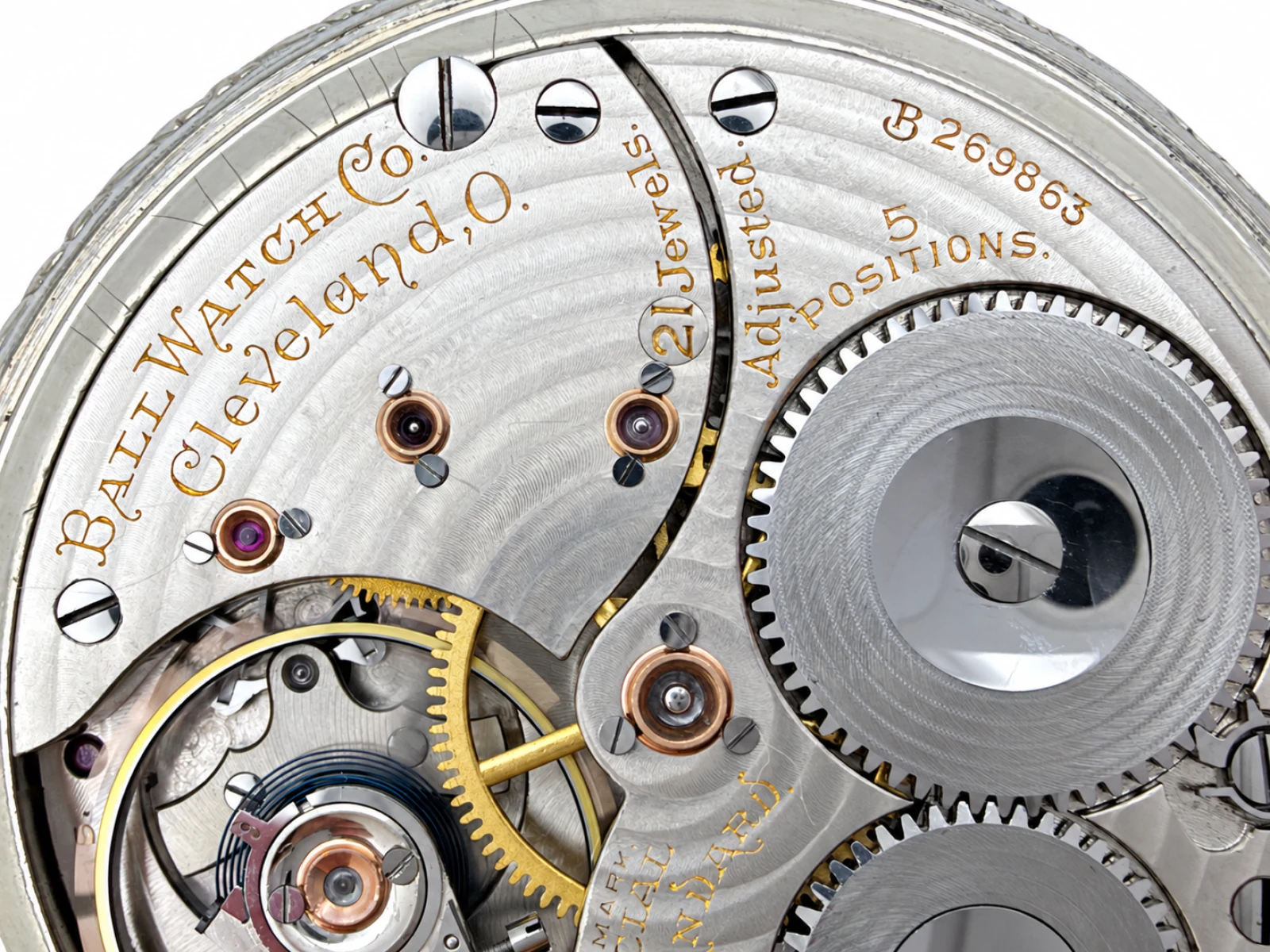
Webb C. Ball never built a watch movement himself. He was a Cleveland jeweler who, after the April 1891 collision at Kipton, Ohio, became Chief Time Inspector for the Lake Shore & Michigan Southern and spent the next three decades defining what a railroad watch had to be. For his 16-size watches he turned to the Waltham Watch Company, which built the movements to his specification and shipped them to Cleveland, where Ball's own watchmakers finished, timed and adjusted them before they went into service. This is one of those watches: a Ball-Waltham Official Standard, Model 1899, serial B269863, 21 jewels, dated to 1920 and made in a run of just 300 movements. Waltham's Ball serials end at about B271000 around 1922, so this example comes from the final years of the partnership. At 106 years old it is in excellent condition, serviced and ready to carry.
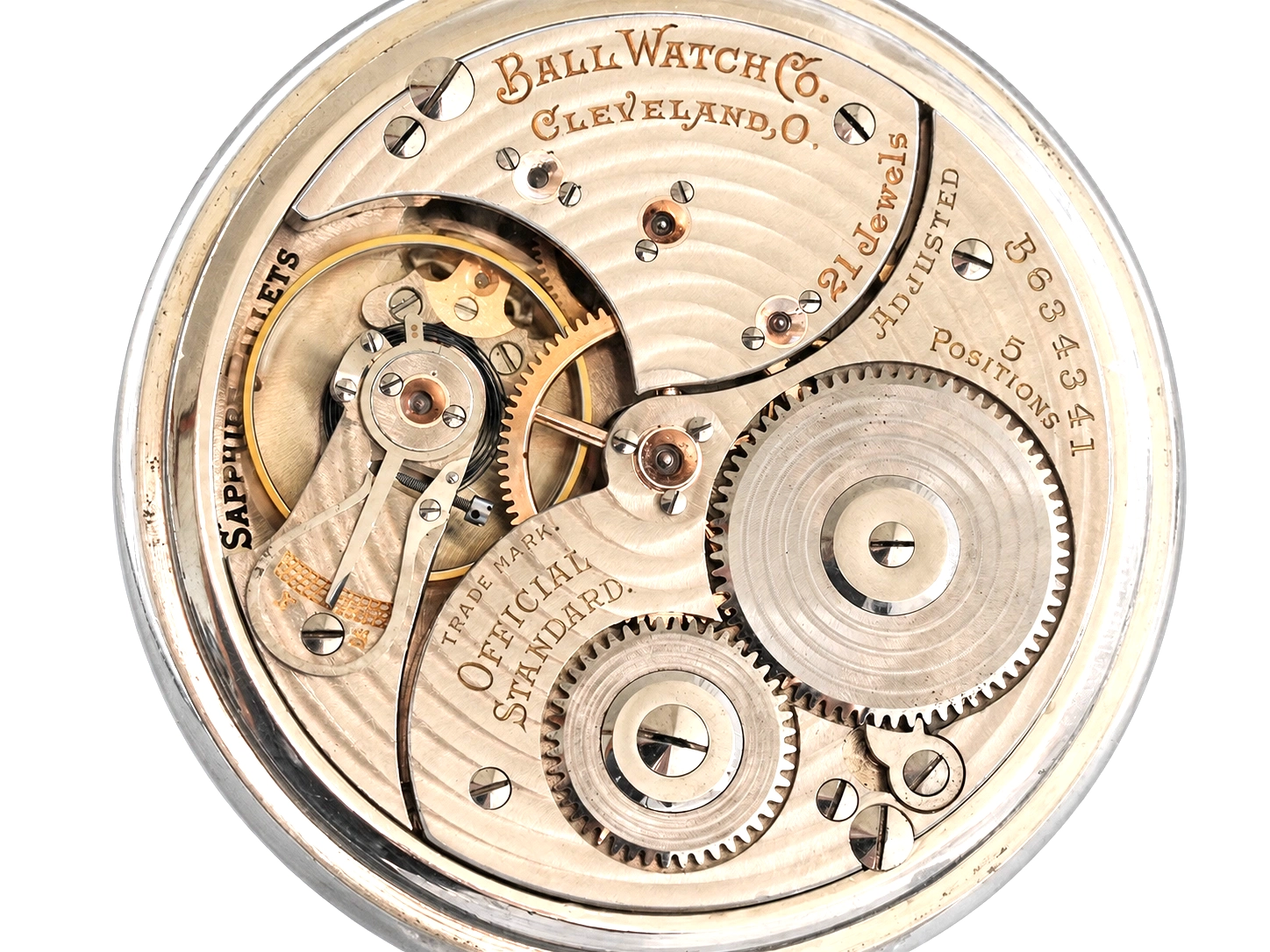
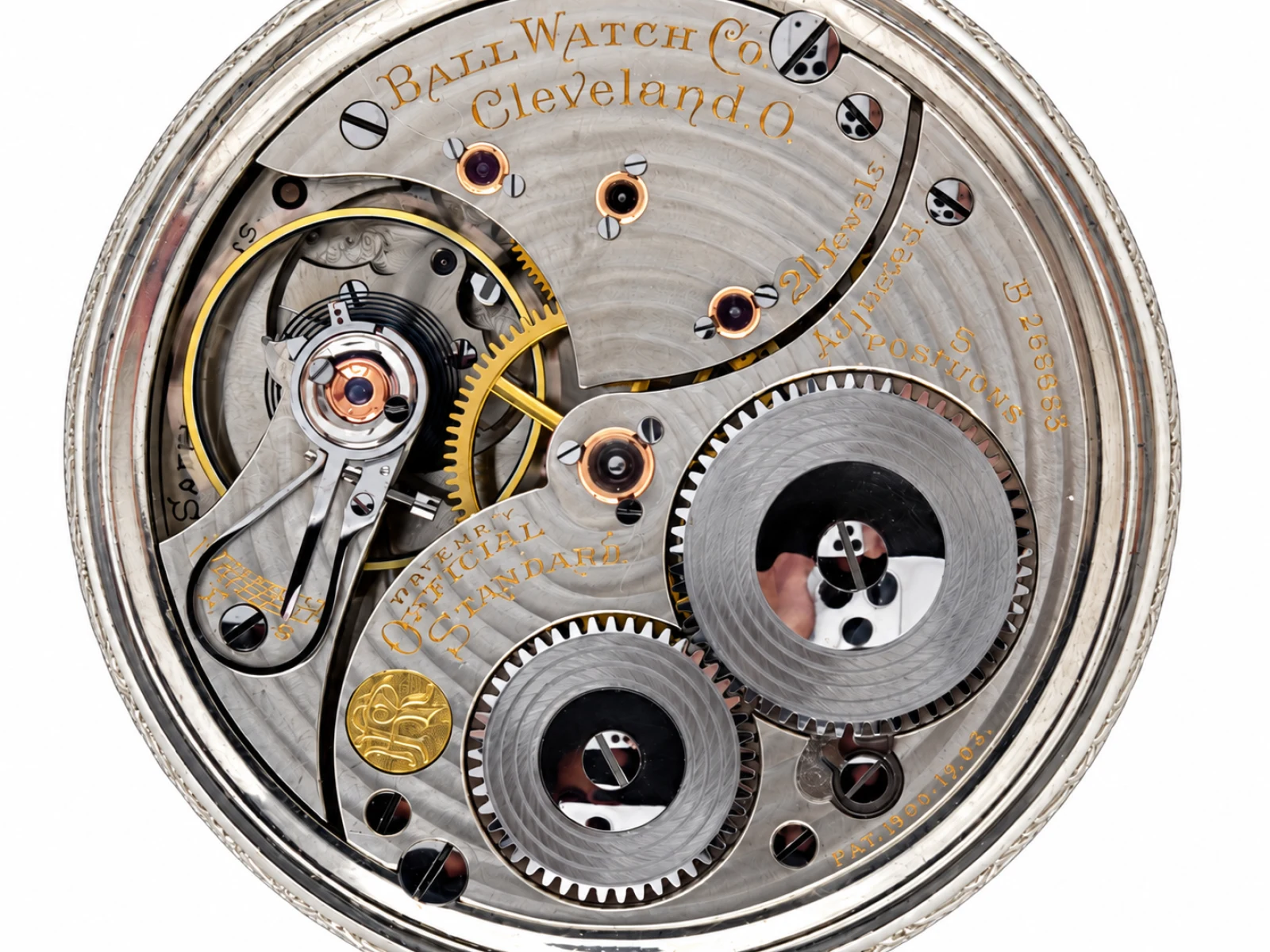
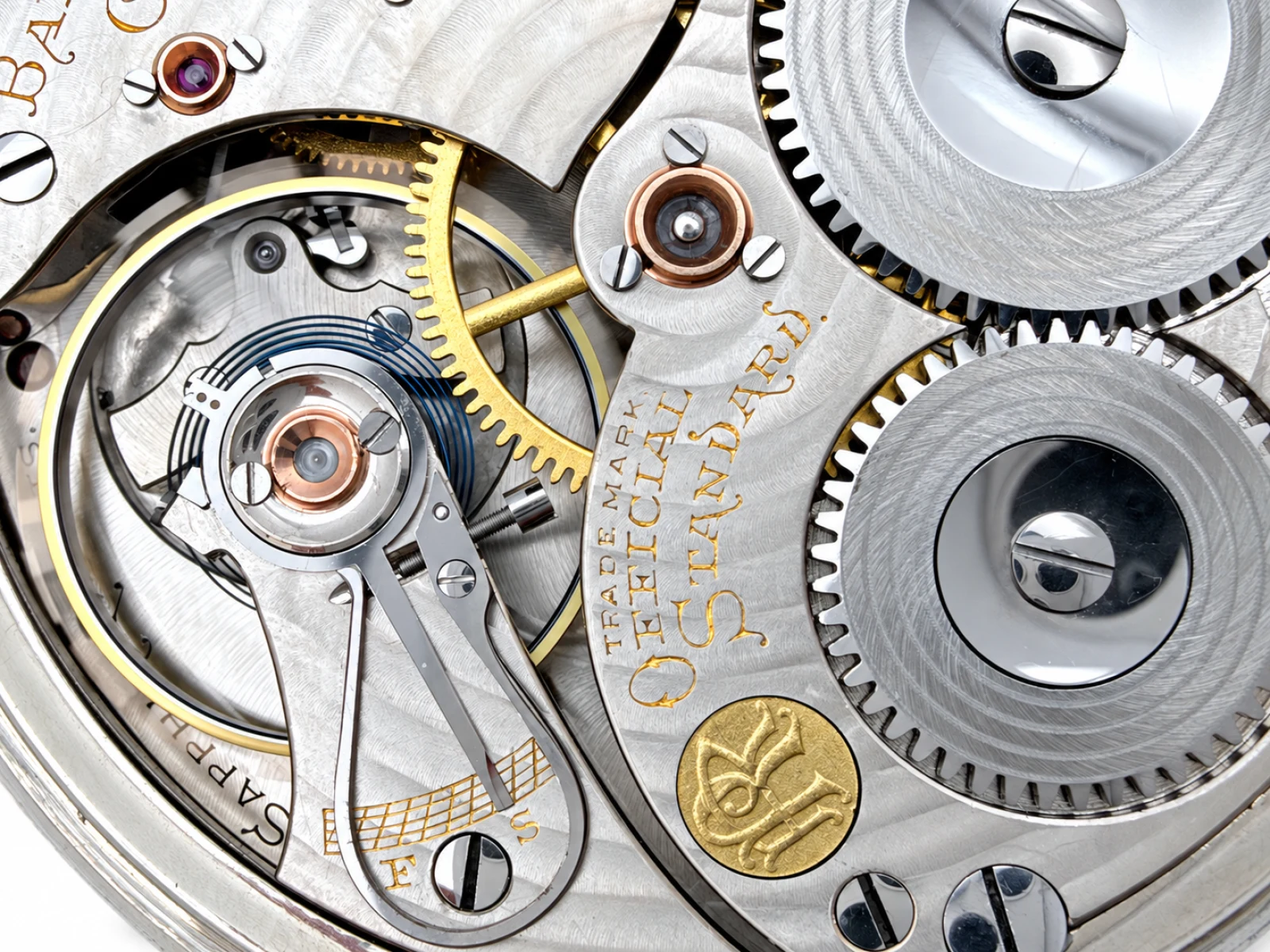
The nickel three-quarter plate movement carries 21 jewels in gold screw-set settings, each stone held in its own gold chaton by screws so a watchmaker can replace one without disturbing the plate. Beyond the 17 jewels of a standard railroad movement, four cap jewels sit on the escape wheel and pallet arbor pivots, letting those pivots run against polished end stones where the escapement does its work and keeping the rate steady as the watch changes position. It was adjusted to five positions (dial up, dial down, pendant up, pendant right and pendant left), to temperature, with a bimetallic compensating balance trimmed by its rim screws so heat and cold do not change the rate, and to isochronism, so it keeps the same rate fully wound as it does near the end of its run. A Breguet over coil hairspring breathes evenly around the balance staff, and a micrometric regulator of George Reed's 1867 whiplash pattern allows fine regulation by a single screw. It is lever set, the method railroads required so the hands could never be moved by accident while winding: with the bezel off and the setting lever drawn out, the clutch shifts the crown's work from the winding pinion to the setting wheels, which turn the minute wheel and cannon pinion to set the hands. The plates are finished in circular damaskeening, with the Ball Watch Co. Cleveland signature, the jewel count and the "Trade Mark Official Standard" engraved and filled in gold. The RR emblem set between Official and Standard is Ball's trademark for his railroad grade, the watches built to pass his time inspectors, and with 21 jewels and five-position adjustment this movement sits near the top of that line. Ball's own November 17, 1896 watch-plate design patent and a gold-inlaid Waltham medallion complete the plate.
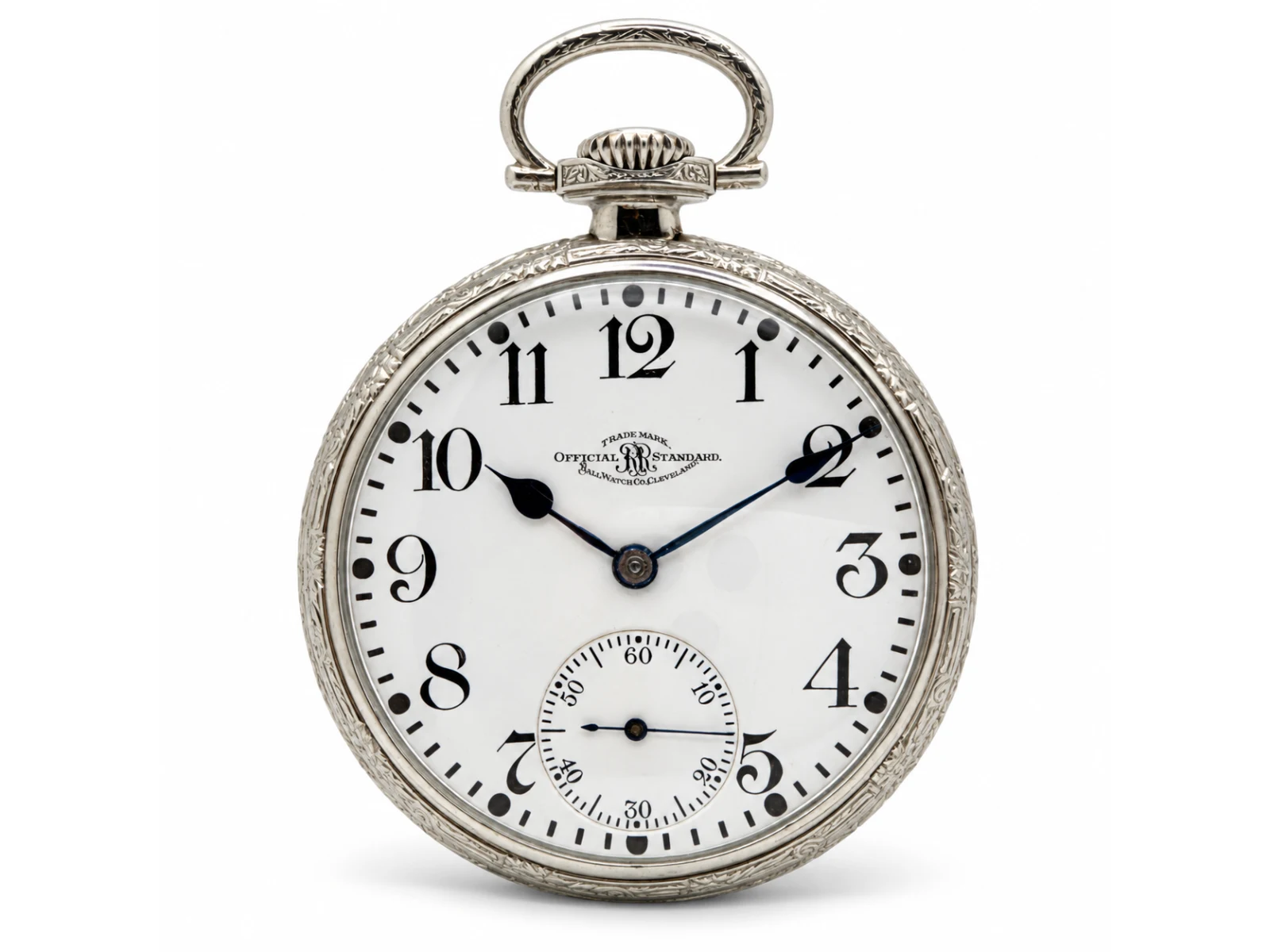
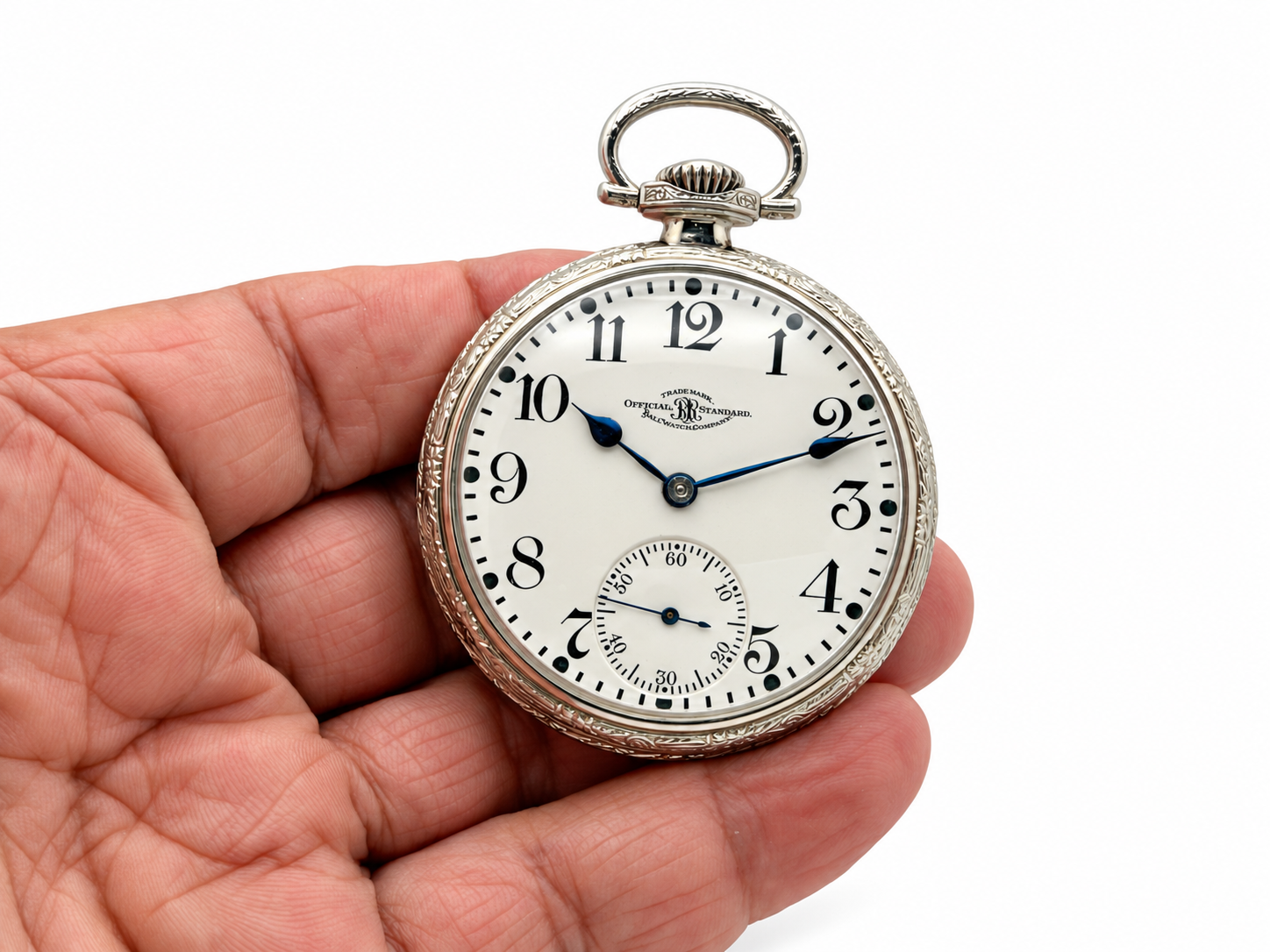
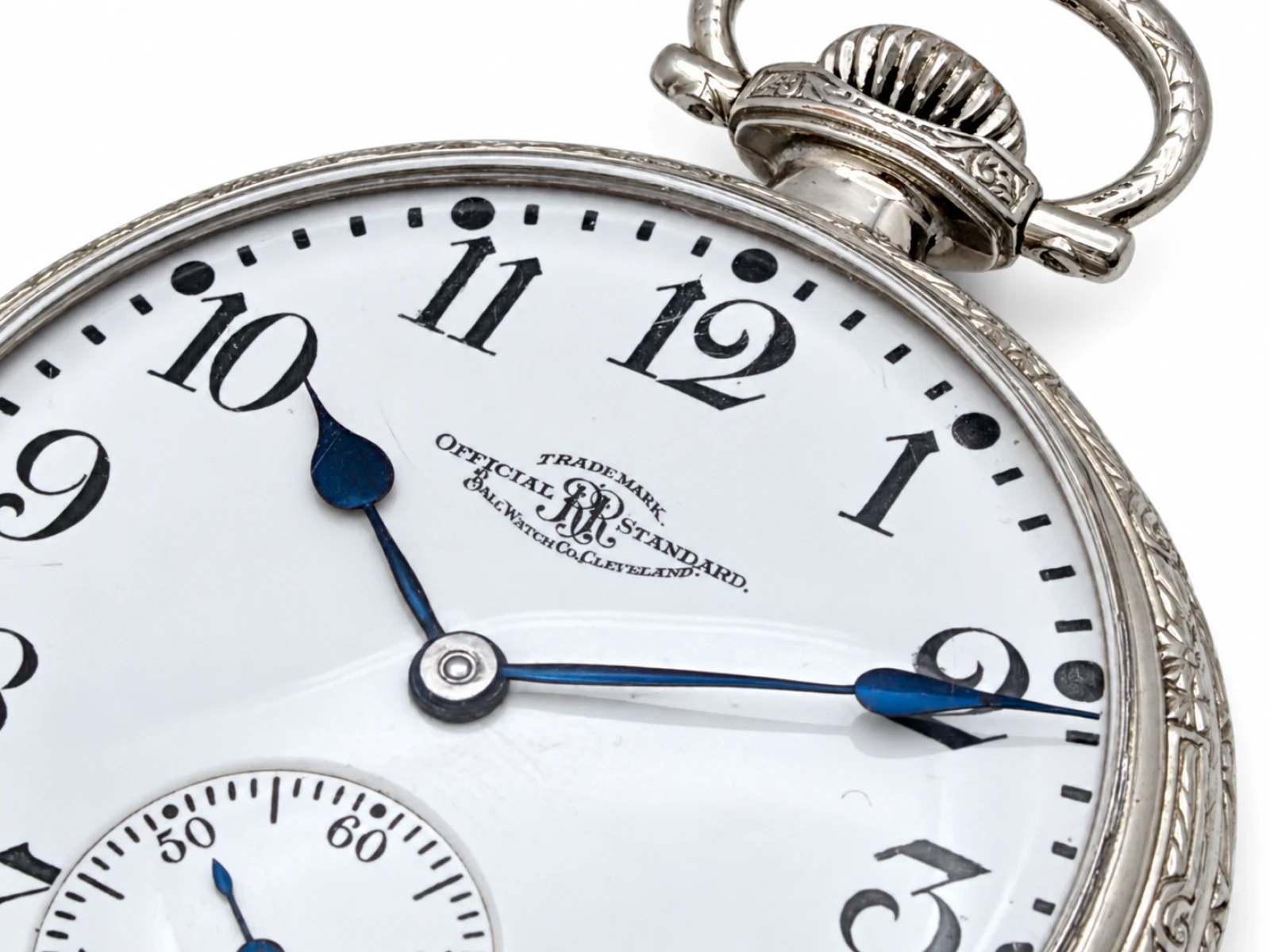
The dial is signed for Ball rather than Waltham, printed "Trade Mark, Official RR Standard, Ball Watch Co. Cleveland" on pristine bright white enamel. Its layout follows the rules Ball set out in his own writing on railroad time service: plain upright Arabic numerals, five-minute points marked by bold dots, lighter minute marks between them, and a subsidiary seconds register at six. Ball argued against fancy figures because train crews misread them at night, and this dial reads at a glance. Heat-blued steel spade hands, tempered until the steel turns a deep blue, stand out sharply against the white enamel. This dial is in excellent condition shows beautifully and is a wonderful interface with the user.
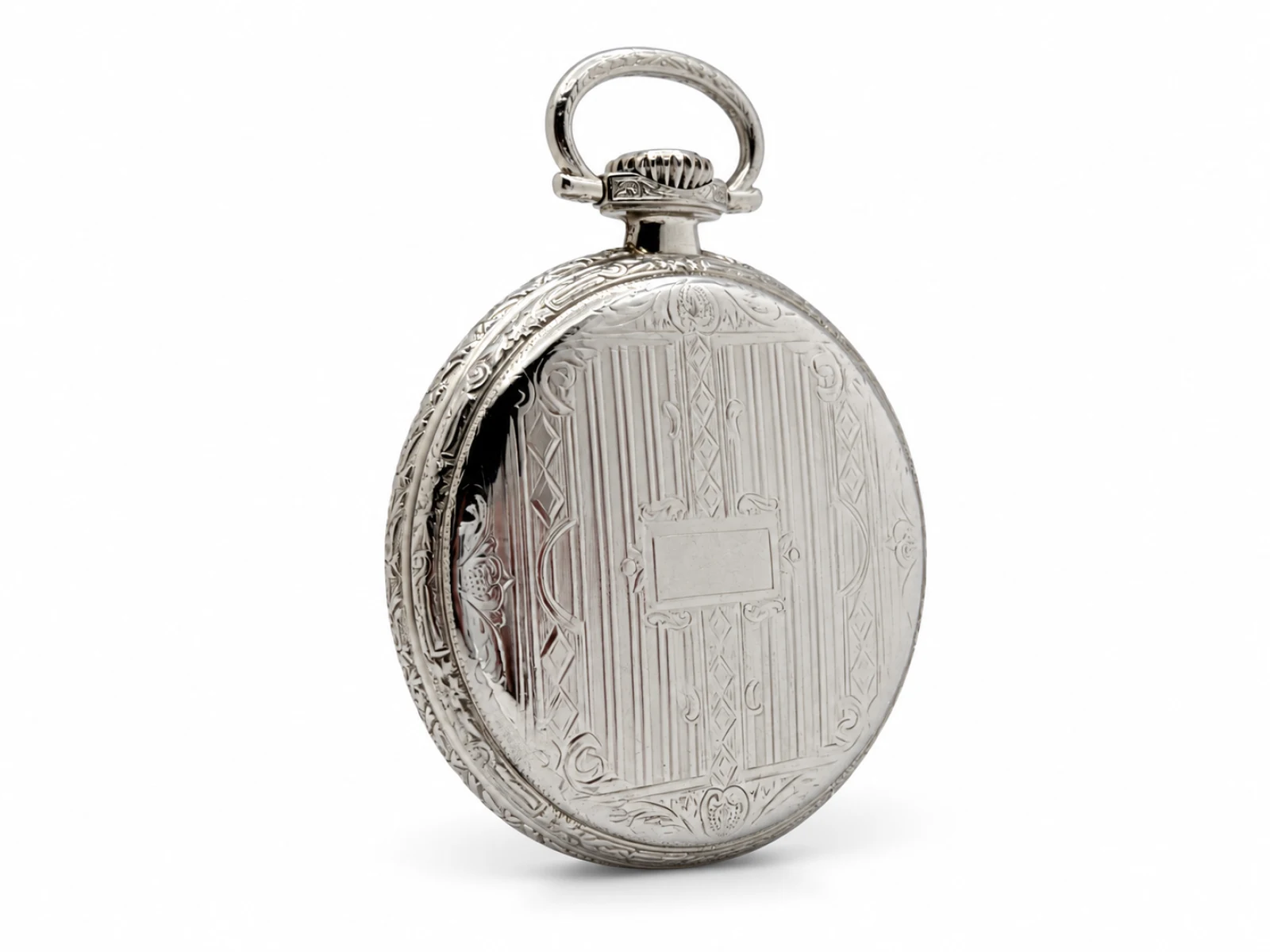
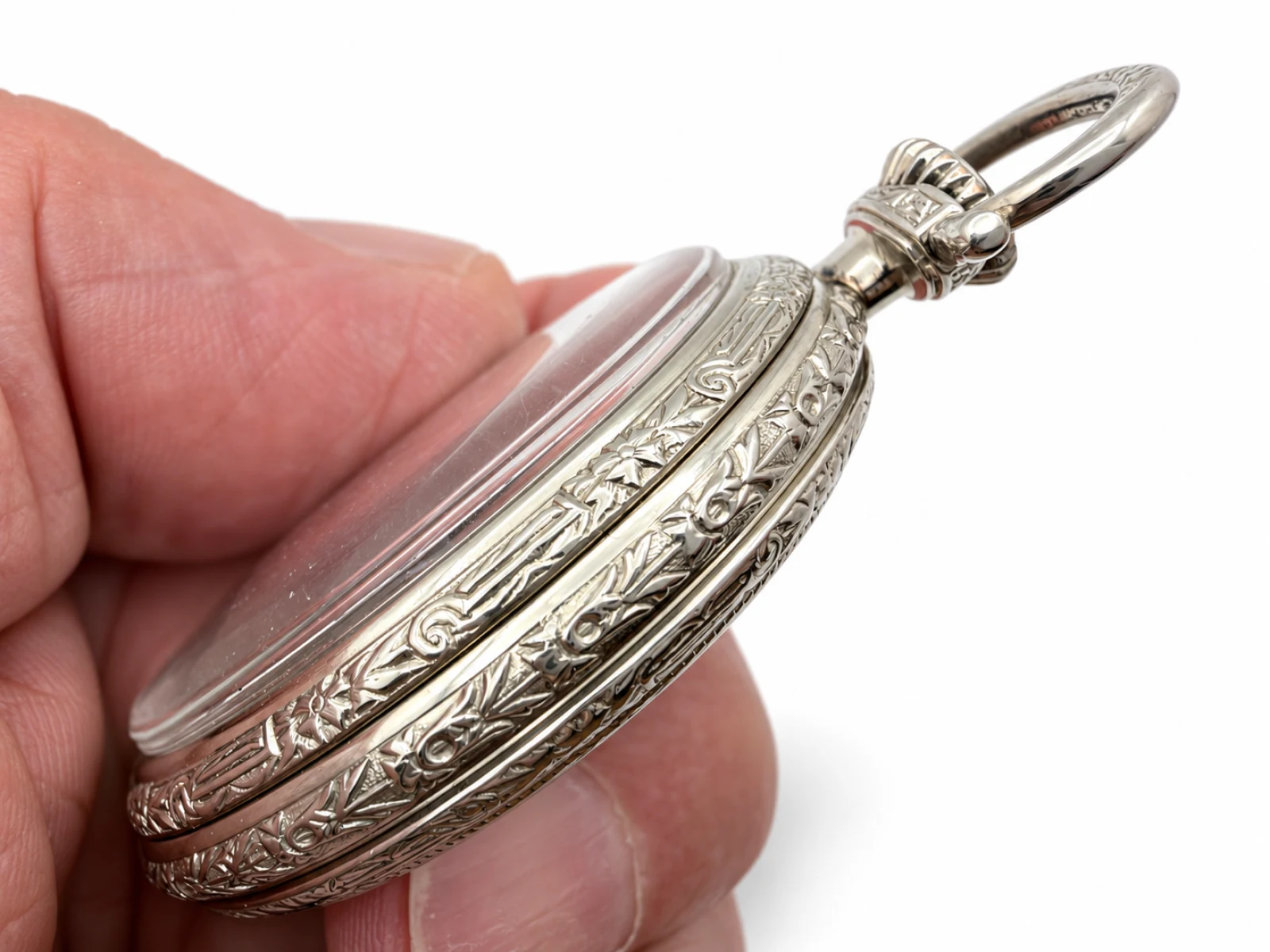
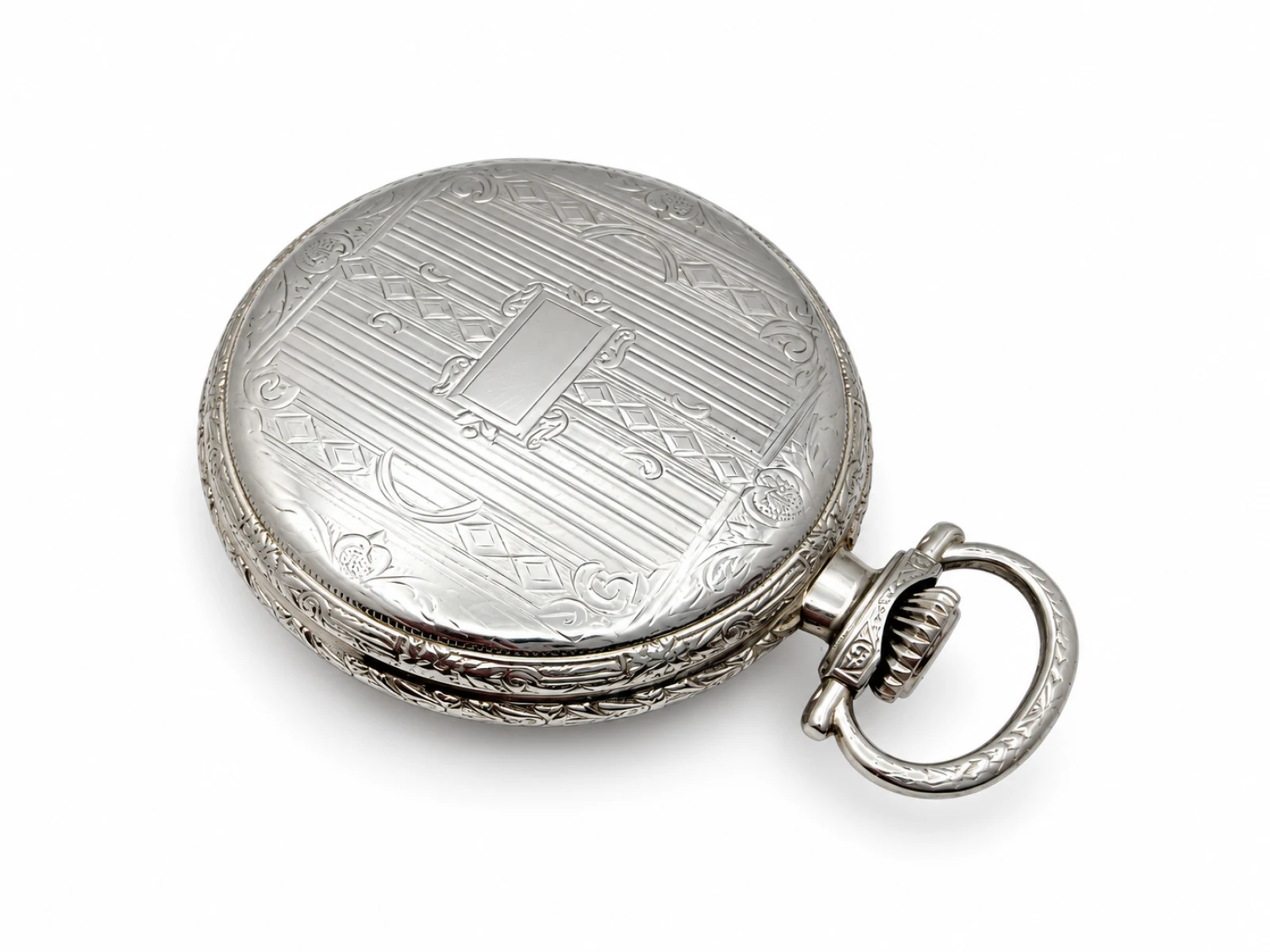
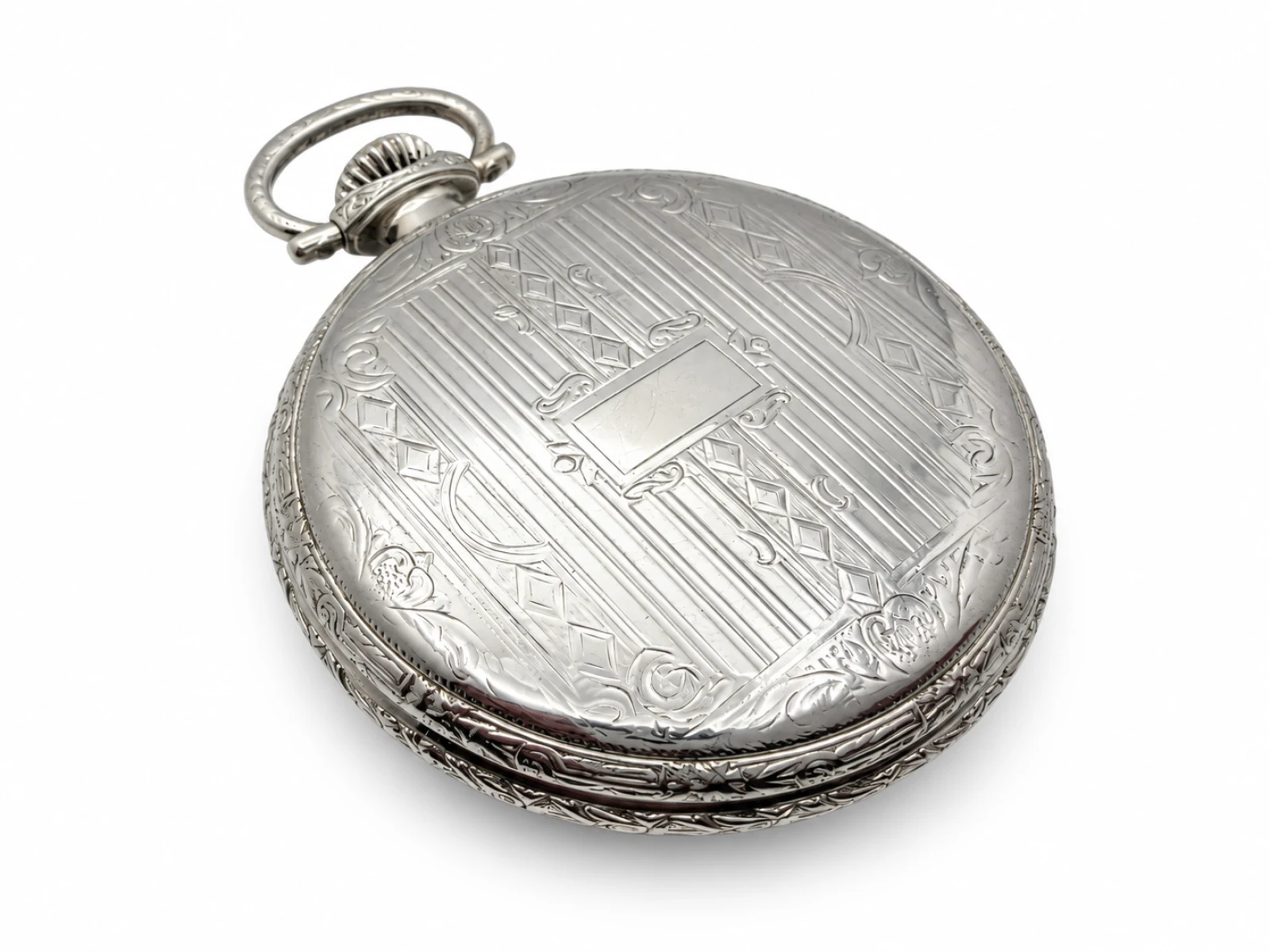
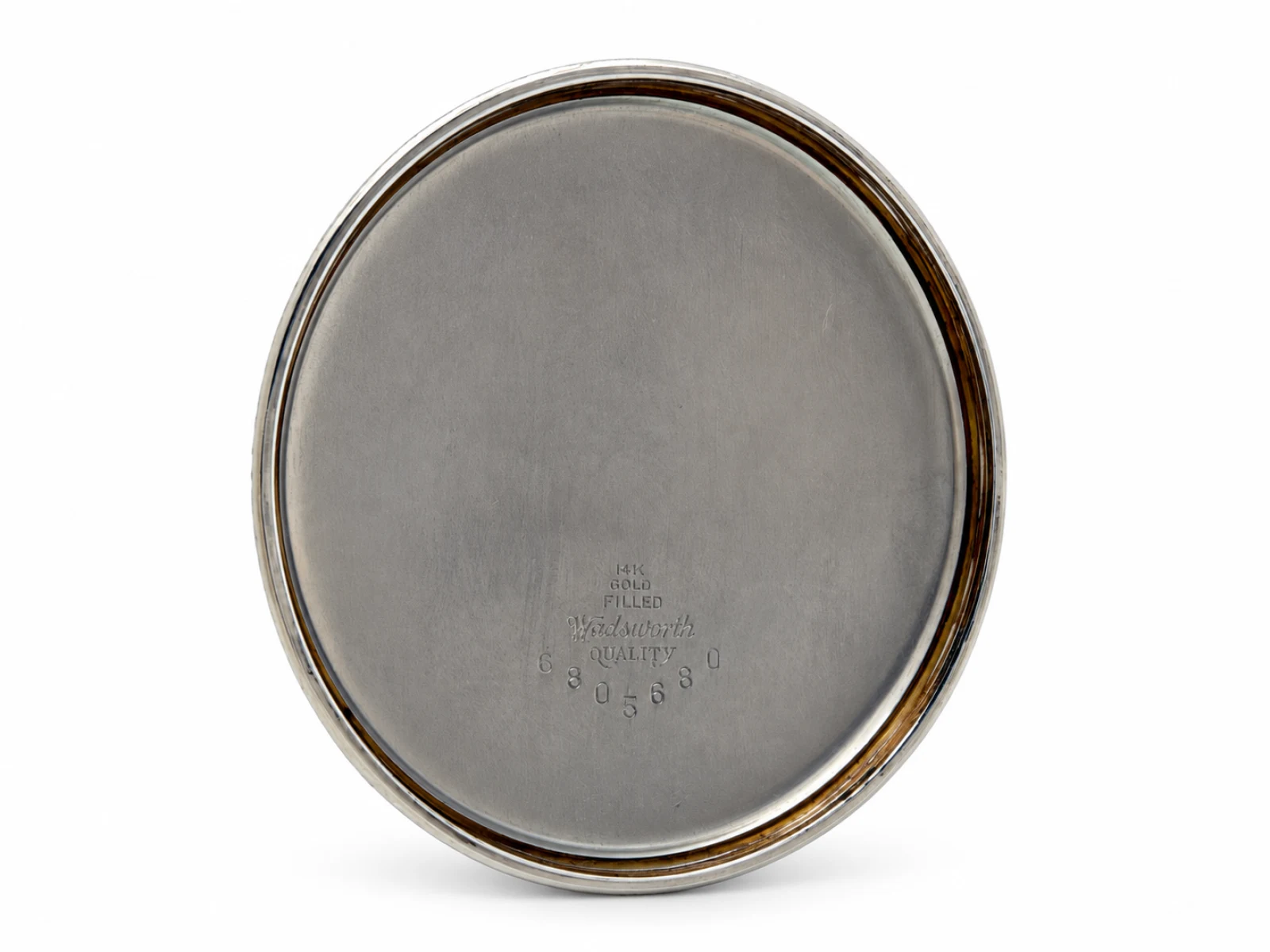
The movement is housed in an open-face 14K white gold-filled case by Wadsworth, the Kentucky case maker founded in 1889 that went on to produce more than 29 million cases. Gold-filled means a heavy layer of 14 karat gold bonded to a base-metal core by heat and pressure, far more durable than plating, and the inside of the back is stamped "14K Gold Filled, Wadsworth Quality." The back is engraved in a beautiful stripe and diamond pattern around a vacant cartouche ready for a monogram, the bezels and band carry a continuous engraved floral border, and the bow is engraved to match. This Wadsworth case is in excellent condition, with crisp engraving and a wonderful tactile experience in the hand.
1920 was a turning point for the railroads this watch was built to serve. On February 28 President Wilson signed the Transportation Act of 1920, and on March 1 the lines returned to private operation after more than two years under the United States Railroad Administration, which had run them through the war. American railroad employment peaked that year at about 2.1 million workers, and since March 1918 the time zones the railroads had drawn up in 1883 had been federal law under the Standard Time Act. Webb C. Ball was still running his time service from Cleveland; he died in 1922. A 21-jewel Ball-Waltham from his last years, one of 300 in its run, finished in his own shop and still in excellent condition, is as direct a link to American railroad timekeeping as a collector can hold.
All Vintage Pocket Watches are cleaned, oiled and adjusted for accuracy and warranted for one full year from the date of purchase.
Included with Purchase
- Fitted gift box
- Velvet storage pouch
- Display stand
- Cleaning cloth
- Tarnish-free storage paper
- Free FedEx Overnight
Questions about this watch?
Call 310-486-0572Specifications
| Manufacturer | Ball - Waltham |
|---|---|
| Location | Waltham, Massachusetts |
| Serial Number | B269863 |
| Production Year | 1920 |
| Grade | Official Standard |
| Model | 1899 |
| Size | 16s |
| Jewels | 21 |
| Configuration | Open Face |
| Movement Setting | Lever |
| Finish | Nickel |
| Adjustments | 5 positions, temperature, isochronism |
| Dial | Enamel |
| Dial construction | Single-sunk |
| Movement finish | Circular damaskeening with gold screw-set jewel settings |
| Case Material | White 14k gold-filled |
| Case Maker | Wadsworth |
| Railroad Grade | Yes |
Condition Assessment
Case
Excellent
Dial
Excellent
Hands
Excellent
Movement
Excellent