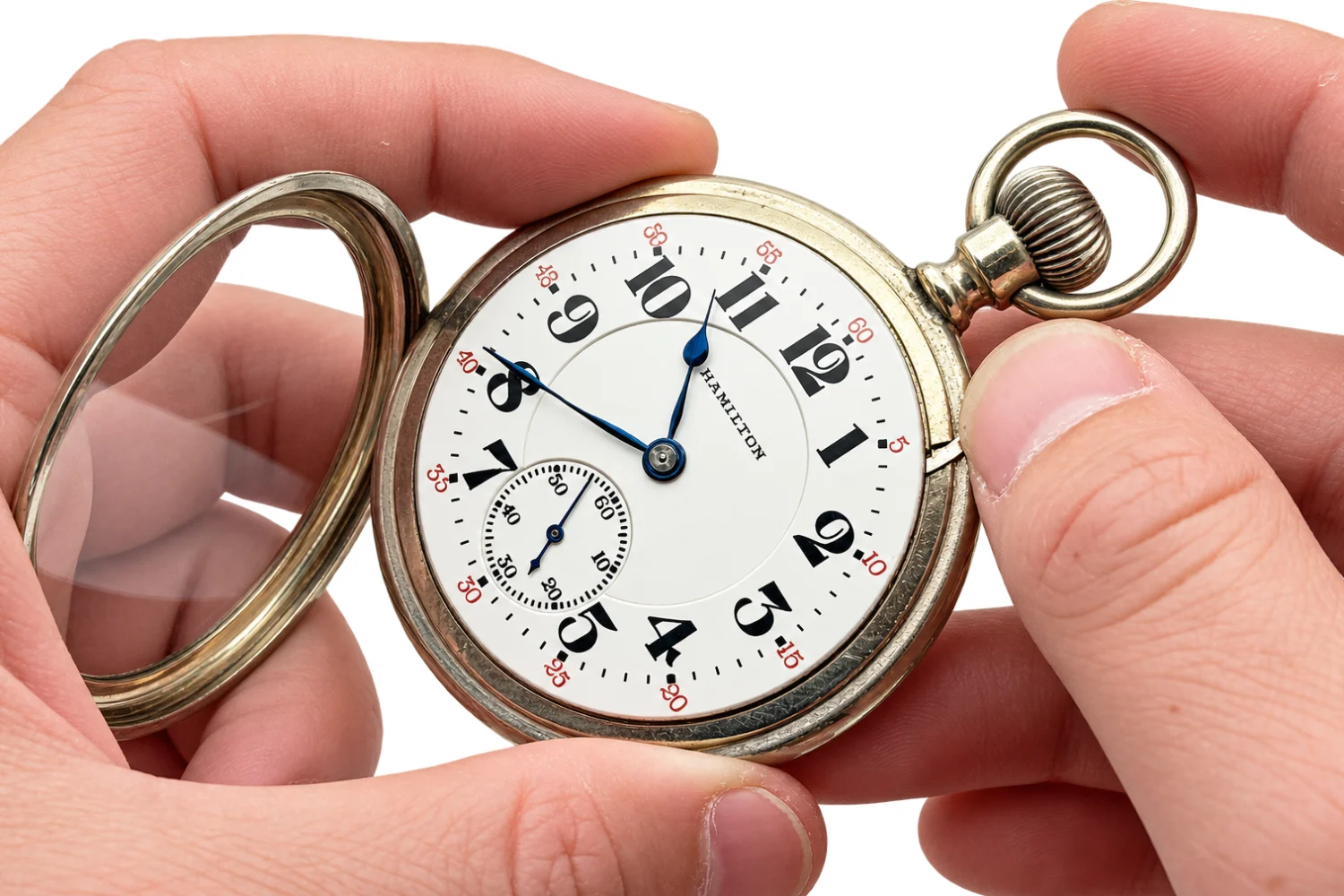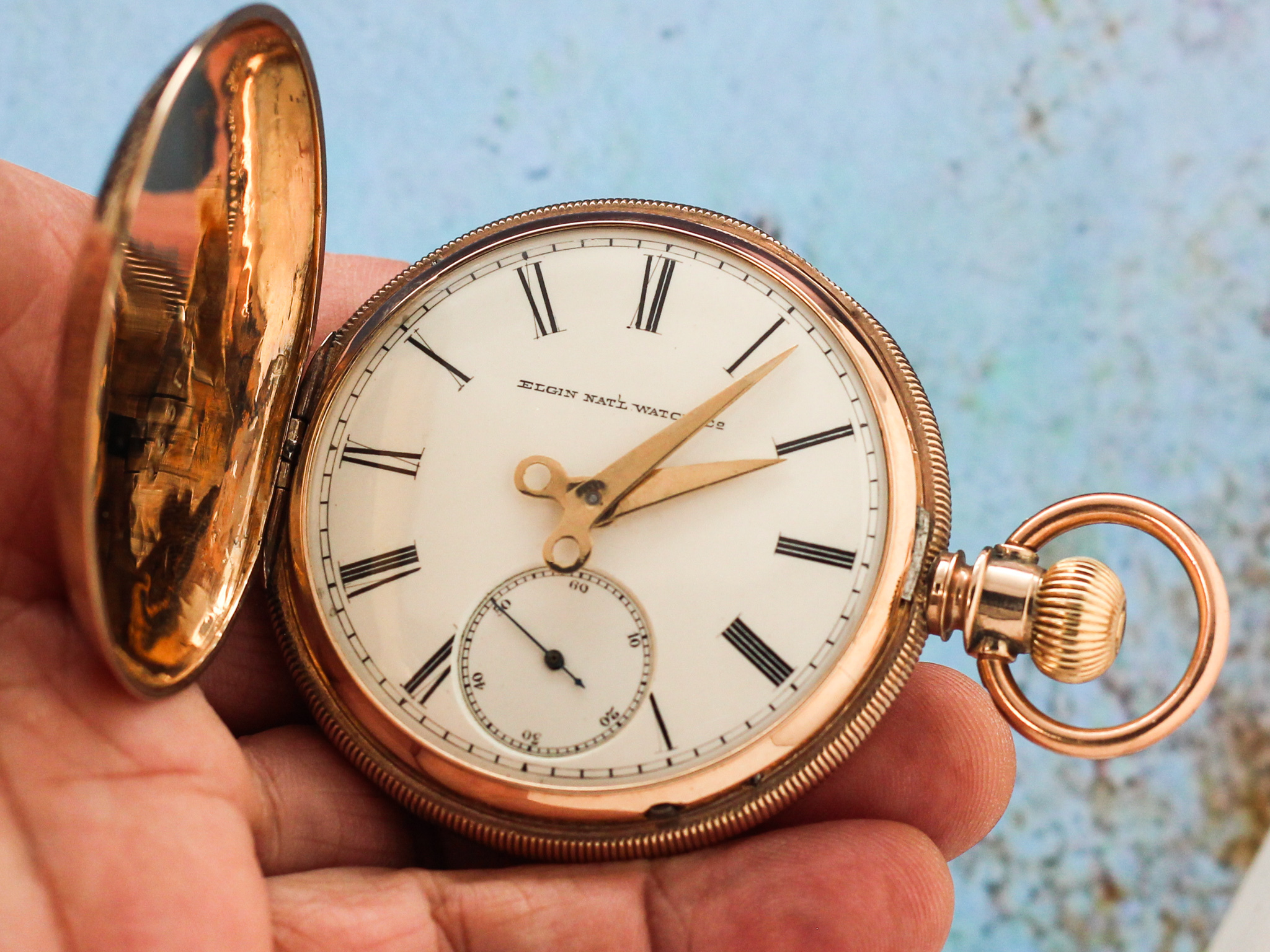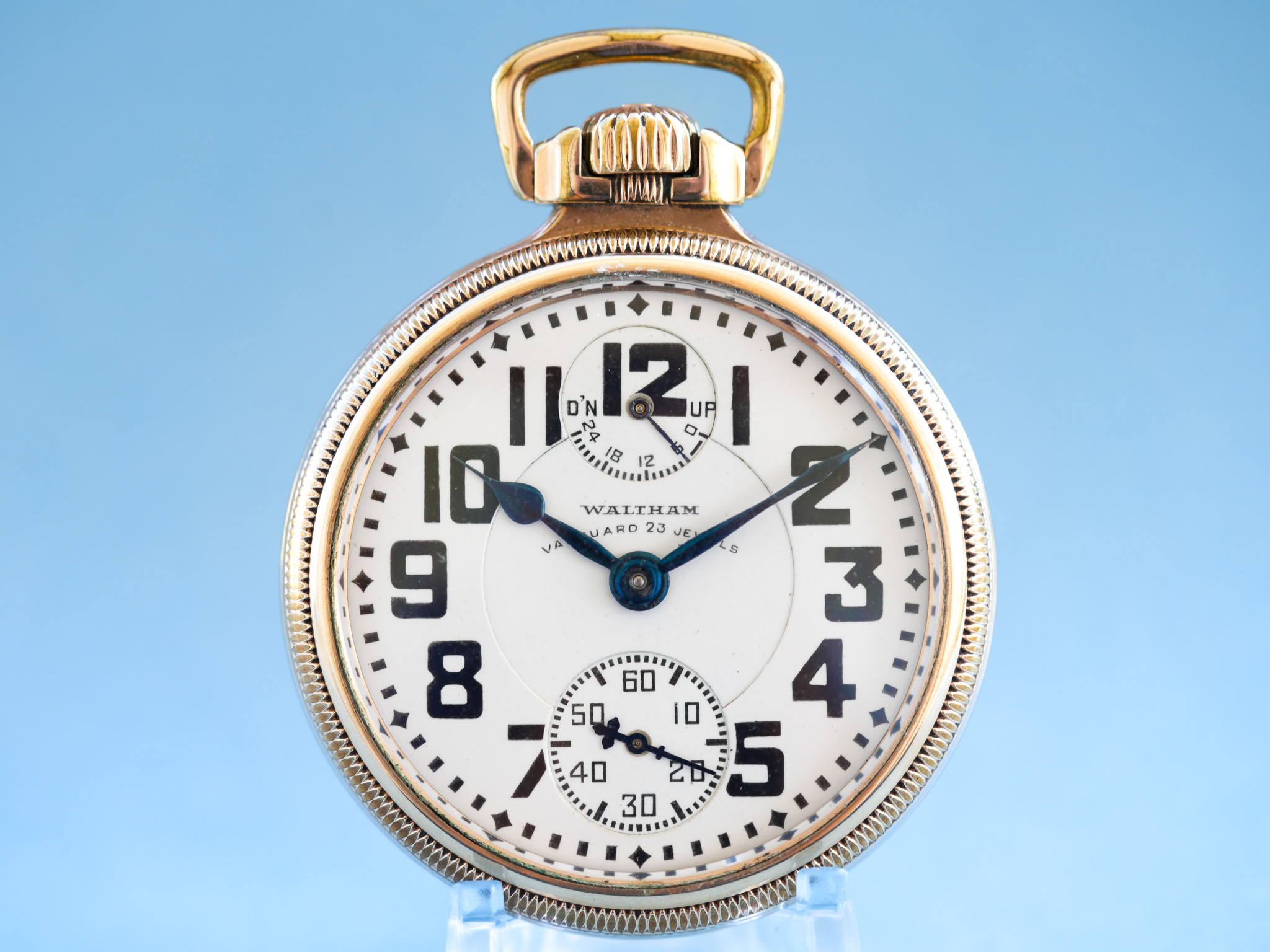
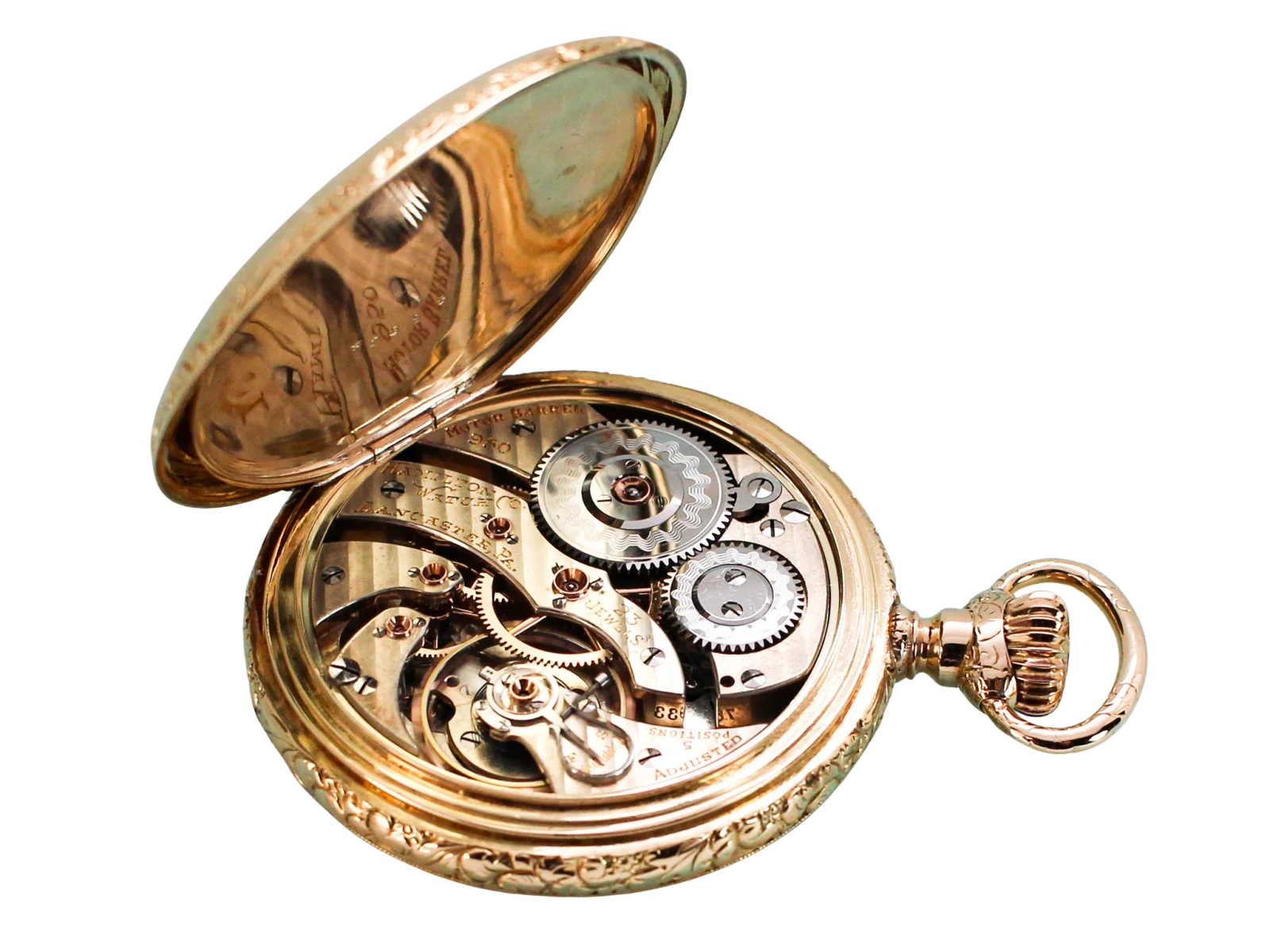
From its earliest days in Lancaster, Pennsylvania, the Hamilton Watch Company set out to make timepieces that could be relied on absolutely. By the turn of the 20th century that ambition had carried Hamilton to the top of the American watchmaking trade and into the vest pocket of every railroad engineer who needed his time accurate to the second. The watches that came out of Lancaster in those years are wonderful things, and the ones still in circulation today carry, on their movements, almost everything you need to know about them. Pop the back cover, find the serial number on the plate, and the year of manufacture, the grade family, and the era to which the watch belongs all begin to come into view.
If you've come into a Hamilton, whether by inheritance, an estate sale, a drawer at last opened, or a deliberate purchase, this guide will walk you through what to look for. I've put hundreds of these through the shop over the years, and the process has a comforting consistency to it. Most of what you need is right there on the movement.
Why the Movement, Not the Case
The serial number that tells you what you've got lives on the movement, not on the inside of the case. The two are almost always different, and there's a reason for that going back to how American pocket watches were sold. Movements and cases were ordered separately by the jeweler. A Hamilton movement would arrive from Lancaster, and the customer would choose a case to pair with it. Gold-filled or solid gold. Plain or hand-engraved. Hunter or open-faced. Marrying the two was the last step before the watch went into the display case for sale. After the the mid 1920's Hamilton stared selling their watches cased and timed from the factory.
So when you pop the back cover of a Hamilton, the long serial number etched or stamped into the nickel plate, usually somewhere near the balance wheel, is the one that comes from Hamilton's own records. The number on the inside of the case, often engraved in fine cursive script, belongs to whoever made the case (Keystone, Wadsworth, Fahys, Dueber, and a handful of others) and follows that company's own numbering. Both numbers tell a story. Only one tells you when the watch was made.
Finding the Serial Number on the Movement
On most Hamilton movements, the serial number is right out in the open. You'll see it etched into the nickel mainplate, somewhere between five and ten digits long, and on later grades sometimes prefixed with a letter. A loupe helps, especially with the darker-finished plates, where the numbers can hide in the light.
Be careful not to mistake the serial number for the grade number. The grade number tells you what kind of movement it is: a 940, a 992, a 950, and so on. It's printed smaller, usually marked "Grade" on the plate. The serial number is the longer one, unique to that specific movement.
If your Hamilton's serial begins with a letter (something like C123456), that's a production-run marker. Hamilton began using letter prefixes on certain grades in the late 1930s. The 992B, which ran from November 1940 through 1969, used a "C" prefix for its entire run, and that small letter alone places the watch firmly in Hamilton's railroad heyday.
Reading the Year From the Serial
Hamilton sold its first watch in 1893: a Grade 936, serial number 15, sold to a man named W.C. Davis. Every Hamilton ever produced fits somewhere on the production timeline after that, and a serial-to-year table is enough to date most of them within a year or two.
Here are the milestone serials and their approximate years for Hamilton movements produced in Lancaster:
- Serials 1 through 20: 1893
- 160,000: around 1900
- 450,000: around 1905
- 661,000: around 1910
- 1,158,000: around 1915
- 1,400,000: around 1920
- 2,333,000: around 1925
- 2,500,000: around 1930
- 2,600,000: around 1935
- 3,200,000: around 1938
- 4,500,000: around 1940
These are approximations. Hamilton production wasn't perfectly linear from year to year, and certain grades had their own numbering quirks. But for a watch from the standard Lancaster line, this table will get you within a year or two every time. For lettered-prefix grades like the 992B, there are separate year charts. The Pocket Watch Database (pocketwatchdatabase.com) keeps the definitive online lookup, and it's the place I send people when they want to confirm a specific serial.
The Grade Tells You What You're Holding
Once you have the year, the grade is the next thing to settle. The grade number is what determines the character of the watch and, in honest terms, most of its value. A 1935 Grade 950 and a 1935 Grade 978 came off the Lancaster line in the same year, and yet they live in different worlds. One is a 23 jewel railroad watch built to a standard so demanding it's still discussed today. The other is a perfectly nice gentleman's dress watch carrying a fraction of the same material and adjustment work. Both are lovely. Only one is railroad royalty.
Grades 936 and 940: the Early Railroad Era
The 936 was Hamilton's very first movement, introduced in 1893 as an 18-size full-plate. The 940 followed a few years later, a higher-jeweled, railroad-approved grade that helped establish Hamilton's reputation in the wake of the 1891 Kipton disaster, when the American railroads moved decisively toward stricter timekeeping standards. By the time the dust had settled, the 940 was instrumental in cementing the Hamilton Watch Company's legacy as the railroad timepiece company of America. If you've got an 18-size Hamilton from the 1890s or early 1900s, odds are good it's a 936, 937, or 940. These are the early years of American Pocket Watch greatness, and a well-preserved 940 in a coin-silver or gold-filled case is still a wonderful thing to hold.
Grades 992, 992E, and 992B: the Workhorse Railroad Movements
The 992 is the Hamilton most railroad conductors carried in their vest pockets through the early decades of the 20th century. 21 jewels, 16-size, adjusted to temperature and multiple positions. Hamilton's legendary 21 jewel Grade 992 movement motivates a great many of the railroad pocket watches still in collectors' hands today, and to look closely at one cleaned, oiled, and adjusted is to see why the company's reputation grew the way it did. Solid gold chatons. Gleaming, unmolested screws. A solid gold center wheel on the higher examples. An engine for ages.
The 992E, introduced in the 1930s, added the Elinvar hairspring, a nickel-steel alloy that made the movement a good deal more stable across temperature swings. From what I can gather, Hamilton produced roughly 63,900 of the 992E before replacing it with the 992B in November 1940. I've got a beautiful Hamilton 992E with the Elinvar hairspring in a Model 10 case in the shop right now. It's a wonderful example of that transitional moment, just before the 992B took over and ran for the next twenty-nine years.
And then there's the 992B itself. It ran from 1940 through 1969, with roughly 525,000 produced over those years, and earned a reputation among collectors as one of the most accurate and durable railroad-grade pocket watches America ever produced. Many will tell you it sits at the very top of that list. Serial numbers begin with "C" and run through the entire production. If you pop the back of a 992B and find "Hamilton 992B" on the plate alongside a C-prefix serial, you're holding the watch Hamilton built for the height of the railroad era.
Grades 950 and 950B: the Top Shelf
If the 992 series is the workhorse, the 950 is the thoroughbred. 23 jewels, 16-size, with solid gold chatons, a solid gold center wheel, and adjustments to six positions. Introduced in 1910. Total production of the Grade 950 came in at roughly 22,300 units across its entire run, a small fraction of the 992 numbers, and that's part of what makes them so collectible today. The 950B that followed is rarer still and sits, in the view of most collectors I talk to, at the absolute peak of what Hamilton ever made.
The 950B's movement is, in a word, phenomenal. A perfectly preserved example shows the craftsmanship Hamilton's master watchmakers spent decades perfecting. To see and hear it working is to appreciate the respect and pride its original owners felt, and present-day collectors still feel, for the watches that came out of Lancaster.
We have two 950s in the shop at the moment. The first is a 1935 Hamilton 950 in a Bar-Over-Crown Model 2 case, just a wonder to hold. The second is a rare 950 in a Keystone nickeloid case, an earlier run, beautifully preserved. Either one is the kind of watch you'd buy once and never sell.
The Ball-Hamilton 999B: a Rare Cousin
Little known fact: the Ball Watch Company didn't actually build movements. Webb C. Ball sourced them from the best American makers and held the finished watches to his own strict railroad standards. The Ball-Hamilton 999B is one of the scarcer variants. A Hamilton movement, finished to Ball specs, in a Ball-signed case, often with a Ball-signed dial. I've got a rare Ball-Hamilton 999B Official Standard in the case right now. If Hamilton railroad watches are your thing and you'd like something not many other collectors will have, this one is worthy of your careful consideration.
Identifying the Case Maker
Once you've worked out what the movement is, the case is the other half of the story. Hamilton factory-cased watches from 1925 forward, but for most pre-1925 Hamiltons, the case came from one of the great American case houses and was paired to the movement at the jeweler. The case has its own kind of character, often hand-engraved or richly decorated, and a period-appropriate case in good condition adds real life and value to the watch.
The main case companies you'll run into on a Hamilton are:
- Keystone Watch Case Co. The Model A case, introduced around 1940, was advertised specifically for the 992B. Keystone cases typically carry a keystone-shape logo and the "Keystone" name stamped on the inside back cover.
- Wadsworth Watch Case Co. Made several factory-spec cases for Hamilton, including the Model 2 and Model 3 used with the 992B and 950 series. The Model 2 was first introduced in March 1926 for the 950 line.
- Fahys. An older house that supplied Hamilton with many of its gold-filled cases. The first Fahys No. 3 case appeared in 1926 for use with the 992 and 950, and Fahys gold-filled cases came on line in September 1929.
- Dueber, Crescent, Illinois, and Star. All produced cases you'll encounter on earlier Hamilton movements, before Hamilton standardized around Keystone, Wadsworth, and Fahys in the factory-cased era.
The inside of the case is where the identification happens. Pop the back. You'll find the case maker's mark, a serial number unique to the case, a metal-content stamp (10K gold filled, 20 year, etc.), and sometimes a case model number. None of this connects to the movement serial number in any way, and a correct, period-appropriate case is the norm on a pre-1925 Hamilton.
Need a Hand? I'm Glad to Help
Putting all of this together into a confident identification takes a few passes. If you're holding a Hamilton and would like a second pair of eyes, I'm glad to look. Send me a few clear photos of the movement (back cover off, full view of the plate), the dial, and the inside of the case with the maker's mark visible. I can usually tell you the grade, the year, the case maker, and a real-world value range without much trouble.
If the watch isn't running, or it's running poorly, that's fixable too. These movements were built to be serviced. A good cleaning, fresh lubrication with modern synthetics, and a careful adjustment will bring most Hamiltons right back to life. Send photos through the repair page or call me at (310) 486-0572. I'll tell you straight up whether it's worth servicing and what it'll take.
The Workflow at a Glance
Once you've done this a few times, the whole process becomes second nature. I open the back, note the movement serial and the grade number, cross-reference the serial against the production-year table to date the watch, and then think about which family the grade belongs to: a 936 or 940 from the early era, a 992-series workhorse, or a 950 from the top shelf. From there I flip to the inner case and read the case maker's mark, the metal stamp, and the case serial. A look at the dial finishes the picture, since original factory dials carry a real premium and refinished dials are perfectly fine but come at a discount. By the end of that walkthrough, I usually know whether the watch in front of me is a keeper, a piece worth servicing, or something to pass along to its next caretaker.
A Few Things That Trip People Up
A few things tend to trip up people new to Hamilton identification:
- Confusing the grade with the model. The grade lives on the movement. The model lives on the case. A Grade 992B in a Model 11 case is a perfectly normal pairing.
- Assuming a case serial dates the watch. It doesn't. The case and movement may be years apart. Always date from the movement serial.
- Trusting the dial signature over the movement. Dials were sometimes replaced. The movement is the more authoritative record of what you've actually got.
- Overlooking the hairspring material. A 992E and a 992B can look fairly similar at a glance, but the hairspring tells you which is which. If you can't see the difference through a loupe, the grade number on the plate will.
Hamilton Pocket Watch FAQ
What's the most valuable Hamilton pocket watch?
In the open market, a fully original Grade 950B with its factory box, papers, and original dial is the high-water mark in most collectors' eyes. A 950 in excellent condition is close behind. Rarity and originality drive Hamilton values far more than age alone.
How do I tell if my Hamilton is railroad grade?
Look for the grade number. Hamilton's railroad-approved 16-size movements include the 992, 992E, 992B, 950, 950B, and the earlier 18-size 940. If you see one of those grades, the watch was built and adjusted to the General Railroad Timepiece Standards of its era.
Is a higher serial number worth more than a lower one?
Not by itself. Very early serials, the first few thousand, have historical interest. After that, condition, grade, originality, and case quality drive value. A pristine 1952 992B can easily outprice a rough 1905 940.
What should it cost to service a Hamilton?
It depends on the movement and what it needs. A straightforward clean, oil, and adjustment is one thing. Replacing a broken balance staff or sourcing a period-correct mainspring is another. If you send me photos I'll give you an honest range before you spend a dollar.
My Hamilton doesn't run. Should I still keep it?
In my experience, almost always yes. These movements were built to be serviced indefinitely. A Hamilton that hasn't run in forty years usually isn't broken; it's gummed up. Get it cleaned and it'll run for another century.
Got One You're Looking to Sell?
I buy Hamilton pocket watches every week. Not estate-lot lowball offers either. I pay what they're worth, because I sell to collectors who know the difference between a factory-original dial and a redial, and who pay accordingly. If you've got a Hamilton sitting in a drawer, in a deceased family member's collection, or a watch you inherited and never wore, send me a few photos and I'll give you a fair number the same day. No pressure, no haggling games.
Or pick up the phone. (310) 486-0572. I answer it myself.
Happy collecting.