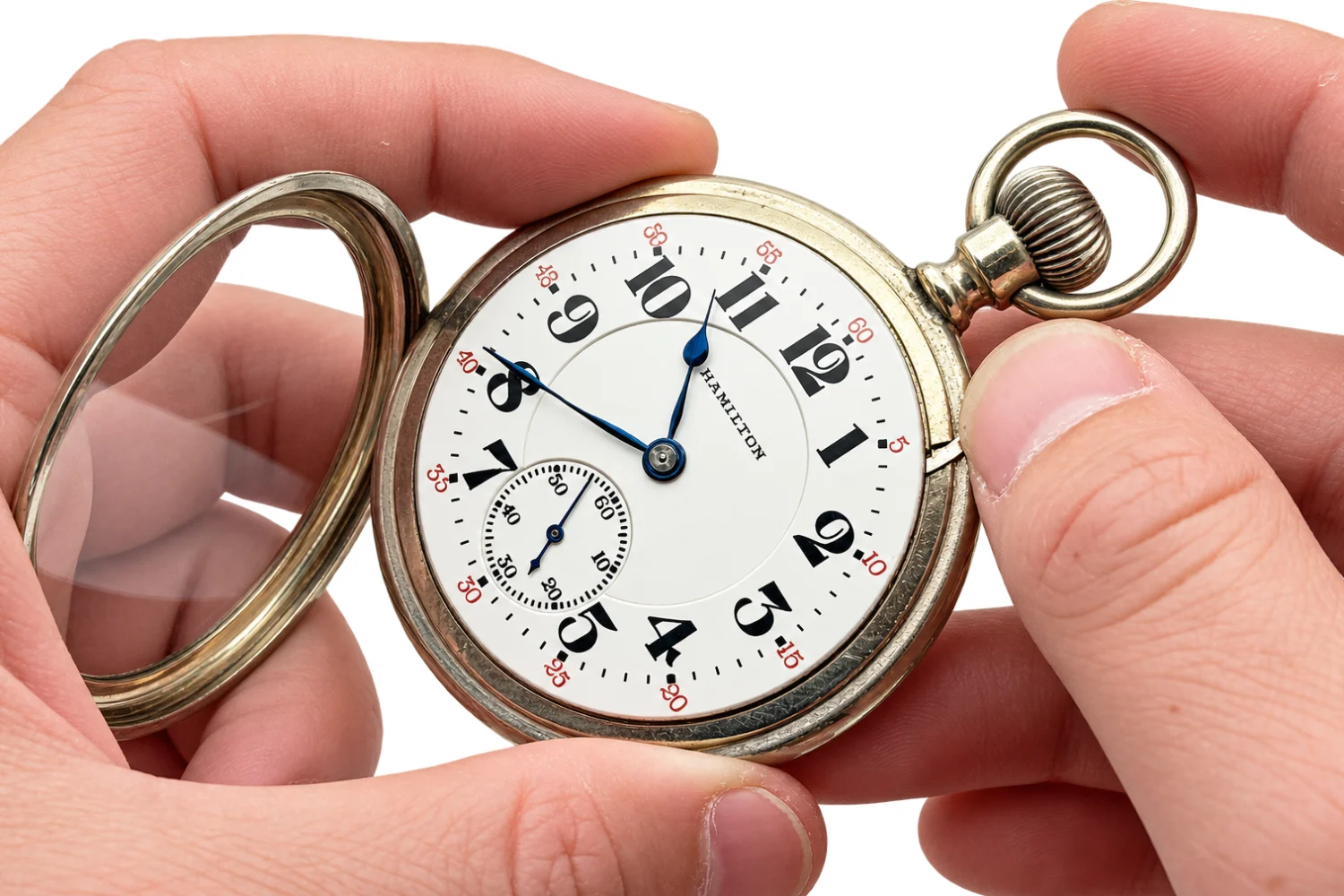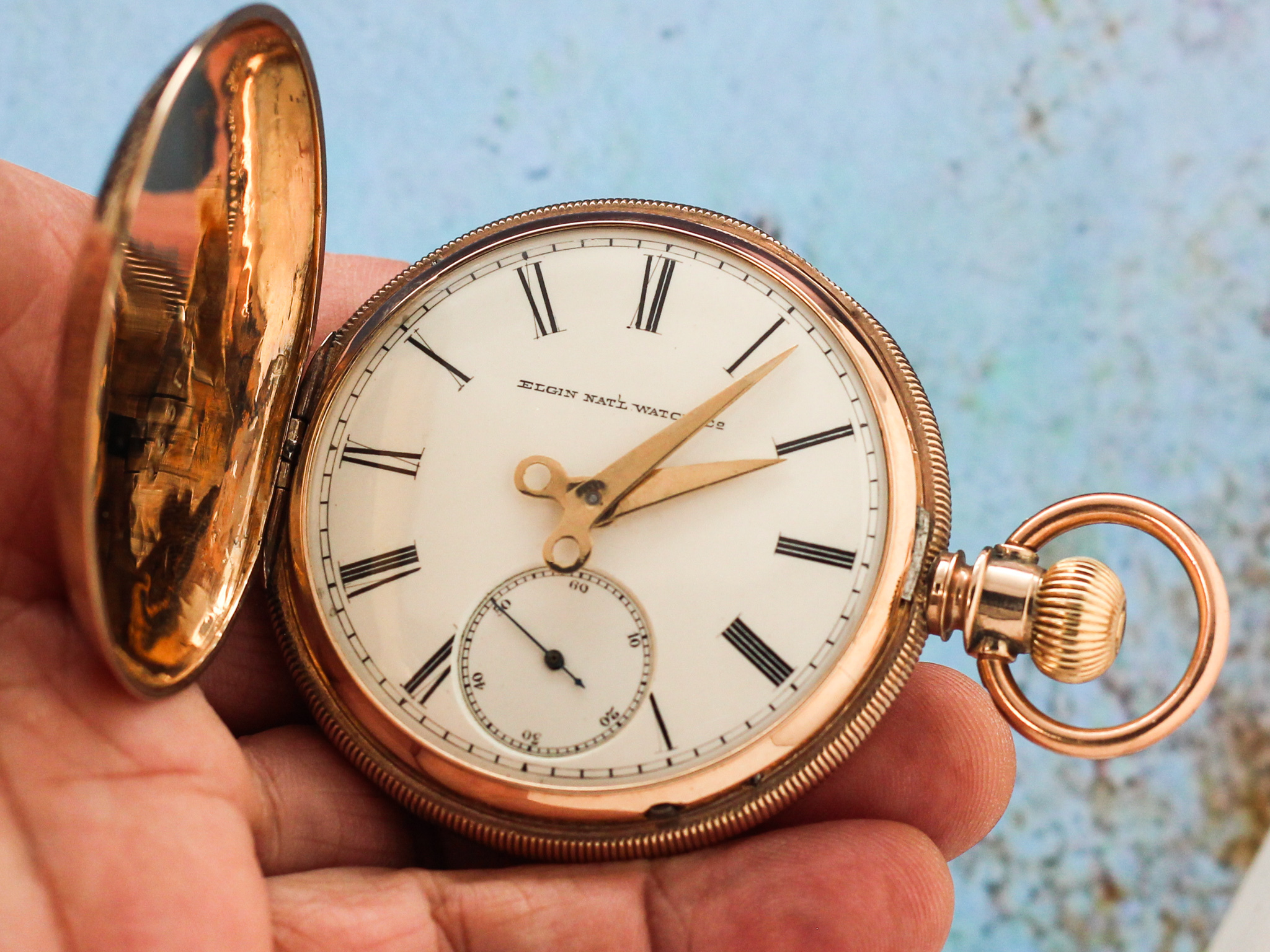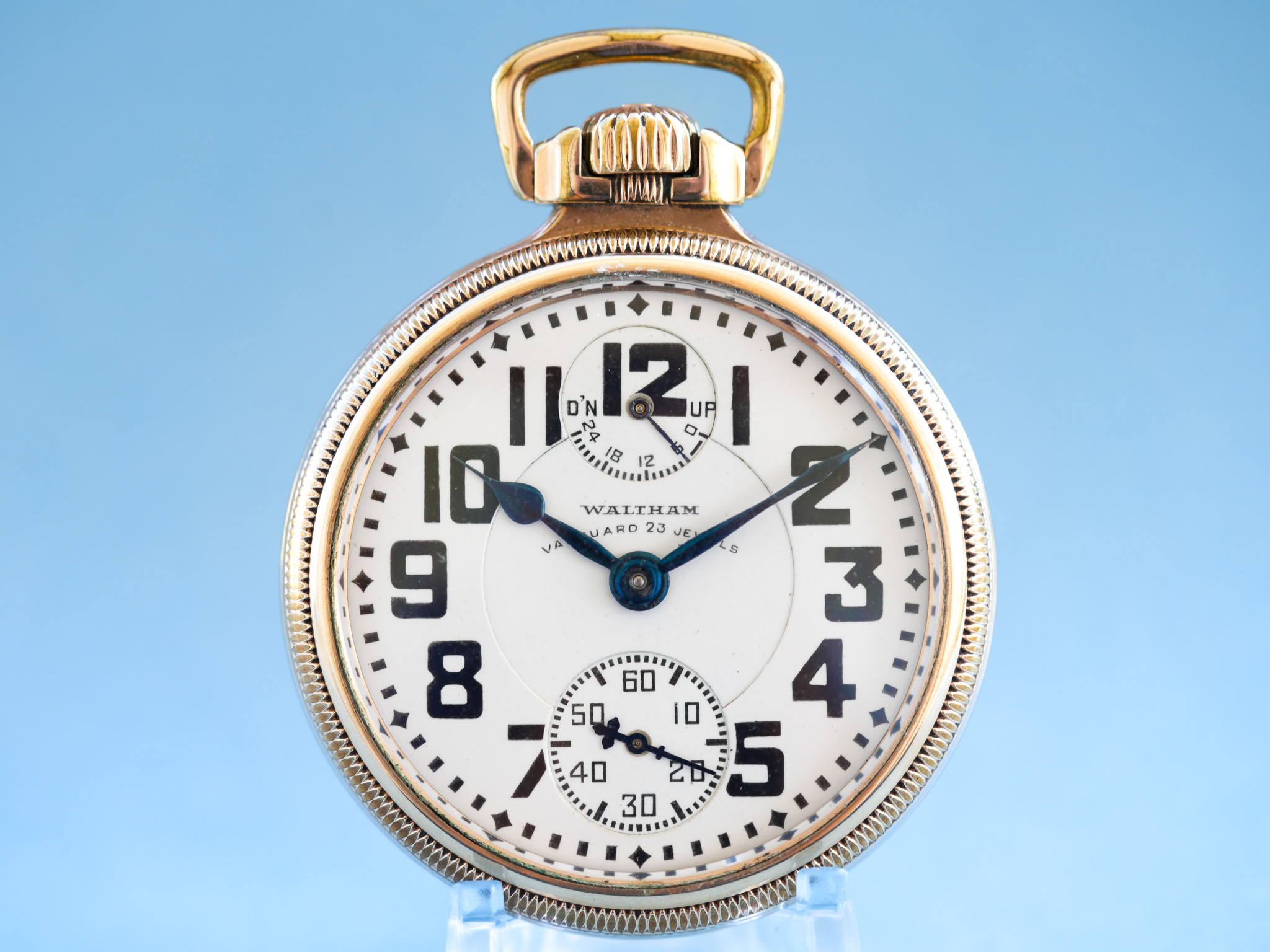
Little known fact: when the Hamilton Watch Company opened its doors in Lancaster, Pennsylvania in late 1892, it inherited a brick factory that had already buried three failed watch firms. Adams & Perry. Lancaster Watch Co. Keystone Standard. Each one had tried and gone broke in the same building. Hamilton was the third time being the charm, and then some. Within a generation, the company would be supplying more than half of the railroad watches carried by the engineers, conductors, and trainmen of America.
I think about that history a lot, because every Hamilton pocket watch that lands on my bench carries it. The 950 in front of me right now has solid gold train wheels and a Breguet hairspring. It is a hundred years old. It runs. And the men who built it were perfecting their craft in a building that three earlier companies had failed inside of. There is something American about that.
This is a working collector's guide to the Hamilton pocket watches I see most often, written across the counter rather than from a brochure. If you are starting out, or you are deepening a collection, or you inherited grandpa's railroad watch and you want to know what you actually have, read on.
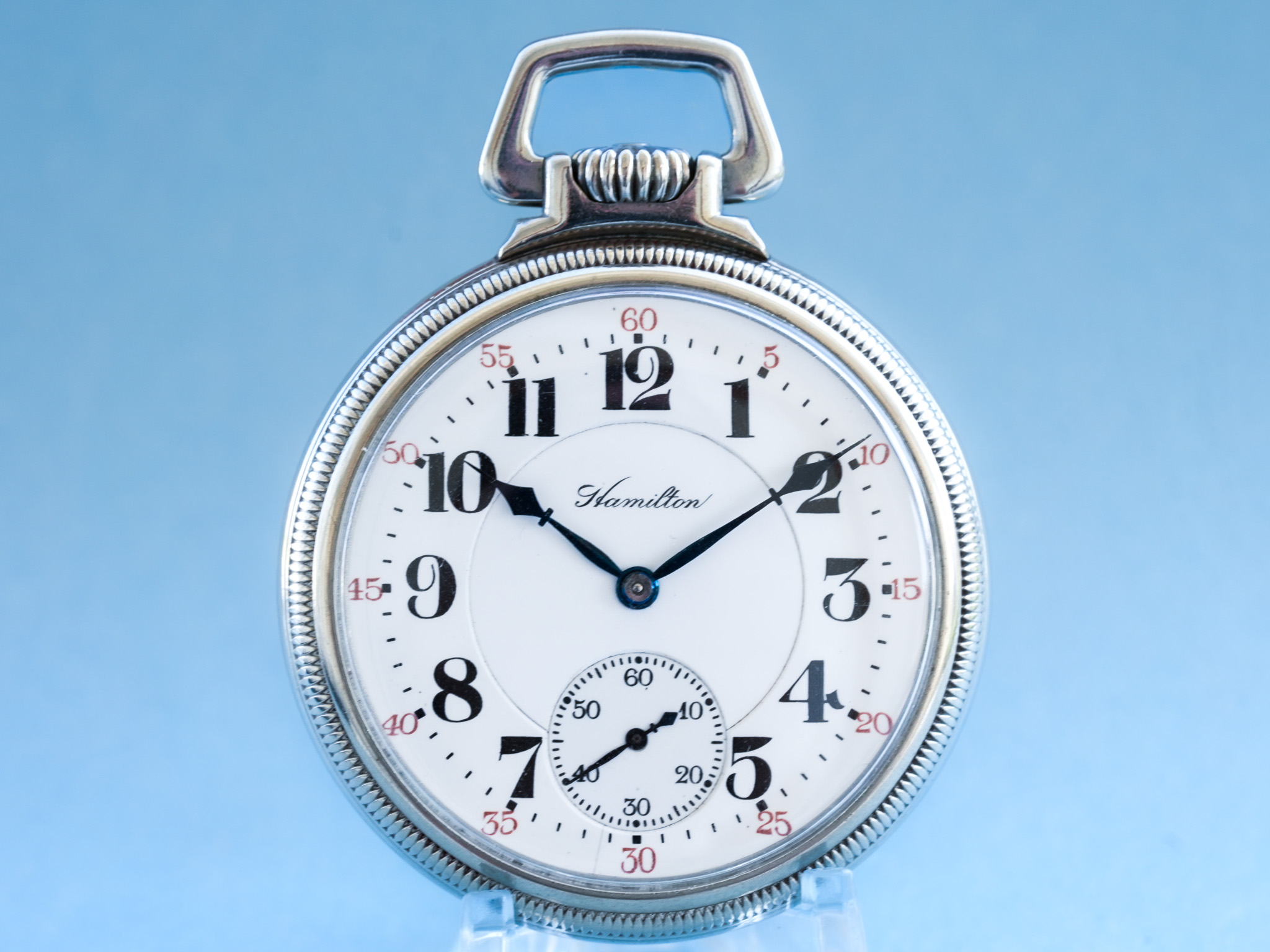
Why Hamilton Became the Railroad Watch of America
Hamilton positioned itself for the railroad market from day one. The very first watch the company produced, the Grade 936, was an 18-size, 17-jewel, lever-set movement designed by Henry J. Cain and aimed squarely at railroad service. It was marketed as the "Watch of Railroad Accuracy," and the strategy worked. By 1912, an industry survey of railroad watch inspectors found that nearly 56 percent of the engineers, conductors, and trainmen on inspected American railroads were carrying a Hamilton.
That market share did not come by accident. The 1891 Kipton, Ohio collision, in which a railroad watch four minutes off contributed to the deaths of nine people, had pushed the railroads to standardize. Webb C. Ball was brought in to write the rules. Hamilton built watches that exceeded them. The result was a Lancaster factory whose pocket watches synchronized the freight, the mail, and the passengers moving across a continent that had only finished its transcontinental railway a generation earlier.
Pause on that for a moment. The pocket watch in your hand was not just a personal accessory. It was the synchronization layer of an entire industrial economy. Before radio dispatch, before centralized traffic control, the only thing standing between two opposing trains on a single-track line was a man on a platform with a Hamilton in his vest pocket, accurate to within thirty seconds a week.
The Hamilton Grade 950: The Top of the Line
If the 992 is the workhorse, the 950 is the showpiece. Introduced in 1910, it was Hamilton's flagship 16-size, 23-jewel, open-face railroad movement. Total production over its run came to roughly 22,300 watches. Compare that to the more than 600,000 Grade 992 movements Hamilton produced before the 992 was retired in 1940, and you get a sense of why a 950 in the case is something I make a fuss over.
I have a 1928 example currently for sale: a Rare Hamilton Railroad Grade 950 in a Keystone Nickeloid case, priced at $2,750. The movement on this one is exactly what makes the 950 the top of the heap. Solid gold center wheel, gold jewel settings, sapphire pallet jewels, Breguet hairspring, beautifully damaskeened bridges. Hamilton built it the year the Yankees won the World Series and the company introduced its Yankee model to capitalize on the moment. It served on a railroad somewhere in America through the Depression, the war effort, and the postwar boom, and it is still keeping good time.
I also have a slightly later 1935 Hamilton Grade 950 in the Model 2 bar-over-crown case, listed at $3,250. By 1935 the world was deep in the Depression and a Hamilton 950 was a serious purchase, a watch a railroad man might have saved for years to put in his pocket. The bar-over-crown case is one of the most-collected of the Hamilton railroad case styles, and the movement on this one is in the kind of shape that makes a watchmaker quiet for a minute.
The thing about the 950 is the finishing. Look closely at the back of one of these movements and you will see hand-cut damaskeening, gold raised jewel settings on screwed-in chatons, and the kind of perlage that costs real money to produce. Watches finished to this standard are simply not made today. The 950 was the everyday top-grade tool of a working professional who needed his watch to be right. We will not see that combination again.
The Hamilton 992E: When Magnets Came for the Railroad
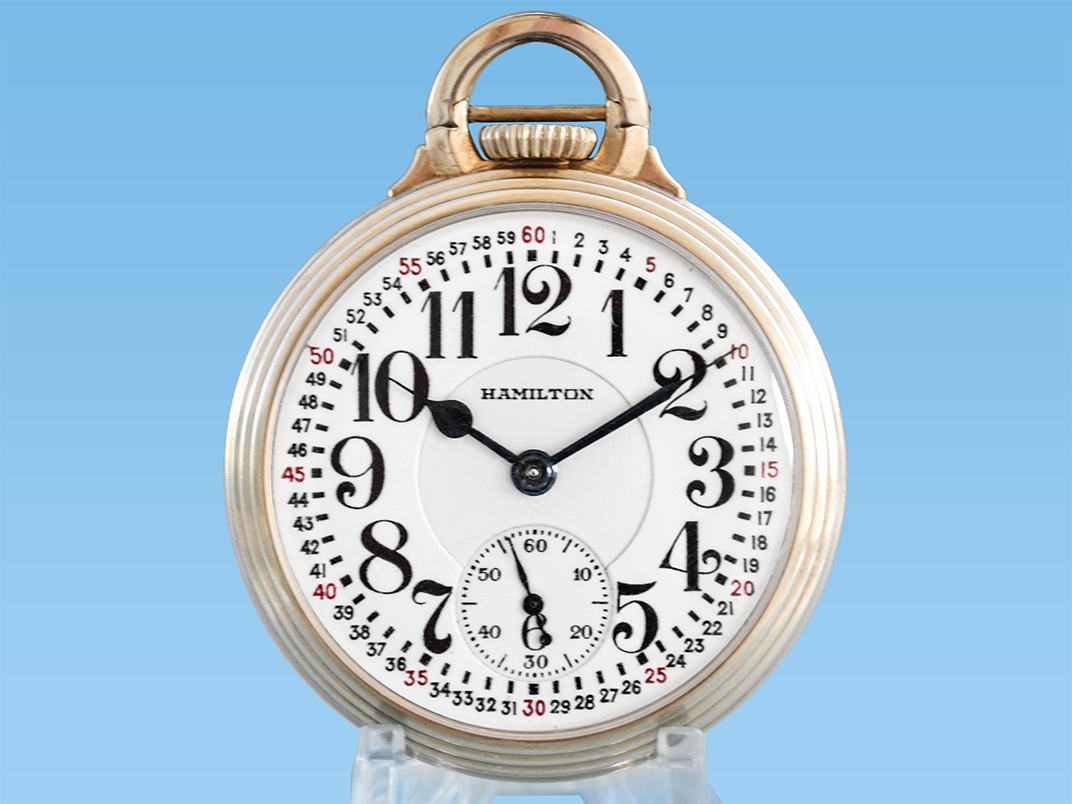
By the early 1930s, American railroads were in transition. Steam was giving ground to powerful electric locomotives. Strong magnetic fields, which a steel hairspring really hates, were now part of an engineer's working environment. Hamilton's answer arrived in September 1931: the Grade 992E, the first Hamilton movement fitted with an Elinvar hairspring and a monometallic balance. The "E" stood for Elinvar, the alloy invented by Charles Édouard Guillaume, who had won the Nobel Prize in Physics in 1920 for his work on nickel-steel alloys.
The point of Elinvar was simple: it was far less affected by magnetism and temperature than the blued-steel hairsprings it replaced. For a railroad man working under overhead catenary, that mattered. Hamilton ran the 992E from 1931 through 1940, when it was replaced by the 992B with the improved Elinvar Extra alloy.
I have a beautiful Hamilton Railroad Grade 992E in the popular Model 10 case at $2,295. This one was built in 1940, the last full year of 992E production, and the same year Roosevelt was reelected to a third term and the country was beginning the buildup that would carry it into the war. The Model 10 case, introduced around 1936, is one of the most recognizable Hamilton railroad cases. The dial on this watch is a dramatic Gothic with bold inked numerals and heat-blued steel hands that catch the light. The 21-jewel movement with its Elinvar hairspring is doing exactly what Hamilton designed it to do.
A 992E is, in my opinion, one of the smartest entry points into serious railroad collecting. You get a genuine Hamilton railroad-grade movement with a meaningful technical story behind it, in a case design that defines the era, at a price below what a comparable 950 commands. It is the sort of watch I am happy to send out the door knowing it will get carried, not just stared at.
Need a Hamilton Serviced? Here Is Where to Start
If you have a Hamilton in a drawer that has not been touched in decades, do not just wind it and hope. The oils inside a movement that has been sitting since the Eisenhower administration have long since turned to varnish, and running a dry pivot will scar the jewels and the staff. Send it in, let me look at it, and I will tell you honestly what it needs. You can start the conversation through my watch repair page or call me at (310) 486-0572.
Ball Hamilton 999B: When Webb Ball Picked the Best Movement Hamilton Made
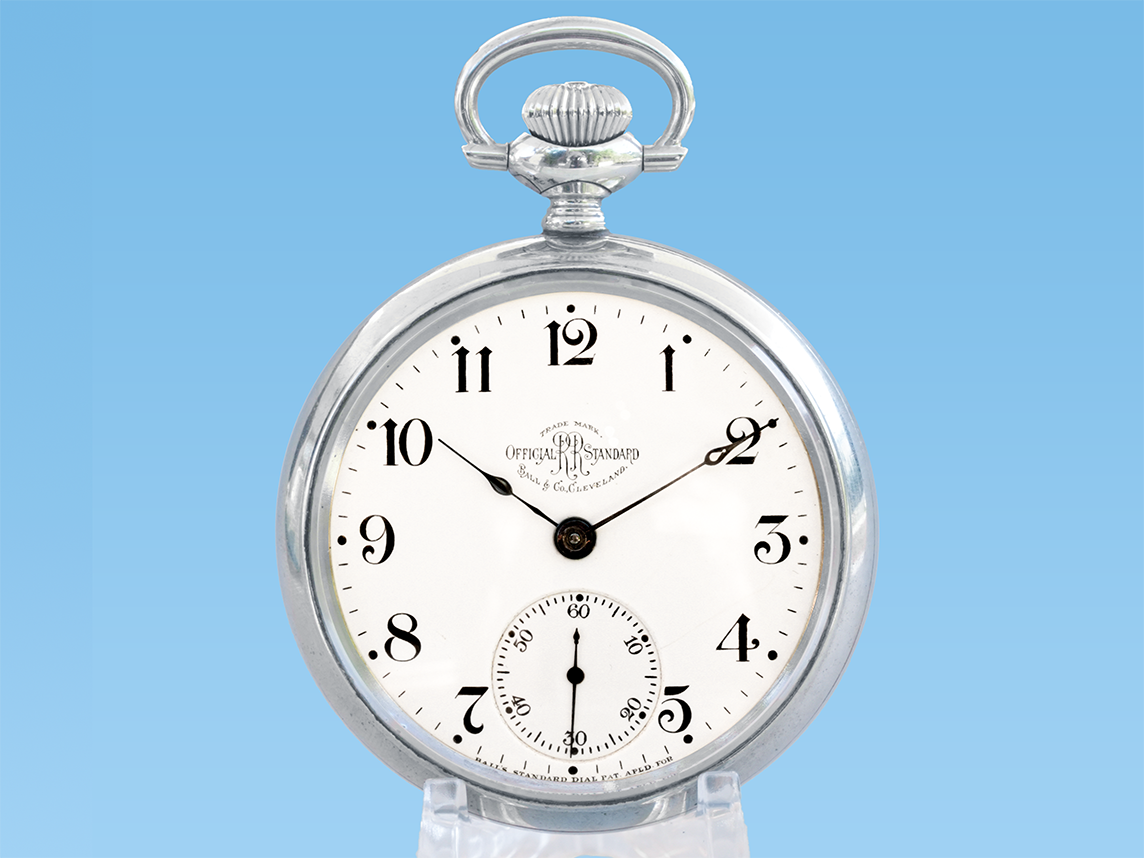
Here is something a lot of new collectors do not know: Webb C. Ball did not make pocket watches. The Ball Watch Company was, in effect, a quality-control outfit. Ball's company branded and distributed watches built by Hamilton, Waltham, Illinois, Elgin, Howard, and Hampden, holding all of them to the railroad standards he himself had helped write after the 1891 Kipton disaster. The phrase "on the ball" is generally said to come from his reputation for accuracy. By the end of his career, Ball was overseeing time inspection on more than 125,000 miles of rail track across the United States, Mexico, and Canada.
By the 1930s, the great majority of Ball watches were being made by Hamilton (with some by Illinois, which Hamilton had purchased in 1928 for over five million dollars). The Grade 999B was Ball's request of Hamilton for a top-tier railroad movement of their own, with its own serial-number sequence and circular damaskeening that distinguishes it from the 992B. The 999B was produced in twelve runs between 1943 and 1954, with total production of roughly 126,000 watches: not rare, exactly, but uncommon, and exceptionally well-built.
I have a Rare Ball Hamilton Official Standard Railroad Grade 999B in the case at $3,250. The 999B carries Ball's full quality program: 21 jewels, adjusted to six positions (one more than the standard five required for railroad service), a Breguet hairspring, micrometer regulator, and the gold center wheel and gold jewel settings that Hamilton built into all its top-grade work. The case is the patented Ball stirrup-bow style, the most-collected and most-recognizable of the railroad case shapes.
Of all the Hamilton-built watches, the Ball Hamilton 999B is the one I get the most questions about. It is the watch a senior conductor or engineer carried when he wanted the best the system allowed. To hold one is to hold the literal endpoint of Webb Ball's life work: the most accurate civilian timepiece available in mid-century America, built to a standard the COSC chronometer rules of today still partly trace back to.
What to Look For When Buying a Hamilton
A few honest things from the bench. When evaluating a Hamilton you are considering buying, the dial is the first place I look. An original double-sunk porcelain dial in good condition is worth real money on its own, and a dial with chips, hairlines, or amateur restoration drops the value of a watch significantly. Hamilton dials were enamel on copper, baked in many layers, and a clean one is increasingly hard to find.
The case matters next. Original cases were made by Keystone, Wadsworth, Fahys, and a few others, and the Hamilton "Model" cases (Model 1, 2, 5, 6, 7, 8, 10) introduced from the late 1920s onward were factory-paired with Hamilton railroad movements. A 950 or 992 in its original Hamilton-signed case is preferable to one swapped into something later. Brassing on the gold-filled cases is normal at the high-wear points (the bow, the bezel edge), but heavy wear-through changes value.
The movement itself should be clean, with intact damaskeening, no rust on screws, and a hairspring that breathes evenly without coils touching. Lever-set is a railroad requirement; if a watch was sold as a railroad piece but is pendant-set, somebody is wrong about something. Serial numbers can be looked up on the pocket watch databases to confirm grade, year, and run quantity, and that is always worth doing before money changes hands.
And the most important thing: buy the watch, not the story. Provenance claims are usually unverifiable. What you can verify is the movement, the dial, the case, and the work of the watchmaker who last serviced it. Those four things determine what you actually own.
Have a Hamilton You Want to Sell?
I am always buying. Single watches, collections, estates. If you have a Hamilton (or any American pocket watch) you are thinking of selling, the easiest first step is the we buy watches page, or you can reach me directly at (310) 486-0572. I pay fair prices and I tell you honestly what I am seeing.
Frequently Asked Questions
What is the most collectible Hamilton pocket watch?
For most collectors, the answer is some version of the 950: the 950 itself (1910 to 1934), the 950E (1937 to 1940), or the 950B (1941 to 1965). It was Hamilton's top-of-the-line 23-jewel railroad movement, with solid gold train wheels and the most ornate finishing the company produced. Ball Hamilton 999B watches are also strongly collected, especially in the patented stirrup-bow case with a triple-signed configuration where the dial, movement, and case are all marked with the Ball logo.
How can I tell if a Hamilton pocket watch is railroad grade?
A railroad-grade Hamilton will be 16-size or 18-size, open-face, lever-set, with at least 17 jewels (most railroad-grade Hamiltons are 21 or 23), adjusted to a minimum of five positions plus temperature and isochronism, and fitted with a double-roller escapement. The big railroad grades are the 940, 950, 950B, 950E, 992, 992B, and 992E in Hamilton's own line, plus the 999 series made for Ball.
What is the difference between the Hamilton 992, 992E, and 992B?
The 992 was Hamilton's most popular 16-size railroad movement, produced from 1903 to 1931. The 992E (1931 to 1940) introduced the Swiss-made Elinvar hairspring and a monometallic balance, an answer to the rise of electric locomotives and stray magnetic fields. The 992B (1940 to 1969) replaced the 992E with Hamilton's improved in-house Elinvar Extra alloy and a redesigned movement. Over 525,000 992Bs were made, and it was the last American-made railroad pocket watch when production ended in 1969.
How much is my Hamilton pocket watch worth?
It depends on the grade, the condition of the dial, the condition of the case (including whether it is original to the movement), the originality of the hands, the running condition of the movement, and how well it has been serviced. A common 992B in a worn gold-filled case might be a few hundred dollars. A pristine 950 in an original solid gold case can be many thousands. If you want a real number, send me photos through the contact page or call me at (310) 486-0572.
Did Hamilton make watches for the military?
Yes. By 1942, the year after the United States entered the war, Hamilton had stopped producing civilian watches and converted its Lancaster factory to military work. They built close to a million military watches during the war, plus marine chronometers for the Navy and bomb timers for the Air Force, and were awarded the Army-Navy "E" Award for excellence before the war was over. The Model 22 and Model 23 chronometers and chronographs from that era are some of the most respected pieces Hamilton ever produced.
One Last Thing
If you are reading this guide, you are already a little bit infected. Welcome. Pocket watch collecting is one of those quiet pursuits that grows on you, and Hamilton is one of the truest places to start. Lancaster built these watches to be carried for a working life, and many of them have been. The fact that we can still wind them, hear them tick, and set them by GPS time and find them within a few seconds of correct is, when you sit with it, a small miracle of American manufacturing.
Have a look at the Hamiltons currently in the case, and if any of them speak to you, give me a call. I love talking about these watches. (310) 486-0572.
— Jeff